
From the Travely-Family archive · Other Entries
Passage to Tasmania, Days 5–6. Masochism, Breakdowns and Provisions
An original publication from the former Travely-Family website. This English translation was preserved from the technical-site archive without editorial rewriting.
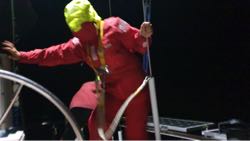
Morning of May 20... Last night, we were too lazy to set anything besides the small jib. The thinking was that we’d soon have to tack anyway, so we’d set something then. When the wind died, Lady Mary trudged sadly towards Tasmania at 1.5 miles per hour. A cockroach can run faster. With a three-metre swell on the beam, there’s never a dull moment. Despite being tied down, the jib fitting kept hammering its sturdy steel car against the steel track tube, like a sledgehammer to the head. Everything inside the boat, from the toolboxes to the forks in the lockers, creaked, rang and clattered in anguish.
How we managed to fall asleep amid all that, I have no idea. But it was the wind that jolted us awake. The jib stopped hammering away, making it extraordinarily quiet (everything is relative, of course), and we went flying at a whole 3 knots towards Antarctica—the south of Tasmania. It is still too early to tack, and we can’t be bothered to set more sail, so we’re carrying on at our flying 3 knots. I’m off to wake the crew. They’ll love it: it’s +12 in the yurt; I don’t know how cold it is outside, but at least there’s no frost )). Our outdoor thermometer, after spending the past year in hothouse conditions, was apparently so startled when the temperature dipped below +10 in the evening that it switched itself off. It needs fixing.
The service batteries need fixing too. More precisely, replacing. Because both of them have suddenly stopped holding a charge. In their defence, the service batteries lasted five and seven years. The starter battery is still young, only four years old, so it is more or less alive. Electricity is in short supply. Once the sun goes down, the battery voltage drops at a rate of 1 volt every 3–4 hours. Last night we couldn’t even start the engine to charge them. There is less and less sun; by 44 degrees south there will be hardly any at all, and it’s winter too.
In short, we are feeling the energy crisis. One water tank is empty, and we’re finishing the second; in heavy seas, the watermaker either refuses to work or produces less water, while drawing more of the charge coming from the panels. So there we have another expense—we need to find two batteries somewhere.
Winter is coming. Today I took two sleeping bags on watch instead of one. And Andryukha said:
“Maybe to hell with Tasmania? We’ll go round the south, pop in for a couple of days, then head for Sydney and the warmth?”
I giggled and tried to remember where we had buried our boots. Four pairs. With no unlimited access to laptops, we entertain ourselves by reading aloud with the children. Lada has started rereading Harry Potter, and we’re reading the third book aloud. Nastya is reading The Twelve Chairs, and when Harry Potter gets tiresome, we switch to Ilf and Petrov. Exercise tends to be stationary: sit-ups on the narrow sofa, squats and push-ups, planks, lunges, and twisting whatever comes to hand. There isn’t much scope for running around in a heavy beam sea.
And there is less room in the wheelhouse now because there is a huge pilot’s chair in here. It has to be said, it is a lifesaver at night when the windvane self-steering can’t cope and someone needs to steer by hand—you can do it sitting down. We also can’t get over how glad we are that, in Cape Town, after six years of suffering, we finally cut a plywood divider for the large aft berth (a brilliant contraceptive, sorry )). Now two people can sleep on the aft berth even on passage without constantly falling on top of each other. It is strange to think that we put up with it for six years without the divider.
Morning of May 21. The wind is 25–30 knots. If it were following, like a trade wind, it would be brilliant. But instead we have a four-metre beam sea, so every morning I seriously contemplate the extent of my own masochism: if I feel so awful on passages, why do I live this way? Yesterday evening the wind piped up, and we flew along at 7 knots under a reefed genoa. By morning I woke the captain and the sailor and sent them to take down the genoa and set the jib. This is how our watches are divided for now: I sit up all night guarding the corn, and whenever something needs doing, I wake the crew.
Or just the cap. Once a night isn’t really that much—that is how I justify my lack of self-sufficiency when it comes to crawling out into the cold night. Our sixth day underway is drawing to a close. There are 853 miles left to the south of Tasmania on the rhumb line. Coordinates: 41°22′ S, 127°23′ E.
PROVISIONS
In the previous post, I promised to write about provisions. It is a pity you can’t send a proper photo by satellite: I want to show you, not merely describe, what properly packed expedition food looks like. Before leaving Western Australia, as usual, we crammed the lockers with provisions. Lady Mary’s endurance is approaching six months. But this time we did not buy any tinned food, pasta or anything like that—only fruit and biscuits for tea.
A varied assortment of properly packed tinned food came to us from the yacht Esmeralda, aboard which Igor Zaretsky completed half of the Golden Globe Race before being forced to leave the boat in Australia. Throughout this entire year of quarantine, we were berthed side by side with Esmeralda. With no way to move the yacht anywhere from Australia because of the pandemic, her owner, Vasily Senatorov, publisher of the country’s leading sailing magazine, Yacht Russia, gave all of Esmeralda’s stores to us. And neat rows of tins moved from Esmeralda to Lady Mary.
There is everything there, from vegetables and green peas, just like in childhood, to a unique small-batch selection of stewed wild boar, lamb and elk. Dried herbs and dried fruit, Russian condensed milk—many things that are extremely hard to find abroad. Every time I open one of the labelled and sorted vacuum-sealed pairs of tins, I can feel the warmth and sense of responsibility with which Vasily Yuryevich’s team prepared Esmeralda for the round-the-world race.
Vasily Yuryevich and your entire team, thank you so much for the moral and material support you have given our voyage!
Friends, our real-time track is available under the Route tab on our website. Thank you very much for supporting the expedition’s ship’s fund via paypal.me/travelyfamily and sobe.ru/na/travelyfamily