
From the Travely-Family archive · Pacific Ocean
Crossing the Pacific Outside the Trade-Wind Latitudes. Daily Life
An original publication from the former Travely-Family website. This English translation was preserved from the technical-site archive without editorial rewriting.
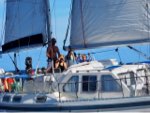
Crossing the Pacific Outside the Trade-Wind Latitudes. Daily Life. When we left Easter Island, the port authorities asked us to make sure we wrote to them from Pitcairn. They worry that we might disappear without a trace, as happened a couple of years ago. A solo sailor set out from Easter Island and still hasn’t arrived anywhere. And as a parting shot, they told us how many yachts had sunk around Easter Island, and how many had dragged anchor onto the rocks. Then they wished us a safe passage. They also found out—and entered in their records—how much water and fuel we had, and how many months our provisions would last.
The captain replied that we had food for three months, 500 litres of water, and 700 litres of fuel. Otherwise they wouldn’t have let us leave. The passage is going well, though it is tedious. The good thing is that we’re moving rather than wallowing in calms. For the fourth day running, we’ve had 15–20 knots on a close reach, shifting from a broad close reach to close-hauled and back again (in simpler terms, the wind is always in our faces, with slight variations). If it drops to 8–10 knots, that means we’re creeping up on a cloud—and then a squall of nearly 30 comes rushing out from under it.
But it passes quickly, and we go back to beating. Andryukha says there won’t be a following wind now until the Marquesas. If you take the well-trodden route from the Galápagos straight to the Marquesas, you slip neatly into the trade winds and fly along on them as if you belonged there. But if you decide to break with the established order and head south to Easter Island, the trade-wind zone ends and completely different winds blow. You have to climb north again, closer to the equator, and from the Gambier Islands (the first part of French Polynesia we’ll encounter), cross the trades.
So life won’t improve for at least another month; we’ll be stuck on this less-than-comfortable point of sail. So be it, as long as there’s wind. The sails are perfectly trimmed, and since last night we have hardly touched them, except to ease the sheets slightly as we bore away from close-hauled to a broad close reach. Yesterday morning a cable on the windvane self-steering broke; the captain splashed around behind the stern for half an hour, and now our Iron Felix is back on duty. All we do is glance at the iPad to make sure we’re not being swept towards the equator or Antarctica.
There’s no point setting out on a circumnavigation without a windvane. Or rather, with one there is nothing to do; without one, someone has to be constantly on watch at the helm. Incidentally, it’s funny: every yacht’s windvane has a name. When we were corresponding with the flotilla sailing in company to the Marquesas, everyone mentioned their own speechless crew member and called it by name. There are Harry and Peterson, Little Red and Freddie. And ours is Iron Felix. Hurrah for him! There are no ships. In all four days since Easter Island, Andrei has spotted only one vessel, about three miles away, heading west.
It didn’t show up on AIS; it has been silent as a fish the whole way. Speaking of fish. The captain put out the fishing line for the first time since our passage to Easter Island. Back then we gorged ourselves on so much fish that we begged for the torture by tuna and mahi-mahi to stop. But apparently the time has come again. Except the fish have taken offence at us and refuse our appetising red-and-white piece of plastic with a hook in it. We’re eating the captain’s bean soup (he’s a man of many talents), while I regret buying so little Mexican jalapeño salsa—and so few jalapeños themselves. I should have bought three times as much. Or four. And more biscuits and chocolate too. Our supplies of those are dwindling catastrophically ).
-+-+-+-+-+-+-+-+-+-+-+-+-+-+-+-+-+-+-+-+-+-+-+-+-+-+-+-+-+-+-+-+-+-+-+-+-+-+-+-+-+-+-+-+-+-+-+-+-+-+-+-+-+-+-+-+-+-+-+-+-+-+-+-+-+-+-+-+- The crew mostly lies around, with breaks for food and exercise. My laptop has started overheating and its battery drains quickly. The second e-reader in a month has died—the whole boat is in mourning. When will they finally learn to make them fit for real life? Ladunya is avidly reading Nosov on the iPad, while Nastya is reading Walter Scott on her phone. If those electronics die too, we’ll have to read paper sailing directions in foreign languages.
By the way, we have now definitively left the Spanish-speaking zone, where we spent more than a year. Ahead of us are French- and English-speaking territories. So we are deliberately abandoning Spanish and concentrating on English. Nastya pretends she is going to resume her French lessons, but so far this titanic effort has gone unnoticed by everyone around her. Perhaps she studies at night? ) All schoolwork except history is being pushed into the furthest reaches of the youngsters’ minds. Although every other day Lada finds the strength for maths and English.
She hasn’t found it yet today—she’s reading. And just now she built two little ships out of cardboard, toothpicks and scraps of paper, and is trying to cajole me into playing flotillas. On days like these, every inch of the boat seems nasty, awkward and uncomfortable to me. The nausea only leaves me when I’m asleep. Work has ground to a halt; all I want to do is lie down and read. From shore, sailing across the ocean looks far more romantic than it does from aboard a yacht beating to windward—that’s what I think ). I hope the weather at Pitcairn will allow us to land and stay there for a while.
For a sailor, meeting land is the most wonderful thing, of course. Though Andryukha would probably disagree with me. He doesn’t get seasick. That’s one thing. And secondly, on land he is constantly expected to do things: go ashore, go hiking, carry a backpack... Out here, life is bliss: he can lie on the settee with a book, periodically demanding the captain’s tea. Yesterday, though, he did helm us through the rain squalls and got soaked to the skin. Lady Mary, hands proudly on her hips in 28 knots, went flying along, scooping up the sea over her one-and-a-half-metre-high topsides.
At times like that, the captain’s tea is like medicine: you have to look after the captain, cosset him, and keep him warm in every possible way. We have covered 420 miles from Easter Island. 760 miles remain to Pitcairn. Coordinates: 25*05.20 S 116*04.28 W