
From the Travely-Family archive · Atlantic
Atlantic Crossing. Days 21–22
An original publication from the former Travely-Family website. This English translation was preserved from the technical-site archive without editorial rewriting.
Atlantic Crossing. Days 21–22
Trade winds? Nope, never heard of them! 😉 All night we were a motorboat, which allowed Lady Mary to reach the wind by morning )). A five-knot close reach could neither pull us southwest nor counter the Guiana Current, which was sweeping the yacht north at 3.5 knots.
No sooner had our bow begun bravely slicing diagonally through the treacherous current than the engine sighed and died. The fuel was sloshing around at the bottom of the tank—the sediment it stirred up had clogged the fuel filter. An hour drifting north, several futile attempts by the engine to sabotage our plan—and once again we were hurtling towards French Guiana, puffing out foul-smelling diesel exhaust.
And the trade winds...
Well, what about the trade winds? They ended back in the middle of the ocean. They stayed behind somewhere north of the Intertropical Convergence Zone. They are probably still blowing there, driving the season’s last hurricanes westward. Once again, a tropicbird circled above us for a while, then vanished into thin air (that same neat-looking bird with a slender needle of a tail, which we rudely called a frigatebird), and after it the insulted frigatebird itself paid us a visit, snapping its black hooked beak in warning: “Read the bird encyclopaedia, keep reading—or else I’ll...” Well, we’re reading it. What else can we do? 🙂
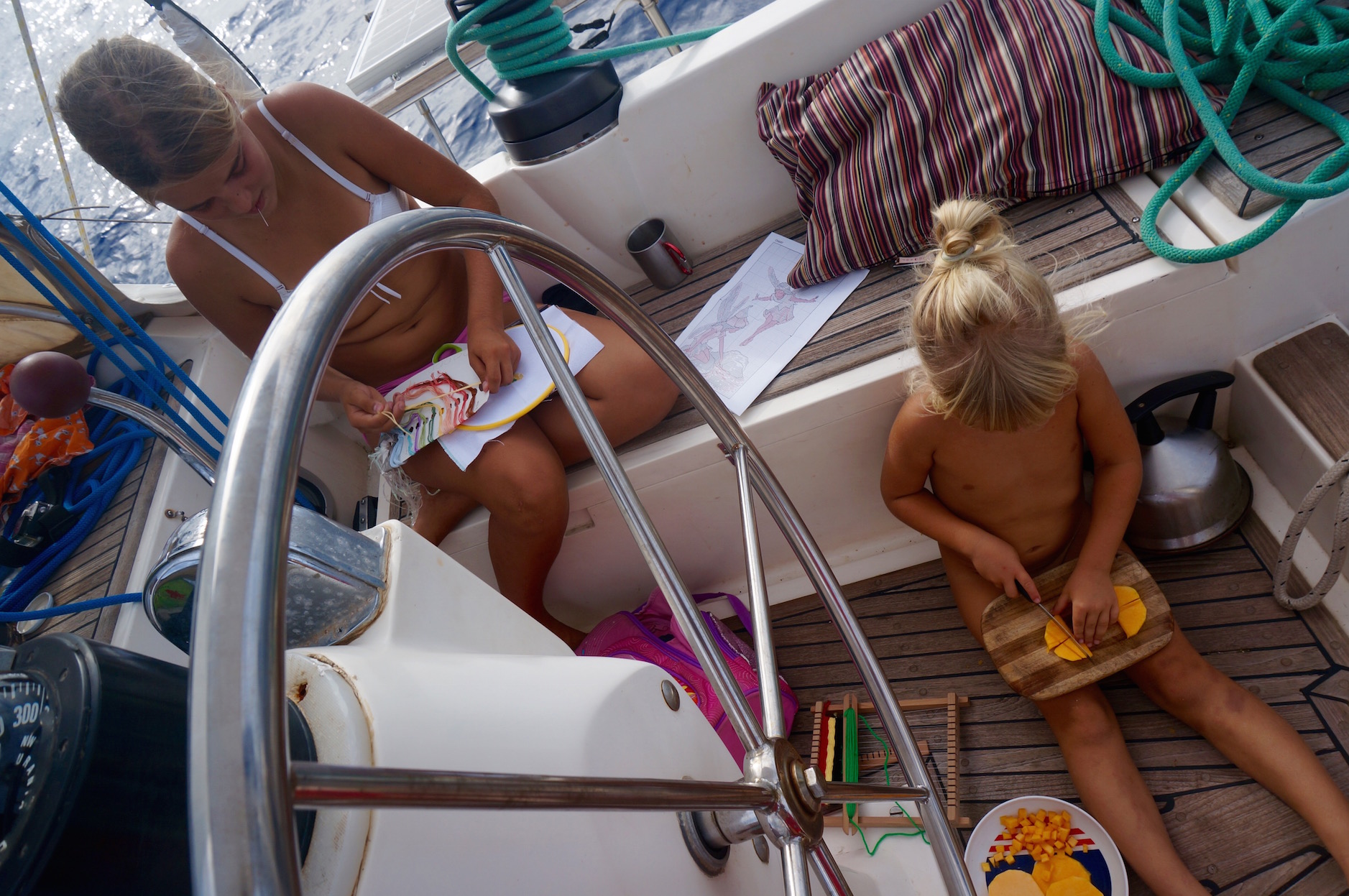
Yesterday was cloudy, so the girls took up their handicrafts. Lada is weaving, dreaming of selling her woven goods in distant lands “so we’ll have more money.” Nastya settled down to embroider, with a break to make yet another pizza with a new “whatever’s left will do” topping. We liked the pickled cucumber, pumpkin and sun-dried tomato topping, but the sweetcorn and boiled egg one seemed a little dry. Pizza has been added to the crew’s daily diet so we can finish off our large stock of cheese and switch off the fridge, which is devouring our entire reserve of electricity. Lada cast herself and Nastya as “the weaver and the cook, and you, Mum, will be Babarikha the Matchmaker. And Dad will be Bab-Babarikh the Matchmaker!” “Maybe Grandpa-Dedarikh?” And so it was settled.
Overnight, the ocean changed colour from bright blue to bottle green. The mighty Amazon’s waters have stained the hundred-mile-wide shelf zone the colour of a river. What an immense volume of water it carries! The first mate had dreamed of reaching the mouth of the Amazon ever since her first geography lesson in Year 6. And now, would you believe it, the Guiana Current is carrying Amazonian waters right beneath our yacht’s keel, and the Amazon is only a couple of hundred miles away—but we’re heading elsewhere. They say you shouldn’t take a yacht up the Amazon, “or snow will fall on your head and you’ll be completely dead.” They say you should sail to Recife in Brazil and fly from there to the Amazon. All right, we’ll check in about five years;).
A sail on the horizon!
The depths decreased from 2–3 kilometres to 100 metres. Ships began appearing occasionally in the distance. Then, in the morning, the captain’s cry rang across the deck: “A sail on the horizon!” Sure enough, a yacht was catching up with us, running before the wind and also emerging from the depths of the ocean. We tried to talk to her crew, but beyond exchanging greetings, we couldn’t make anything out. Perhaps our masthead antenna has worked loose and is playing up, or perhaps it’s something else. Our fellow sailors tried several times to splice the broken thread of our radio conversation, but without success. With a sigh, Lady Mary struck the fading wind with her billowing gennaker and raced off into the bottle-green distance. God willing, we’ll talk ashore:).
And there are only... 35 miles left to shore!
The captain has already put the children’s champagne, saved for the day the crew reaches the New World, on ice. Our young sailor is already waiting for the coconuts, bananas and monkey-wonkeys promised by the captain. And none of us can believe that tomorrow our transatlantic crossing will be over. With a little help from our young sailor, the captain repaired the navigation light. The fishing rod twitched feebly a couple of times and fell still, while some sort of matter drifted across the dark water—river weed, by the look of it. A fishing vessel rapidly grew from a speck on the horizon into a black, sprawling ship with a strange name, coming over to take a closer look at our proud, colourful gennaker.
The first mate tensed slightly behind her binoculars: who knew what their intentions might be? But a hundred metres off our bow, the fishing boat crossed our course and headed north in search of fish. A lingering, cool evening settled in, and the sun peered into the dark Amazonian ocean waters, dazzling unknown fish. Lada was cutting pumpkin for the pizza, while the captain lazily adjusted the mizzen sheet with his foot. Nastya was working her magic in the galley to the accompaniment of a French lesson (interspersed, we suspect, with reading Dumas’s trilogy).
We have covered almost 1,900 nautical miles (about 3,500 km) along our track from Cabo Verde. What awaits us on the South American continent? Until next time, friends!