
From the Travely-Family archive · Atlantic
Atlantic Crossing. Days 15–16
An original publication from the former Travely-Family website. This English translation was preserved from the technical-site archive without editorial rewriting.
Atlantic Crossing. Days 15–16
For the first time in ten days, ships appeared during the night. Or rather, their lights did. Three faint patches of light off the starboard side drew our attention, but AIS did not identify them. We’ve gone a bit feral out here in the ocean lately; a touch of anxiety even crept in—we needed to monitor the situation, take bearings on them... And our request for wind, sent out to the Universe and the online community, was answered in the most eventful way possible: the wind arrived almost at once, but now it comes in squalls, with downpours and gusts of up to 30 knots.
All night, the navigator’s “alarm” complained that we were exceeding the speed limit: 8 knots, 9.5 knots, 10.5... Our old Lady Mary hasn’t raced for a long time; for her, 8 knots is already seriously fast. And then there was that fishing fleet—or whoever they were. Why weren’t they showing up on AIS? Though the shipping route to Belém, Brazil, is supposed to run somewhere around here.
We altered course away from the vessels and fought off the squalls, though the first mate and the captain barely slept for two nights: the wind was gusty and unpredictable, while the sea followed its every move, only taking a little while to build. And the yacht, startled, would either luff up into the wind or bear away and start flogging her sails with all her might. The carabiner at the genoa tack even broke. In the middle of the night, the captain rigged some contraption in its place.
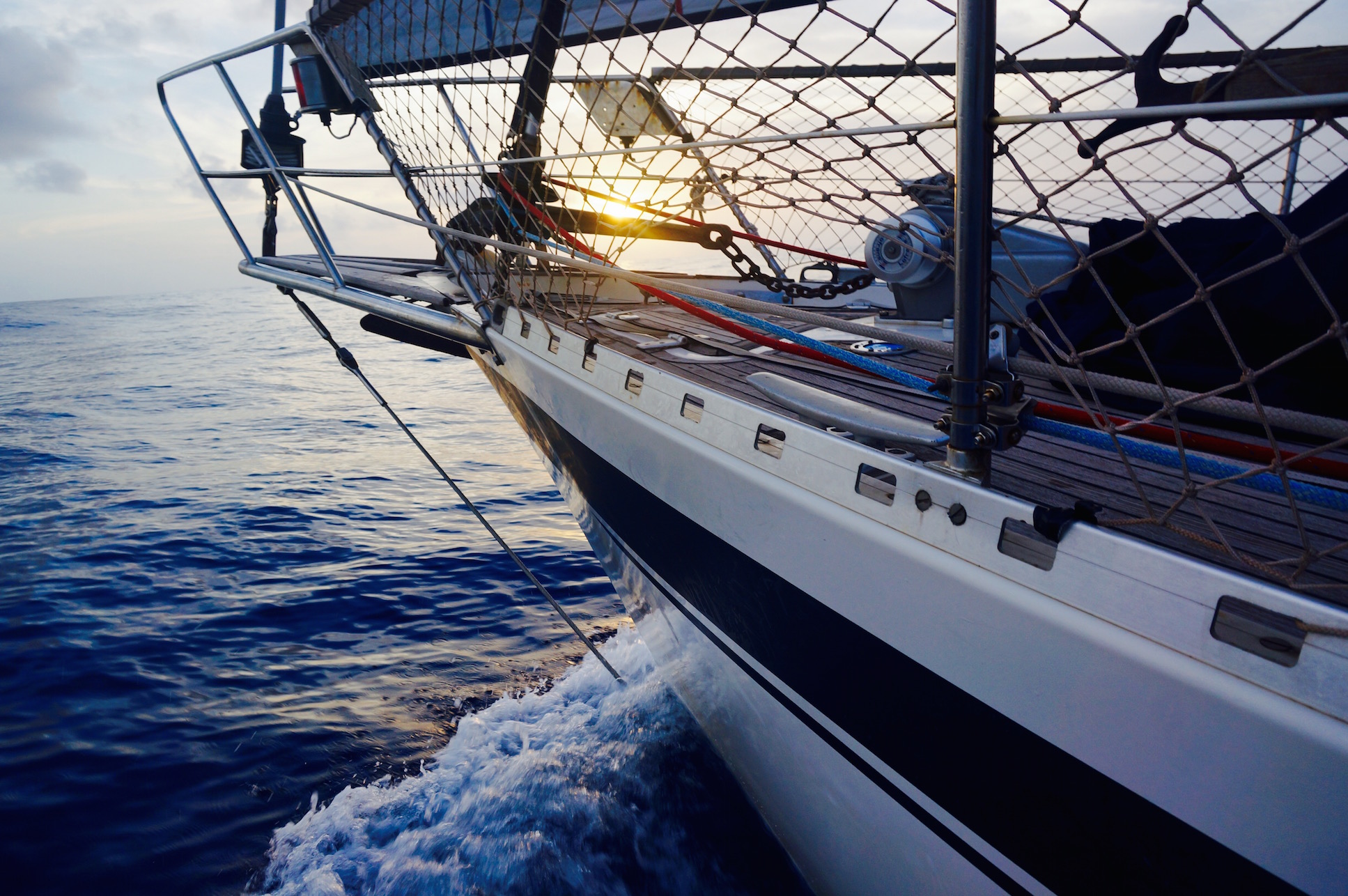
But it is very beautiful on the bowsprit in the dark: the foam sliced open by the bow shimmers with the blue sparks of bioluminescent plankton. And amid those fireworks, it feels as though we are soaring—or galloping? The heel, the howl of the wind, everything flying... The pattern of the night-time weather goes like this: twenty minutes of calm, with the traveller banging the sheets against the side of the coachroof. Then it begins to drizzle. By the time you have closed the hatches, a downpour hits together with a squall. The children try to sleep, the first mate marinates inside, and the captain outside.
Well, he does love taking a shower at the helm. Iron Felix cannot always cope with the squalls, so the captain has to keep an eye on him and step in when necessary. An hour later, everything dies away in an instant, followed by another half-hour of calm. And then it all starts again.
During the night, the crockery decided to find out what was tossing it from side to side. The entire stack knocked open the cupboard door and... Well. We now have half of the half-set that survived last time. All because the calms made us complacent and we failed to wedge the dishes in the cupboard with a tray. So nothing stood in their way when they stormed the door.
About dolphins and other wildlife
Dolphins have started coming to us—large, grey, blunt-nosed ones. For the first ten days, there was no sign of anything except flying fish. Yesterday, a group of seven adults and two calves swam with us until dark. One calf was tiny, only about 60 centimetres long, huddling close to its mother under the protection of two other dolphins. At first, the other adults behaved rather phlegmatically, but then they began doing somersaults right beside the hull. The girls are delighted, and the dolphins... I think they know we are human, that we are watching them, and deliberately put on a show. The first time they came was at night, leaving glowing, starry-blue trails in the water. You can barely see the dolphins themselves; you hear only their breathing and splashes, while glittering torpedo trails pierce the ocean night.
The fish have started getting away again, bending hooks and biting off lures. On the other hand, the flying fish have begun jumping aboard in pairs at night, straight into the cockpit:). Frigatebirds often visit us—very graceful and beautiful, with the long tail’s slender whisker. Before them there were albatrosses, and yesterday what was probably a petrel flew by. It was simply the only ocean bird that was “like black lightning”—with a black head, back and wings, and a white belly. All the other feathered visitors are either white or grey. There is little sun, so the batteries are not charging. And the wind generator... In my opinion, it is only of sustained use when close-hauled in 25 knots or more. Otherwise, what it puts in, it takes right back out. At least it isn’t hot—only plus 30°C ))).
The ITCZ is a lovely place. One moment it’s calm, the next there’s a squall, then a contrary current. We hope to reach America in five or six days without getting caught in a storm. We are already at 7 degrees north latitude, beyond the reach of tropical cyclones. We have 560 miles left to go; over the past two days, we have made a whole 170 miles of progress:). Optimism to everyone!