
From the Travely-Family archive · Pacific Ocean
Just Before Cape Horn!
An original publication from the former Travely-Family website. This English translation was preserved from the technical-site archive without editorial rewriting.
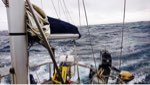
Just before Cape Horn! The morning of January 18. 140 miles to the Horn. During the day we’ll reach the continental shelf and see what happens to the waves there. The forecast we received this morning promises the wind will build again to 35–40 knots, die down overnight, and then return to 35–40 in the morning. We don’t know what that will look like in shallow water—we’ll tell you....... Yesterday around lunchtime the wind eased to 20–25 knots. We’re still sailing under the jib alone, without changing any sails. And during these twenty-four hours, only Andrey went out on deck; the rest of us managed to stay holed up below.
The swell is very high; the captain says it’s wind-driven. The waves roll in like something from the cartoon about Buyan Island, curling beautifully and rearing up. “O wave, my wave, so frolicsome and free.” They rise and foam, and then the little curls of foam scatter. The wind tears the crests off the waves.............................................................................................................................................................................................................................................................
After the Horn, we still have another 150 miles to go, half of them already within direct sight of the coast. We’ll first clear in on the Chilean side, at Puerto Williams. It is the southernmost settlement on the planet, I think. It isn’t even on Tierra del Fuego, but farther south, on Navarino Island. And in general, if you zoom in on the whole thing—the map, that is—you are surprised to discover that everything you used to think was Tierra del Fuego consists of a whole mass of islands and straits. Argentina’s Ushuaia, the world’s southernmost resort, nestles on Tierra del Fuego.
Cape Horn itself is actually on the island of the same name, with another hundred smaller islands scattered around it. Andryukha says you can even anchor off the Horn. Get yourself sorted out, wash, hide the remaining grapefruits and onions inside the sails so the border and quarantine officers don’t give us a hard time. Apparently, they give you a hard time for money. We’ve been advised to call first on the Chilean side, at Puerto Williams, find out what the current entry rules and formalities are over in Argentina, and only then continue another 25 miles to Ushuaia.
Both ports await us on the shore of the Beagle Channel; my tongue refuses to call it a canal. The Beagle Channel is another alternative route from the Pacific to the Atlantic and vice versa. That makes five routes between the oceans. From north to south: the Northwest Passage above Canada, with many variations among the islands and through the ice; the Panama Canal; and three routes south of South America—the Strait of Magellan, the Beagle Channel, and the Drake Passage via Cape Horn............................................................................................................................................................................................................................................................
Things are complicated here between Chile and Argentina. On the map, Argentina is on the right and Chile on the left, while the ports of entry are the other way around. And some of the fjords that carve up the entire western coast from Cape Horn itself to 35° latitude are still sort of disputed territory. To ensure that nobody even thinks of disputing them, they are guarded with particular zeal by the gallant Armada de Chile. You’re not allowed to enter the channels. Anyway, we’ll see. We’ll see about Antarctica too. Usually, any prohibitions that look absolute from afar turn out to have ways around them once you get close.
We’ll ask the local yachtsmen what’s what. If we can manage without a permit from Moscow for the icy continent, then all we’ll have to discuss is buying thermal underwear and thermal felt boots with thermal galoshes. But first we have to live that long. Or rather, sail that far...... It’s very nerve-racking. Last night, for the first time in ages, we set the watch alarm, and every two hours the captain and I had the pleasure of listening to “The Ballad of Struggle,” summoning Andryukha to scan the horizon. According to AIS, a strange ship passed us on a reciprocal course at 2 knots, 13 miles away.
We couldn’t see it........................................................................................................................................................................................................................................................... Half a day ago. Banks of fog hang around us, the wind blows a moderate 20 knots, and the ocean breathes deeply, the colour of smoke-darkened lapis lazuli.
There are more petrels now; otherwise, nothing much has changed. Except that the navigator display now shows not only us and the weather arrows indicating the winds, but also the jagged, bent spearhead of the southern tip of the two Americas. The young sailors are dead asleep; the captain has dozed off after half a night watch, taking advantage of the fact that nobody’s feet are bracing his firm backside from the opposite end. Those feet are now braced from the edge of the settee against the bulkheads, to prevent a repeat of yesterday.
Yesterday, on a wave, I dropped the computer with two 2-terabyte archive drives plugged into it. To transfer, search for, and edit files between the devices, you have to keep several moving objects stationary at once: your own body, the laptop, and both drives—and in such a way that the electronic devices do not move even a millimetre relative to one another. Otherwise, the loose connection breaks in the middle of copying and everything freezes. That’s what years of electronics living in a hostile environment will do. Anyway, I managed to keep everything balanced for three hours, but then either a large wave arrived or my vigilance slipped.
Either way, down we went with all the electronics. But I caught myself—I have hands. The open computer went flying onto the cabin sole. The cover of its case flew off, and from a distance the captain mistook it for the lid of the computer. “We’re screwed,” he said. For five minutes I was afraid to look inside the laptop and discover sorrow. When I finally dared, the MacBook didn’t even understand the reason for my tears of joy: everything was fine. The drives needed about half an hour to get back up to speed. The MacBook doesn’t even seem to have suffered brain damage.
The metal casing was a stroke of genius by Apple. And the MacBook is a godsend for a sailor. My precious..................................................................................................................................................................................................................................................... And the waves are utterly alive. I’m not the first person to feel that the ocean has a soul.
Everything probably does. But the sea’s soul is somehow vast, restless, and all-embracing. It has mesmerised me since childhood..... Well, here I wrote another whole page in the diary about all this maritime mysticism. Better to skip straight to the present moment. There are 46 miles left to Cape Horn. Forty-six, Carl! By this evening it had already blown up to 35–40 knots; I said goodbye to my family, swathed myself in a hundred layers, and went out on deck with the camera. I don’t think the lens captured what I did, or felt even half the storm of emotions raging in my soul.
Especially because from the deck I saw land for the first time in 50 days. The tiny Islas Ildefonso were sticking up ten miles abeam. Laaaand!—the cry from us girls rang through the ocean air and the belly of the yacht and echoed all the way off Antarctica. Birds of every kind; the cape was still about 70 miles away, but the shelf had already begun, and in depths of 100 metres the waves danced beautifully, though fortunately from astern. And every time we slid six metres down, I thought that if you were beating against waves and wind coming from the Atlantic, you would get those very storms with almost no progress at all.......
Woooh! Guys, Cape Horn!.... Woooh! Swinging up, down! Spray in the face, and slooowly back again—Woooh! Soon, very soon. We’re flying under the small jib at 5–8 knots. We have to keep correcting the helm; the big waves knock Iron Felix off course. I only managed to force myself back inside the yacht after an hour....... Very conveniently, the wind has almost died by nightfall, while in the morning they are again forecasting up to 20 metres per second—that same 35–40 knots. We’ll fly again, but in daylight. We hope to see the Great Cape rather than fog.
It’s busy around us now. Two vessels on AIS. We’ve just passed a large ship. “Peeeo-ple!” we sang softly, our noses pressed to the wheelhouse windows. “We’re heeere! Peeeo-ple! You exist! Hellooo, peeeo-ple!”............................................................................................................................................................................................................................................................
And to you, our dear readers, Nastya asked us to make sure we thanked you for being so fantastic, kind, and wonderful! Yesterday, shore support sent us a kilometre of your comments, and for half an hour we read them all aloud and talked to all of you. How lucky we are to have such a support group! Peeeo-ple, we looove yooou!.................................................................................................................................................................................................................................................
Special thanks to the shore-based part of our team, those who keep fuelling our enthusiasm through PayPal.me/TravelyFamily. Thank you to Dmitry D. from Novosibirsk, Dmitry K., Andrey G. from Nizhny Novgorod, Valentin S. from Krasnoyarsk, and Elena A. from Rostov-on-Don. You have become true partners in this expedition, for the glory of our home fleet and geographical discovery!............................................................................................................................ Hugs to everyone from 55.59S 68.36W! We’ll be back in touch beyond Cape Horn. Tomorrow we’ll tell you how we rounded it in Force 8 winds. The most important thing is that the wind will be from astern.