
From the Travely-Family archive · Patagonia and Tierra del Fuego
An (Un)successful Start and Yacht Repairs
An original publication from the former Travely-Family website. This English translation was preserved from the technical-site archive without editorial rewriting.
An (Un)successful Start and Yacht Repairs
We’re off! Happiness was in the air. Our young sailor was sending her final WhatsApp messages to her teachers at the Russian Geographical School. The engine chugged cheerfully, and the crew, in high spirits, said goodbye to our neighbour on the next yacht, preparing to cast off. All fragile items were secured, and our hearts beat in anticipation of new adventures.
Movement! The great energy of movement sets your eyes alight. It may be sad to leave places you have grown to love, and especially the people, but the call of the road urges you onward. And if you resist that call for too long, you begin to wilt, philosophically frustrated: To be or not to be?
— Not to be! the engine suddenly replies, apropos of nothing.
— Whaaat?...
— Nobody’s going anywhere, echoes the captain, and shuts down the engine.
Our neighbour René finishes writing his greeting in our “Book of Friends,” puts a small matryoshka doll in his pocket and, saying, “If you need help, call me!” goes off to write his blog:
//www.sy-ataata.com. “I simply don’t have time,” René says, “to write letters to all my friends who speak different languages. So I started a blog for them in four languages, so everyone knows what’s happening and how things are going.”
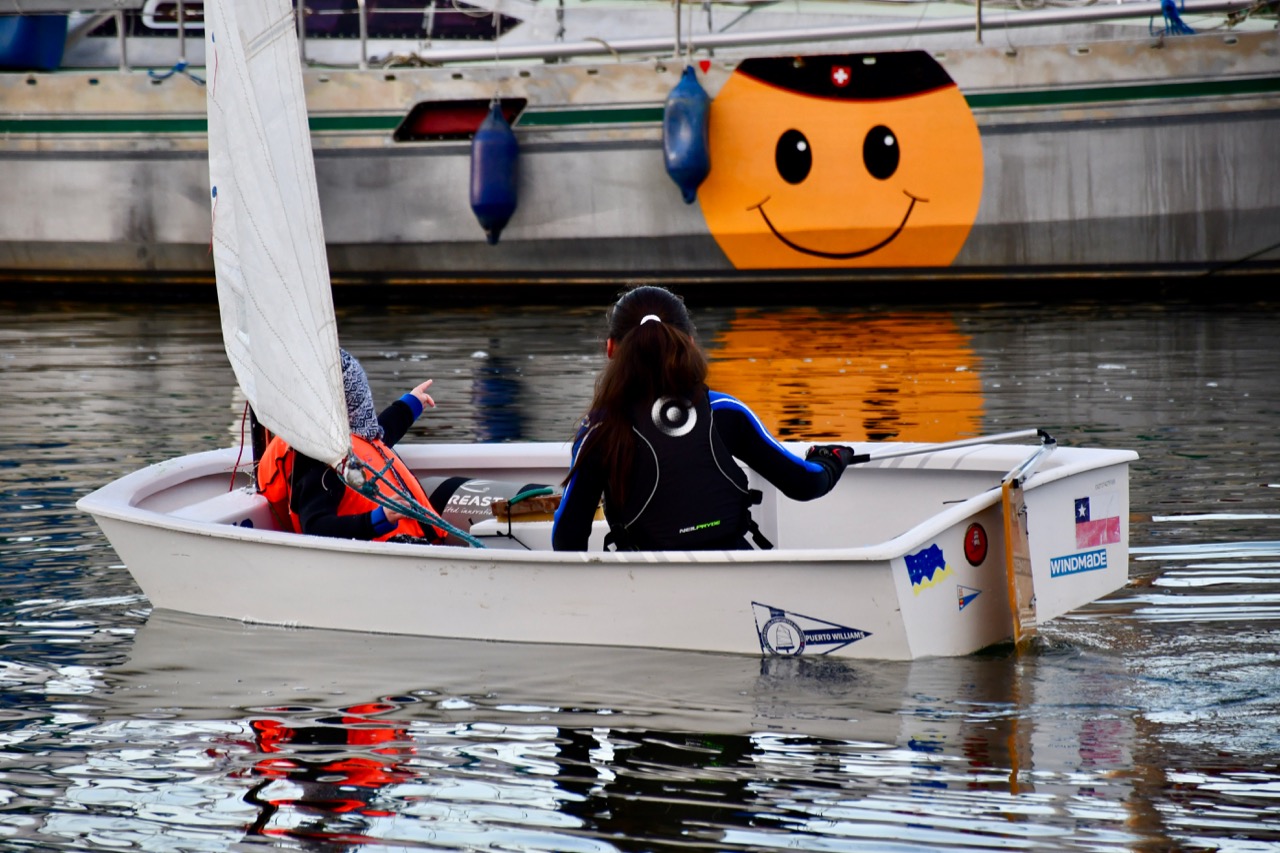
René’s boat—with a smiley:). Our young sailor—with a sail
Meanwhile, yes.
The start was a washout — Andryukh, what’s wrong?
— The alternator isn’t charging the battery.
— And what does that mean? asked our young sailor.
It means the engine isn’t charging the batteries, and the boat will be left without electricity. Hoping for frenzied solar activity at these latitudes in the middle of winter is as hopeless as trying to light up St Petersburg in January with power from solar panels. It also means we can’t use the diesel heater. And soon it will be zero to minus ten inside the boat, just as it is outside.
At first we weren’t too upset—our handy captain would fix everything in half an hour, and Lady Mary would get under way. Perhaps the wire contacts had simply oxidised, hardly surprising in a salt-encrusted bilge. We opened the bilge. The table, bicycles and jerrycans migrated into the galley and saloon. Ladunka’s temporary sleeping quarters were dismantled because the toolboxes live under the settee. The captain disappeared into the depths.
— Hmm, if we got rid of the bikes, we could carry a couple of illegal stowaways in this dry bilge, I remark, apropos of nothing. An African watchman from a mango orchard once begged us ever so earnestly to take him along. He thought he would be better off with us than chasing baboons away from a mango tree. “Though the stowaways would go deaf and get cooked,” I add, still talking about the bilge. It is right next to the engine, after all.
While I am musing along these lines, the captain climbs out of the bilge and onto the deck, and says to one of the local sailors:
— Nosotros tenemos dos problemas.
— Dos? What two problems do we have? While our neighbour Jaime responds with something like “Oh là là!” Nastya and I look at each other in bewilderment.
The mounting
Basically, the contacts between the alternator and the battery were temporarily forgotten, because it turned out that one of the engine’s four mounts had cracked. Andrei unscrewed the hefty part—or rather, its two pieces—and went out into the wilds to find a welder.
It turned out that no one in the sailing community knew the actual welder, but they knew someone who knew the welder. Yet that person—Francisco, who had helped us receive and clear our foreign-made sails through customs—was nowhere to be found. Francisco had gone to the airport (it’s rather cool when a village of 3,000 people has its own airport) to meet some French yachtsmen. They had failed to fit into the little plane on the first flight and had ended up on the next one, causing delays and complications.... This had nothing to do with us, but it filled Francisco’s head with tasks other than finding a welder.
Nevertheless, after lunch the latter was found and brought to Micalvi (the name of the exotic yacht club in the world’s southernmost village, where we are berthed).
After turning the murdered part over in his hands, the welder scratched his head:
— That’s a tricky alloy you’ve got there. Ordinary electrodes won’t touch it. I’ll take your bit of metal home, have a think, and weld it by tomorrow evening.
A little afraid of the word “mañana” (“tomorrow” in Spanish), we rushed off to finish our online chores: we needed to make sure that the social-media pages for our estate, “Gorny Altai: The Gingerbread House,” would keep running without me.
Fungi on board
At the same time, I set about drying the mattresses and fighting the mould, which so far is beating all our efforts by a score of 10–0.
The aft-berth mattresses migrated to either side of the oil-filled heater, blocking the entire cabin. I mopped up the puddle underneath them, threw the plastic bags that lie between the base and the mattresses onto the deck to dry, and set about soaking the fungi—pretty little white ones growing in the cracks at the bottom of the berth—with vinegar. We have a four-litre tub of it. The solution is a bit weak, though.
In a fit of curiosity, I also lifted the base of the marital bed. And there—poetry! On the underside, “in splendid carpets, gleaming in the sun, the snow lies.” Ladunka takes up Pushkin’s lines (she is a schoolgirl, after all, and has already learnt a whole heap of poems. Lermontov, Pushkin and Bunin are her favourite poets). I carefully pass Nastya the plywood berth boards covered in fluffy white mould so that she can teleport them onto the sunny deck—for now—and scrub them with vinegar.
What a pity the wonderful parcel from Ilya in Moscow still hasn’t reached us!
The fungicide
Lignofix, which kills fungi in a way that is safe for wood and people, is a Czech-made product distributed by Ilya’s company. The valiant staff at Domodedovo rejected the miraculous little jar of Lignofix at security, so Oskar Konyukhov was unable to deliver it to us. Perhaps our next guest won’t fly via the Emirates, and everything will work out. Besides, the fungicide comes with a label in Russian as well, and there are no symbols on it likely to alarm airport staff.
A photo to set the mood 🙂
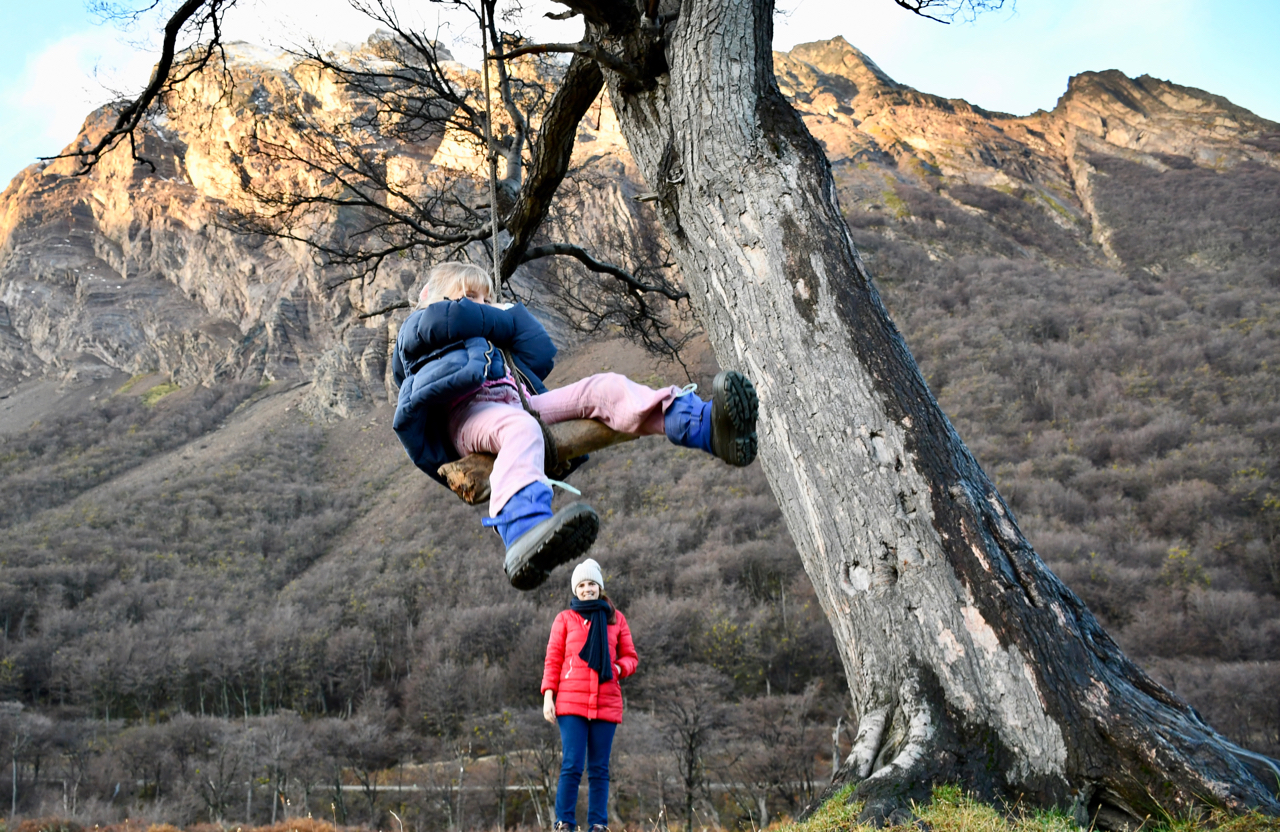
Our young sailor and the rope swing
Meanwhile, in the provincial town of N—that is, Puerto Williams—yacht repairs were under way...
Start cancelled, day two
A photograph of the welded engine mount visited us via WhatsApp that very evening. The physical object arrived aboard Lady Mary half a day earlier than promised—that’s what a military settlement does for you! It even disciplines the civilians. There is a reason Chile is the most prosperous country in Latin America.
The galley and saloon once again filled up with bicycles and jerrycans from the bilge, uprooted mattresses and the contents of the locker. The captain made an honest attempt to bolt the mount back on. A couple of hours later, I was dragged from my (un)comfortable spot on the shelf beneath the ceiling (the only way to catch a Wi-Fi signal without going out into the freezing cold).
Andryukha straddled the engine from one open side of the bilge, while I climbed into the “box for carrying illegal stowaways” from the other.
It turned out that only one of the four bolts could be screwed in properly. Although the spacing between the holes in the part and the engine matched, and mathematicians assure us that any two points lie on the same straight line, we could not get the second bolt in. The engine had sagged slightly, and the hole was a couple of millimetres lower than it needed to be. The captain tied a rope to the top of the engine, led it up onto the deck through a loop on the boom, and tried to lift the almost half-tonne engine with a winch. Down in the bilge, I pushed the bolt against the holes, which still refused to align.
The engine needed to be lifted vertically, not at an angle. Not only was all the heat blowing out through the open hatch, but the force vector was wrong too. Fortunately, the captain has the strength of a legendary warrior. He stood over the bilge, braced himself and pulled the turnip rope, just as they taught him in the weightlifting club. Things began to move. The engine lifted perceptibly. But for some reason the part rose with it. The success of the yacht repairs hung by a thread.
— Maybe we could wedge some sort of jack underneath it?
— Hmm... said the captain.
The rest of the procedure took another three hours. Taking turns to unscrew, lift, lower and wedge assorted objects beneath another corner of the engine, we somehow managed to fit the part to the circumstances presented to us. The fourth bolt went in at an angle. God willing, the mount won’t crack before Punta Arenas, the city on the Strait of Magellan. Once there, we’ll start looking.
Start cancelled. Day three
Cleaning the contacts did not help. One theory is that our valiant car alternator, bought for 50 dollars at an Albanian scrapyard in Montenegro five years ago, is asking to be retired. Some relay or other has died.
— Come on, alternator, what’s the matter with you? It’s only one tiny little part inside a big, strong thing like you. We’ll find an electrician! we promised rashly.
There are only two electricians in this village at the end of the world. One has gone north on holiday; the other sailed off just the other day aboard a Chilean Navy ship, destination unknown. Their respective return dates are a military secret. So we need to find a scrapyard, of which there are none in Puerto Williams. Perhaps one of the villagers has an unwanted alternator. If not, there is Plan B:
At the beginning of the week, our neighbour Jaime is flying to Punta Arenas. He can look for an alternator there and send it back here by plane if an opportunity arises. Given that we are in the middle of nowhere, such opportunities are random, and this is Latin America, we could be waiting another week.
— That’s the pessimistic forecast, the captain pronounced. “Although...” perhaps it is actually the optimistic one.
Summary
What luck! What incredible luck that all these things broke or were discovered right at the moment of departure, rather than a week later in the uninhabited skerries of southern Chile or, God forbid, in the Southern Ocean! Here, at least, there is hope that the yacht will be fully repaired.
Thank you to our guardian angels and to everyone who is rooting for us!
A digression about the internet
The feeble signal that had just about managed to reach the yacht has died. Perhaps the military personnel at Micalvi forgot to pay for the data? The internet now comes from the sailing school on the opposite shore of the bay, but to receive it we have to place the laptop on a stack of books and boxes right under the wheelhouse windscreen. Then—what a paradox!—social media pages will open in a couple of hours, but sending a comment or message is impossible, as is publishing a post on the website in the usual way. Yet cartoons for our young sailor load from YouTube with varying degrees of success.
At least we’ll have something to watch out on the ocean. Our entire film library died along with the four-terabyte drive. As did the antenna for the internet signal booster. Before the false start, the captain sent the sailor up the mast to remove the device. The antenna had shown no signs of life for a long time, but now a hands-on examination confirmed it: dead.
Propane-butane
The gas is a whole separate saga. The active gas cylinder lives in the anchor locker. From there, the gas runs through a hose to the cooker in the galley. In freezing temperatures, the propane-butane mixture behaves in an interesting way: one gas thickens, while the other merrily runs through the hose to burn at the cooker. And once the cheerful gas has burned away, the almost-full cylinder of sad gas refuses to work. So we have no gas when it freezes. But now we have a long gas hose and can move the cylinder into the forecabin. It is almost below zero there too—cucumbers, for example, are starting to freeze in our temporary cold store. But the cylinder will still be warmer there.
Many thanks to Sergei Ostrovsky, who keeps our spirits up from Ushuaia, Argentina. Through a fortunate opportunity, he managed to send us flash drives with films and a gas hose. I think that, were it not for border formalities, Sergei would have flown over long ago to help repair the yacht, bringing all the necessary parts and tools to fix the relay. For he is the best electrician in Ushuaia. Everyone heading to these parts, take note! His contact details are available from Roxana at Marina Afasyn, Ushuaia. Ask for Sergio, the Russian electrician.
We’ll telegraph updates to the website, and if the feeble internet wakes up, or if some kamikaze fancies running a couple of kilometres to the sailing school, then we’ll post on social media as well— Instagram and sailor Nastya’s Instagram.
Our immense gratitude to everyone supporting us through
//PayPal.me/TravelyFamily and //Yasobe.ru/na/TravelyFamily
Vasily Sh. from Moscow, Sergei K. from Samara, Vladimir M. from Novosibirsk and Olga S. from Samara—we’re sending you warmth from our snowy corner of Tierra del Fuego. With the unplanned “yacht repairs” operation now under way, your support could not have come at a better time! A personal hug to each and every one of you!