
From the Travely-Family archive · Patagonia and Tierra del Fuego
Uninhabited Patagonia
An original publication from the former Travely-Family website. This English translation was preserved from the technical-site archive without editorial rewriting.
Uninhabited Patagonia. Sent via satellite. Solitude by the shore. The peculiarities of winter life aboard a yacht: how ropes turn into sticks and equipment freezes. Shore lines and waterfalls, cave-dwelling young sailors and mathematics.
These last 18 days of our expedition have been strange. We seem to be travelling among shores, anchoring for the night, yet interacting with no one but ourselves. Well, the blasts of our horn to the occasional fishing boat passing the other way and the echoes of call signs over the radio don’t count. Before, any journey of ours along a coast meant some sort of contact with either locals or yachtsmen. Here there are neither. The shores are completely uninhabited, and it’s the winter season, so there aren’t even the occasional yachtsmen. There are precious few nutters as hardcore as us, truly precious few.
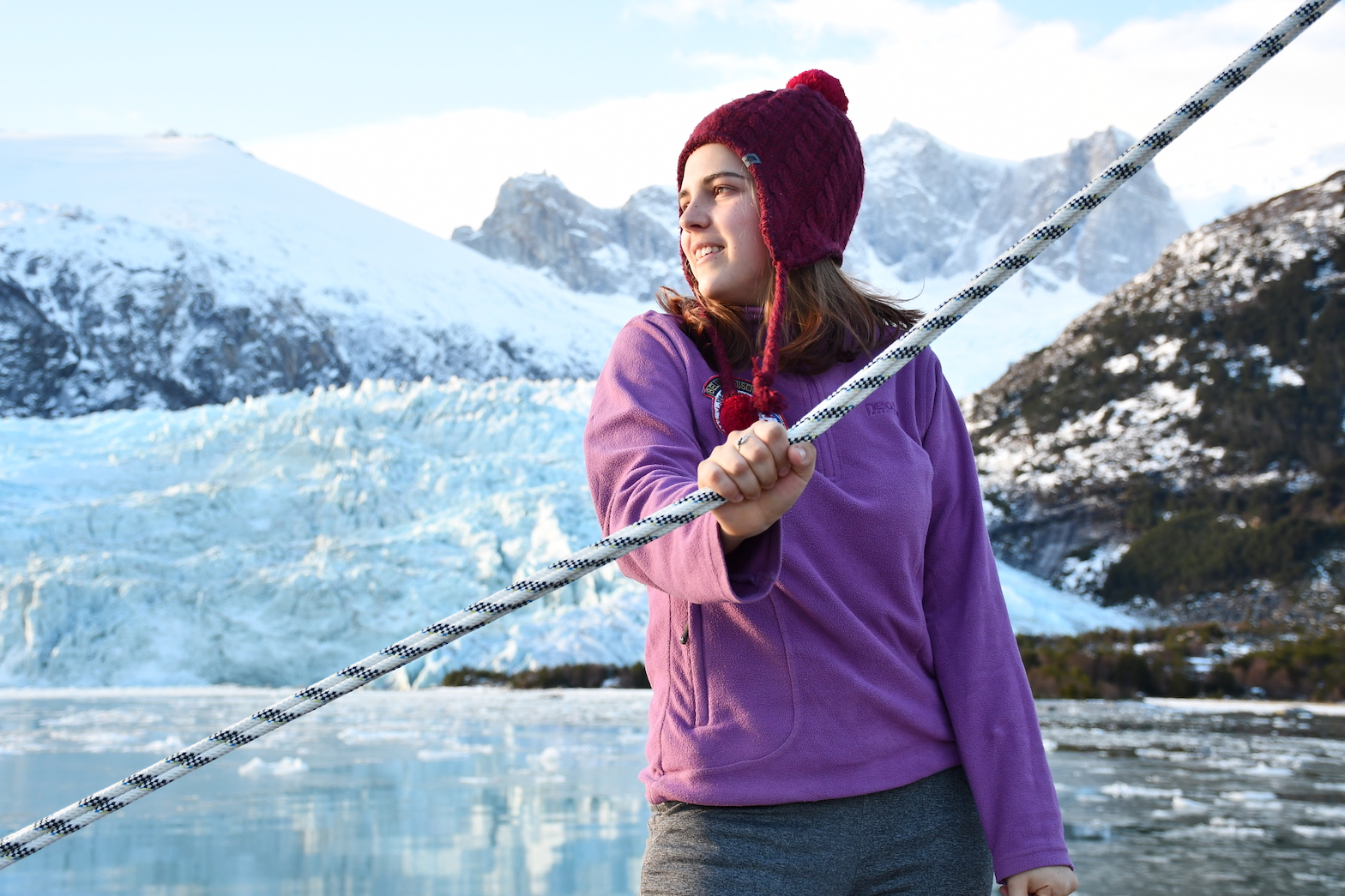
If anyone had told me a year ago that I’d be making my way through the fjords towards the Strait of Magellan in winter, I’d never have believed them. In summer, maybe—but in winter! We know what winters are like at 55 degrees.
In fact, it isn’t all that dreadful: winter here is considerably milder than in Siberia. For a couple of weeks now, it has only dropped below freezing at night; by day it’s around 2°C above zero. Practically Africa, innit. Which doesn’t stop us running the heater all day. We switch it off around midnight, block the entrance with special cushions, and put up makeshift secondary glazing made from cling film; by 9 a.m. it’s 5–7°C inside the yaranga.
Habit is an amazing thing. From the comfort of a warm home, even a week-long winter trip aboard a yacht looks like some sort of extreme sport, but here... After all, we’ve already had winter for more than six months: four months of green winter, and now we’re in our third month of white winter. Plus three weeks in Antarctica. I can’t remember the last time I took my socks off; I even sleep in them. I have two outfits, like Tom Sawyer. One set for daytime and one for night, like pyjamas. Terry socks, fleece-lined trousers, and what the young sailor calls my sleeping telnyashka. For outdoors there are wellies and my foul-weather gear, over which—because it is old and therefore no longer waterproof—I wear a cheery, toxic-yellow jacket that looks like a greeting from a railway tracklayer.
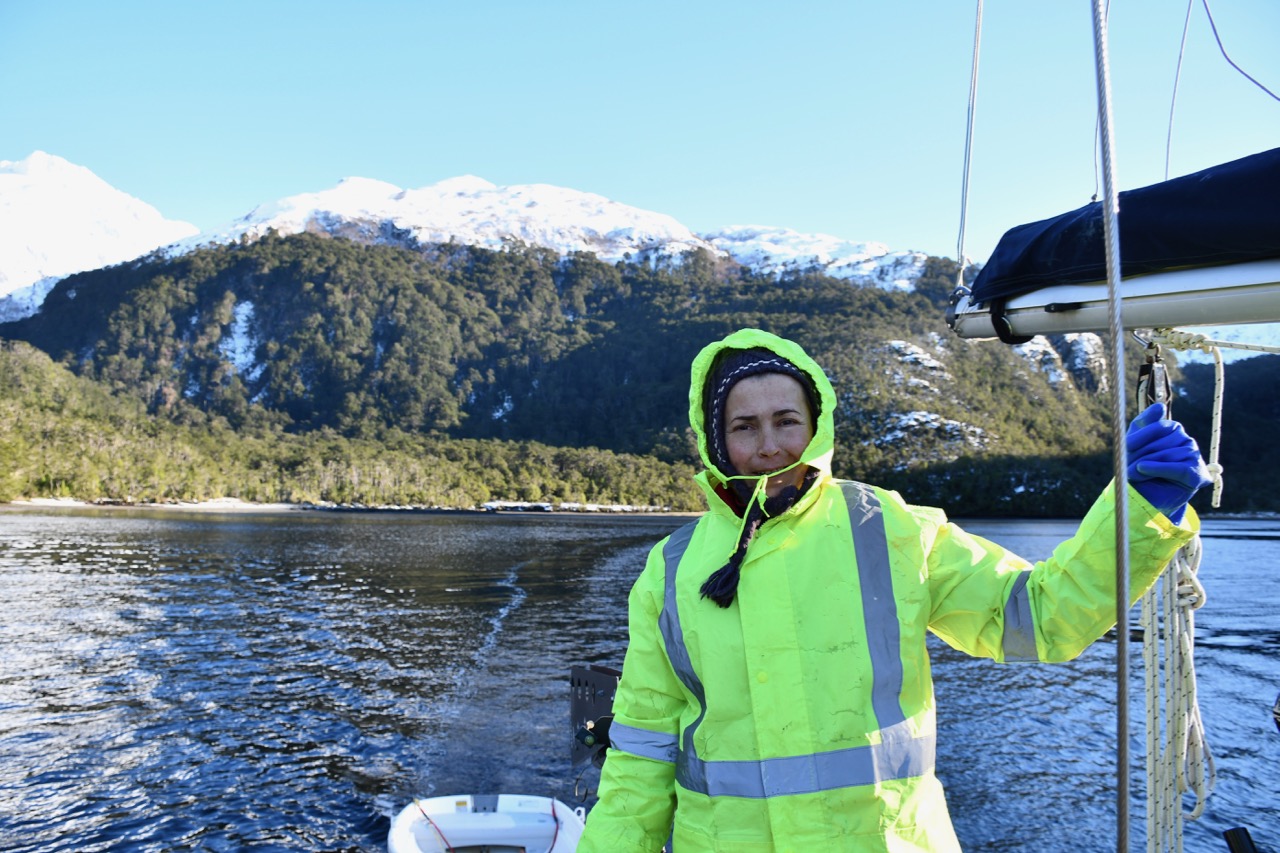
What else is needed to complete the picture? At night I read a book on the iPad. If I fall asleep, then wake up and decide to read another couple of pages, I take the iPad under the blanket against my body for about 15 minutes—and it’s so cold! If I don’t warm it with my body, it dies after a couple of pages. Even technology doesn’t fancy working at 6°C above zero. But at least the sea surface no longer freezes overnight, which means the temperature isn’t dropping below minus five. There’s always a bit of a warehouse feel aboard. Either outdoor clothes are drying everywhere, or blankets and pillows, because if you make the bed neatly every day, it goes damp. This way it’s lively, of course, but at least it’s dry.
Today, day 18, we ate the last pumpkin. Of the fresh vegetables, we have carrots, onions and garlic left, half a head of cabbage, and two beetroots. We’re better off for fruit: there are still apples, oranges, mandarins and lemons. Enough for another two weeks, certainly. Though in a week we should already reach Punta Arenas, the Chilean city on the shore of the Strait of Magellan. They say it’s a very bad place to stay. Strong tidal currents, and the anchorage is exposed to every wind. But we’ve survived worse; we’ll manage for five days, sort out our affairs, then head onwards, out into the ocean. But really, why do I keep going on about everyday life? These anchorages are so beautiful!
We left the unsettled spot in the channel without incident. Though the ropes had spent the night pretending to be sticks, which was very funny. If you put on a suitably fierce expression, you look like Sherlock Holmes straightening a poker bent by the villain. For the first time, the sheets froze too. But that doesn’t matter: we don’t need to set either the genoa or the staysail yet, since the wind is on the nose. We covered 25 miles into another long fjord called Seno Ocasión. At the entrance, we decided to make contact, in case the satellite got lost among the high mountains again and couldn’t reach us.
We got through on about the fifth attempt. Shore headquarters isn’t sending us any comments; they’re probably busy. There are letters from Mum, which is lovely. We travel beneath the shelter of the rocky shore of the island of Tierra del Fuego —it’s the same one again, the main island of the archipelago, only from the other side. There is less wildlife now; only very occasionally do we come across a group of fur seals. They aren’t curious at all here: they don’t even lift their heads out of the water, just a belly and a pair of flipper-arms sticking out. They roll from side to side, and that’s the whole show. Ducks with red beaks have appeared, which turned out on closer inspection to be upland geese. But we only discovered that later, in Caleta Brecknock, a bay bearing the same name as the channel we’re travelling through now.
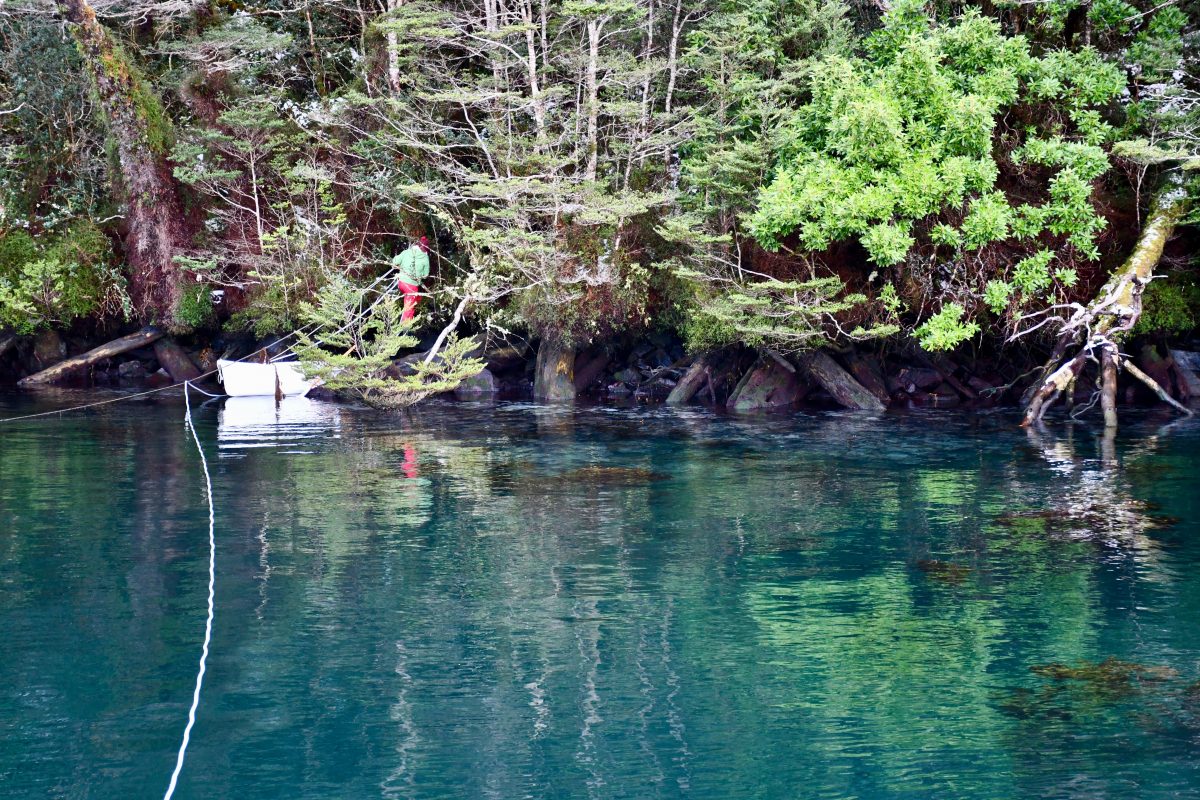
At the very end of the fjord, there’s a pretty little nook to port. Traces of human presence descend into the water in the form of floating lines. One of them was so long that at first we tied our stern directly to it rather than to our own line. But afterwards we swapped it: the other line wouldn’t pass through the fairlead, and the captain didn’t want to leave it like that, rubbing against the solar-panel mounting. Once we were secured, Ladunya and I set off on an outing. Garlands of icicles hang and stand along the rocky walls, some about 70 centimetres long.
As we tie off the line, we try not to touch them, so the whole colonnade doesn’t come crashing down our necks. And so, while the captain puzzles and conjures over something by the anchor, we row over to the waterfall. A broad stream plunges into the bay from beneath crooked, moss-covered trunks—not from very high, but powerfully and beautifully. Beyond it is a tall cliff planted with what looks exactly like a vertical lawn—the sort that foreign landscape designers create on the walls of buildings in big cities. Then they get featured in magazines for it. In short, do you know what the local designers could spin all those city designers on? Well, they’ve outdone them, anyway. Even the captain was impressed when we dragged him over here.
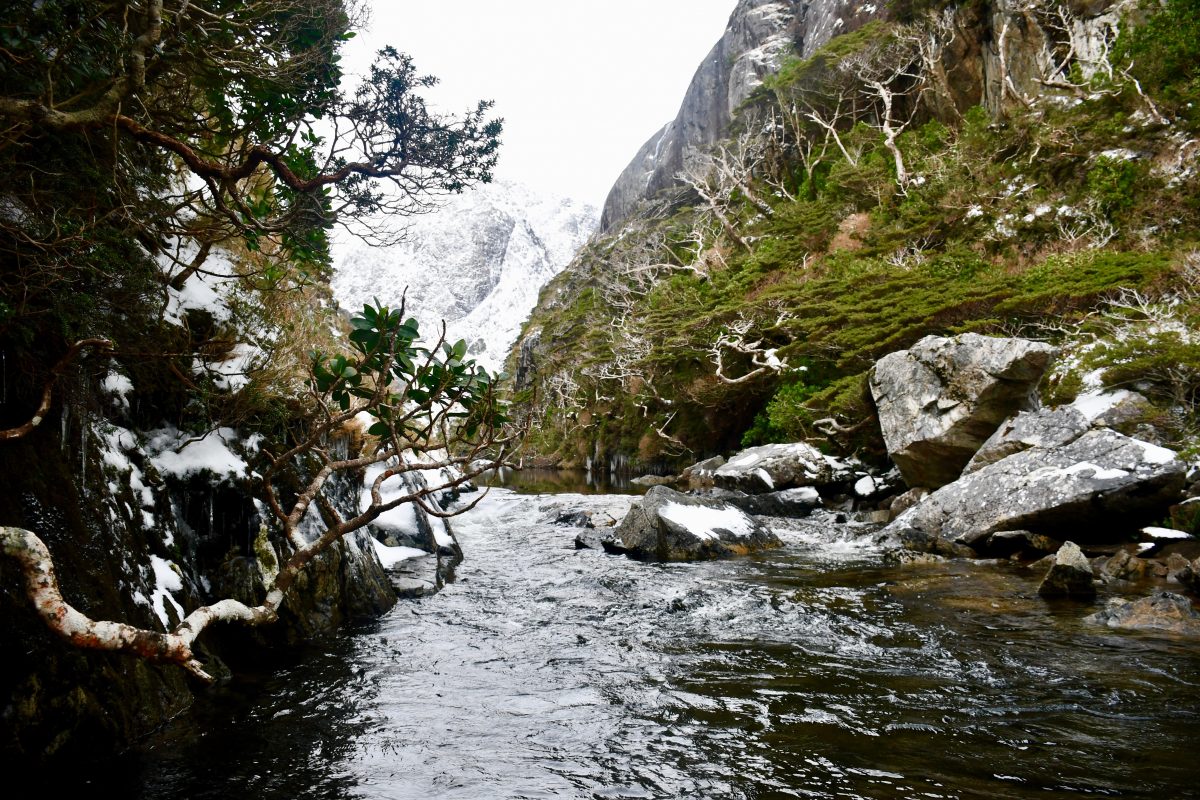
Beyond the wall and waterfall, a river flows into the bay, but the captain’s and Lady Mary’s summoning horn blast prevented us from exploring it on our own. We had to go back, run out another couple of lines, and then the whole crew sailed over for tea beside that very river. Annoyingly, it began with rapids. Of course, we could drag our heavy dinghy across them, but it would take a couple of hours each way. And the water is cold; no one fancies splashing about in it. Beyond the rapids, though, a quiet channel begins, and according to the chart the river flows from a glacial lake.
The next morning, as we were leaving, we discovered that this massive spur of the mountain is washed on its other side by another river, whose mouth has no rapids. We probably could have rowed into that one. But now we’ll never know.
The captain had spent the previous three days frightening us about the next passage, because 15 of its 25 miles are across open water, which means a Pacific swell amplified by the shallows over the shelf. Fortunately, the wind almost died away and, for a while, even blew not on the nose but from the side, so we slipped across the exposed stretches with hardly any damage to the crew’s health. Yes, all our passages here are under power or motor-sailing. The mainsail is on the third reef and helps a little. Even if the forecast says calm, the wind can suddenly whistle up to 45 knots—that’s Force 9, a strong gale—and then switch off in an instant as though it had never existed.....
Yesterday we arrived in Caleta Luis. Everything would be fine, except, damn it, it’s overcast. Today it’s been spitting rain all day. And in this gloom, the wonder is harder to see. The wonders of nature, the curves of the landscape, and the coastal cliffs all merge into a single blur. Even the young sailor, poking her nose out of the wheelhouse while we were anchoring, said: “All these bays are starting to look the same to me.”
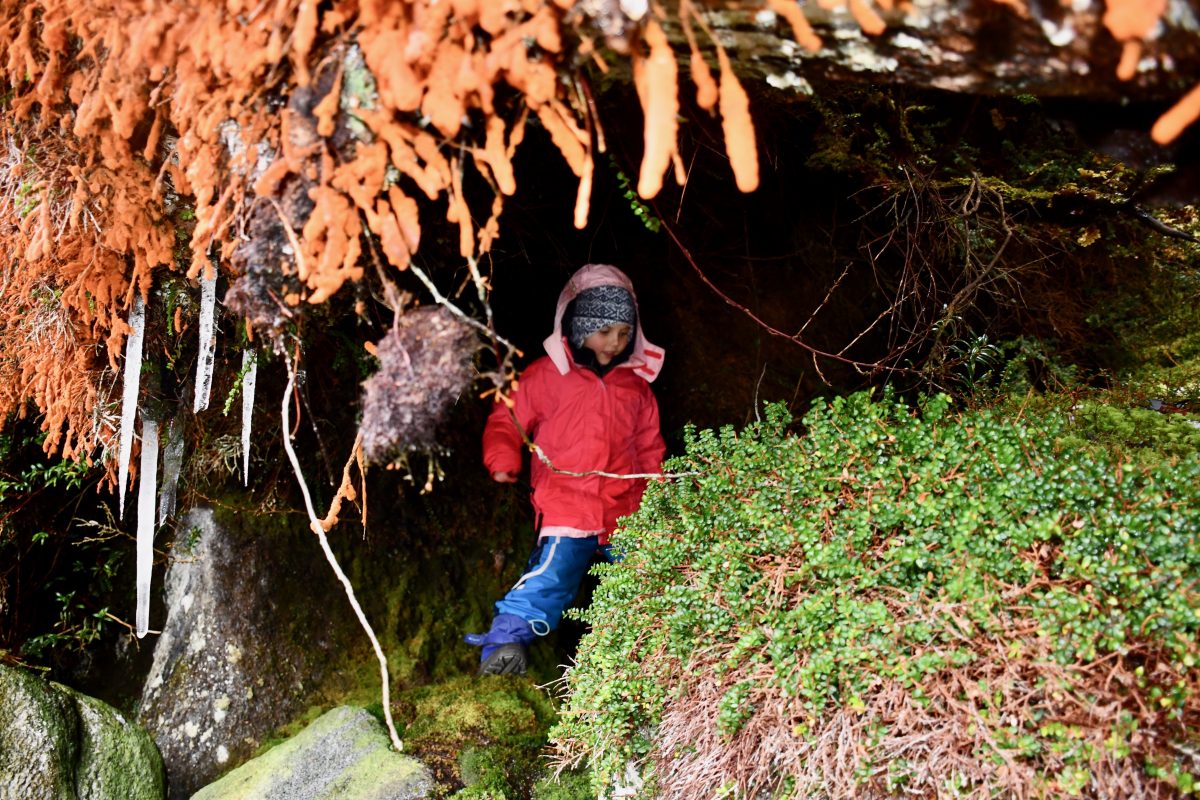
But before sunset the sun beamed with joy a couple of times at the sight of us, and the beauty duly counted. I even managed to row over to a stream with yet another veery small waterfall. Near it I found a cave beneath the roots of an old tree, among twists and carpets of creeping plants. The floor is covered with soft moss, icicles reach all the way to the ground at the entrance, and the arch is edged with an orange moss unknown to our shipboard science, spreading over the surface of dry blades of grass and twigs.
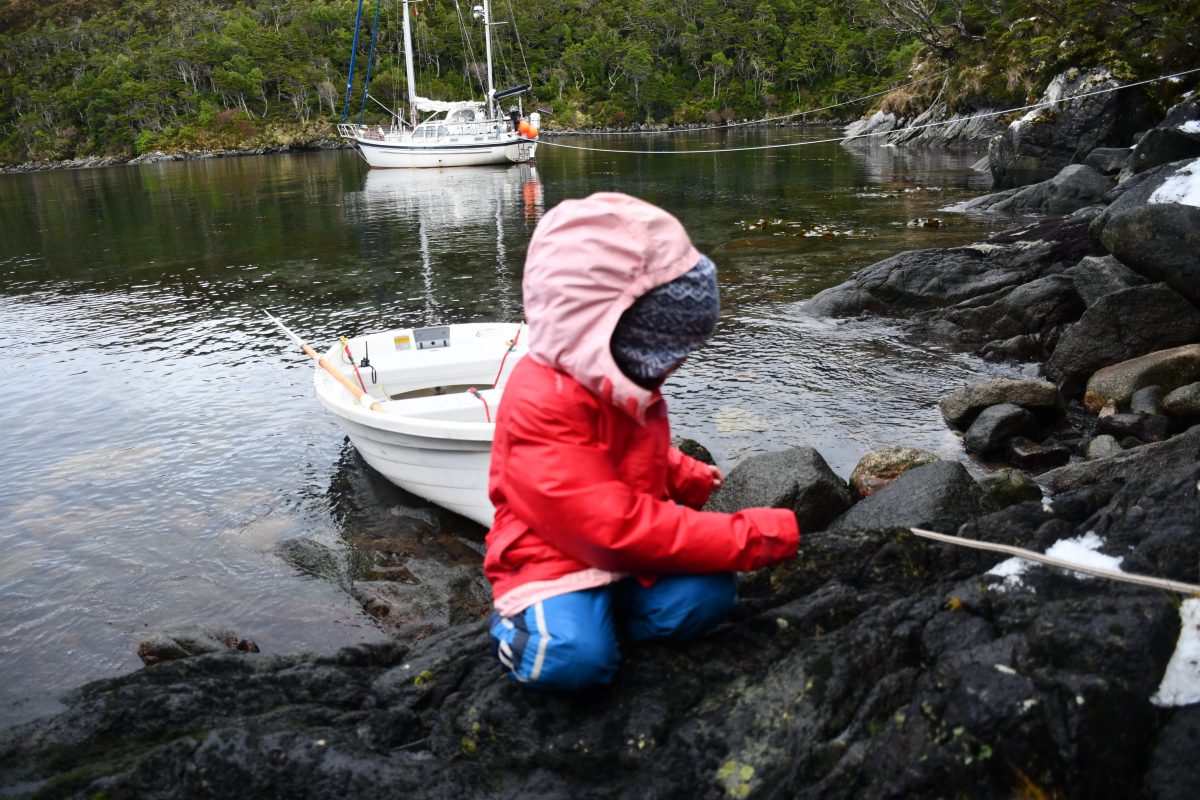
In short, today, despite the rain, the young sailor and I explored both the cave and the area around the waterfall. We got soaked, drank tea, hopped about on the reefs, drenched our gloves, and the young sailor also fell into the stream. Not badly—just her hands. And she cried out very comically:
“People, save me!”
She does it in such a way that you can’t immediately tell whether it’s a game or she’s genuinely calling for help. Well, I’m always nearby; I gave her my hand, rubbed it warm, poured tea over it for warmth, then gave her a couple of sips, and all was well.
In the evening, we rounded everything off with mathematics. It will soon be 1 September at our Russian Geographical School, so we need to catch up. And tomorrow it’s another emergency wake-up. The next 25 miles towards the Strait of Magellan. Write to us! Wishing everyone happy adventures!
You can follow the expedition in real time on our website under the Route tab. There, thanks to MVS Telecom JSC, our Iridium passage track is being recorded. A map with the track and details is also available at bit.ly/iridium360