
From the Travely-Family archive · Other Entries
On Watch After the Storm. Passage to Tasmania, Days 11–13
An original publication from the former Travely-Family website. This English translation was preserved from the technical-site archive without editorial rewriting.
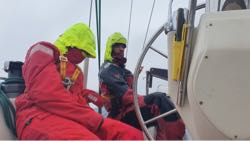
Just a diary, no frills. The waves in this storm really got going, no mistake. Even a day later, they are frightening to look at. We lay hove-to until morning. In one gust I saw 59 knots on the anemometer. It brought back memories of the storm off the Falkland Islands in the first days of spring, after we had left the Strait of Magellan. Why on earth do we keep heading into the high latitudes out of season? )) In the morning we set sail; the following evening we took down the mizzen again and tore along under the staysail at full tilt, at times accelerating down the waves to 11(!)
knots. For Lady Mary, that is warp speed. We are making good progress with almost no batteries (in previous reports, we wrote that the batteries had suddenly remembered their age and all stopped holding a charge at once), no engine, no heater, and our electricity consumption drastically restricted. And now the gas has suddenly started freezing in the hose and is barely reaching the stove. We hardly start the engine because water is gushing from the cooling circuit into the bilge, along with oil. Only if the battery drops to 8 volts at night and the radar detector switches off does the captain climb into the bilge and run the engine for about 15 minutes. If we get some sun during the day, the laptop gets a little charge so I can write. The girls do their lessons on smartphones, which uses less electricity.
26 May. Everyday Life on the Ocean
As always on a gloomy passage, I desperately want to go home. And even according to the most optimistic plan, to end up somewhere not too far from Russia, over the next eight months we have to cover a distance equal to three-quarters of the equator. That is by the general course; our actual track will amount to roughly the circumference of the Earth. Bloody Covid. Despite the weather, we are sticking to our evening film ritual, otherwise the gloom would be unbearable. Because of the power problems, we watched Moscow Does Not Believe in Tears on a phone.
Today, apparently, we will watch Office Romance the same way. Writing is hard. Lada sat down to make a doll out of thread. Yesterday morning we had pancakes and rice porridge. I shouldn’t have made it with panela instead of sugar; the dark colour did not inspire everyone. Today it was porridge again, while I treated myself to lavash with sardines and olives. A bachelor’s breakfast )). It was sunny for the first half of the day, but cold. Outside it is 13.6°C. In the cabin, the sun warms it to 16.7°C, since we are ventilating. Condensation is running everywhere; yesterday we found mould on the walls in the wheelhouse. Very depressing.
At night it is a lovely +11°C in the wheelhouse and +9°C outside. Yesterday we put on a second layer of hoodies and started laying a throw over the blankets. On the plus side, porridge left on the stove does not spoil overnight. I suppose many people reading accounts of passages through the Roaring Forties on the eve of winter expect some sort of heroic deed? In reality, there is a hundred times more dull everyday routine. The rolling wears you down. It is cold and wet, and you dream of a shower. We keep ourselves going with reading and jokes. Nobody goes out specifically to look at the waves, and we cannot see whether there are any whales or dolphins around. The customary pair of petrels and an albatross slice across the horizon with their stern, angular wings.
The Night Is Tender
Lastly, I’ll tell you about last night. It was a good one. Because the wind constantly changes abruptly inside cyclones and along their edges, the waves, as usual, do not have time to change direction with it and start hammering us from different sides. The wind is gusty, and for the second day the windvane self-steering cannot cope. We have come to appreciate the chair that appeared opposite the inside helm for this passage. You can sit in it with your feet braced against the coaming. And steer while seated. Nastya took the first helming watch; I relieved her at about 10 p.m., and in the third hour of the night I woke the captain.
If you do not keep correcting the helm, the boat either rounds up in the gusts or bears away until she gybes on her own. So this is the real thing: for the second day running, we are steering by hand. The full moon hangs over the ocean like a lantern. In its bright light, the heaving surface of the ocean is wonderfully clear through the windows that have not fogged up. The waves are almost astern, and that is the only reason we can keep going. Sometimes mountains roll in so huge that the yacht twists like a corkscrew, the keel bogs down in the wave, the boat spins in the trough, and then soars towards the moon at all sorts of angles.
Usually you cannot see the waves at night, but now you watch their colossal power and fly along on the foaming crests, first up, then down, until you get butterflies in your stomach. It is a good thing waves like these did not arrive in the first week, or we would have had to summon Ichthyander from the depths around the clock. Yes, in the moonlight the foaming crests look like large ice floes or small icebergs. I even have to pull myself up and remind myself that there are no icebergs here; Antarctica is 1,300 miles away. Incidentally, yesterday we already joked about how it was 1,300 miles due south and we would be in Antarctica, right in the Ross Sea somewhere. Nastya looked up sharply:
“Hey, parents, just don’t do that now, okay? Like you did then?”
And “then” means 22 November 2018, when we turned away from the tropics towards the 37th parallel and Cape Horn, saying: “Just imagine, 1,200 miles due south and we’ll be at Maria Theresa Reef!”
That was how our round-the-world sailing expedition via the Great Capes and Antarctica began, with children aboard:).
“No, Nastya,” we assured our daughter, “we definitely won’t go there now. It’s winter, after all. If only it were summer!”
Where We Are Going
Because the batteries have died, we have decided to head straight for the small town of Kettering. Our friends from the yacht Macquarie, whom we met in Tierra del Fuego, live there. They will surely tell us where to find batteries and spare parts to repair the cooling-system circuit.
Incidentally, today, 27 May, we are unfortunately missing a grand event: the formal presentation ceremony for the geographical Oscar, the Russian Geographical Society’s Crystal Compass National Award. We made it into last year’s final, but the ceremony and our attendance were cancelled because of Covid. And today we will find out whether our circumnavigation has won. Unfortunately, we are on passage and will not even see the stories (. How badly we wanted to be there ourselves—among great travellers and scientists with fire in their eyes.
We wanted to bring the children into the Russian Geographical Society, so they could soak up the atmosphere and be inspired to new achievements. But what can you do... The pandemic has wrecked many people’s plans. Our representative at the ceremony will be Oscar Konyukhov, Fyodor Konyukhov’s son. We will hear the details from him once we make landfall. Mmm... Very exciting.
On that happy note, I’ll add that we have 400 miles left to go. And this cry from the heart was cast into the sea at 43°22′ S, 138°43′ E.
Friends, thank you to everyone who is with us! Yesterday Sergey Yakubenko, our eyes and ears, sent us your comments—it felt so good, as though we had had a chat with friends. We thank Ivan P. from Novosibirsk and Elena R. from the Leningrad Region for topping up the expedition’s ship’s kitty through sobe.ru/na/travelyfamily
Your support means so much. Hugs to you all!