
From the Travely-Family archive · Central and South America
A Sea of Birds and a Round-the-World Regatta
An original publication from the former Travely-Family website. This English translation was preserved from the technical-site archive without editorial rewriting.
A Sea of Birds and a Round-the-World Regatta. A yacht straight out of a Jules Verne novel. Leaving an uninhabited island. Anchoring among bird colonies. A bird bazaar, and how the current swept us past the yacht. A round-the-world sailing regatta and a lucky catch. Grilling underway for the first time—in the dark and into a headwind. Arrival in Panama City Off to the bird bazaar
Any hope of a full-crew outing around the perimeter of the uninhabited island is melting away like April snow. The men had shirked the evening excursion too, staying by the campfire while only the girls hacked their way through the jungle and along the cliffs. A large, snow-white yacht enters the bay, looking rather like Jules Verne’s Duncan, and our captain orders us to weigh anchor—it is time to start heading back.
We tack into the wind, making a laughably small amount of progress along our intended course. Everyone aboard is busy with important things: Lada and ES are studying Spanish, while Nastya and I keep ourselves useful, fetching and carrying tea and helping the captain through the tacks.
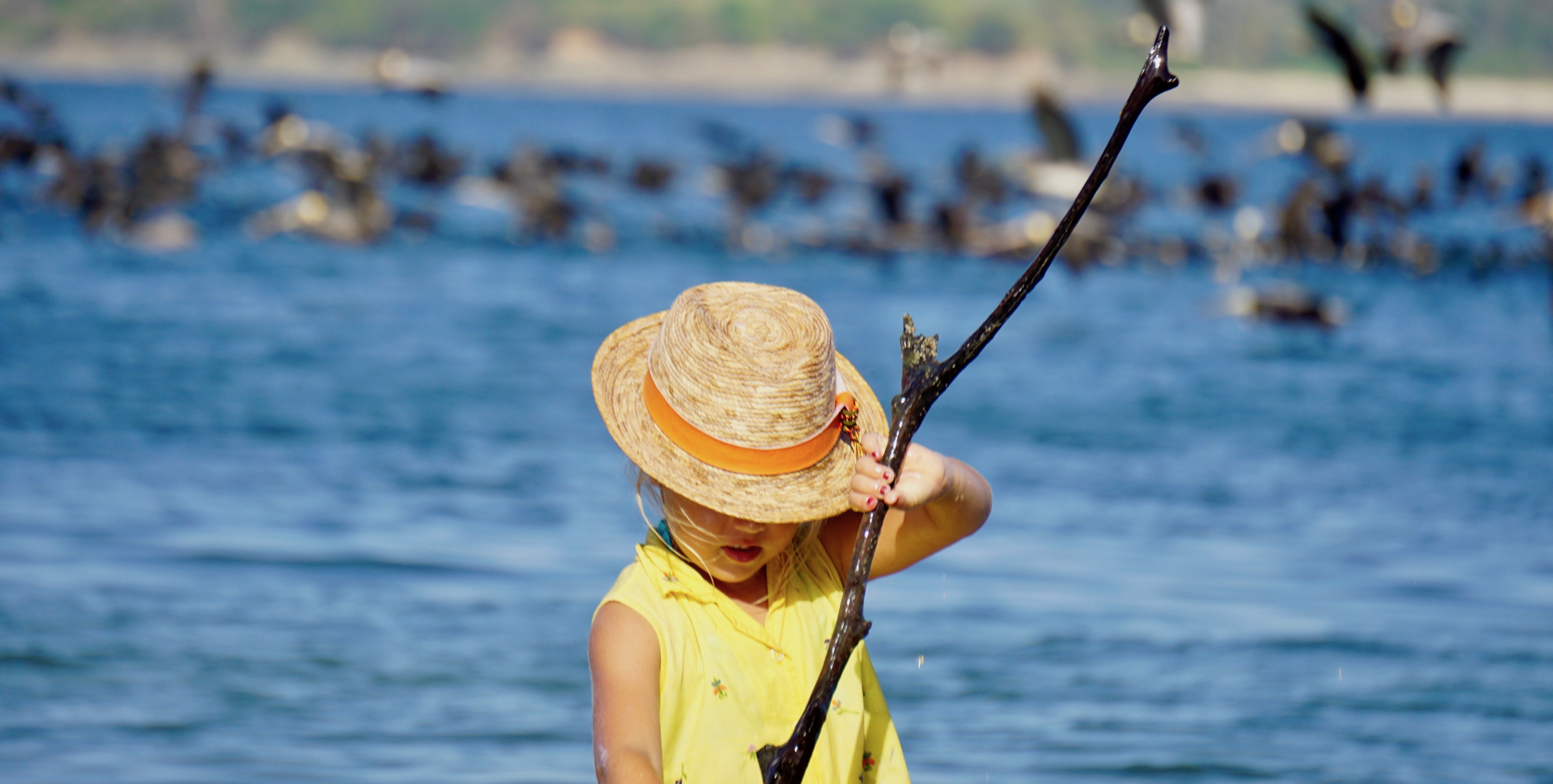
After Isletas Platanal, none of the suggested anchorages seems appealing enough, so we venture deep into a miniature archipelago densely populated by birds.
Half an hour later, with the anchor down, we wonder whether to row ashore in a dinghy whose oars have no rowlocks—the new rowlocks will arrive by post soon—or simply swim straight there, risking emerging from the watery depths right beneath the pelicans’ beaks.
Deciding not to wage war on the frenzied flock, all of us girls pile into the dinghy, while Alexander Palych swims behind to cover our rear; the captain stays aboard to repair the yacht. Nastya and I row out of sync towards the beach, which at low tide turns out to be thoroughly fouled by the birds and smells a little too:).
A bird gathering
Right by the shore, a family of stingrays with barbed tails darts about. No matter how hard I try to capture their portraits, the murky water allows the lens to see nothing but glare.
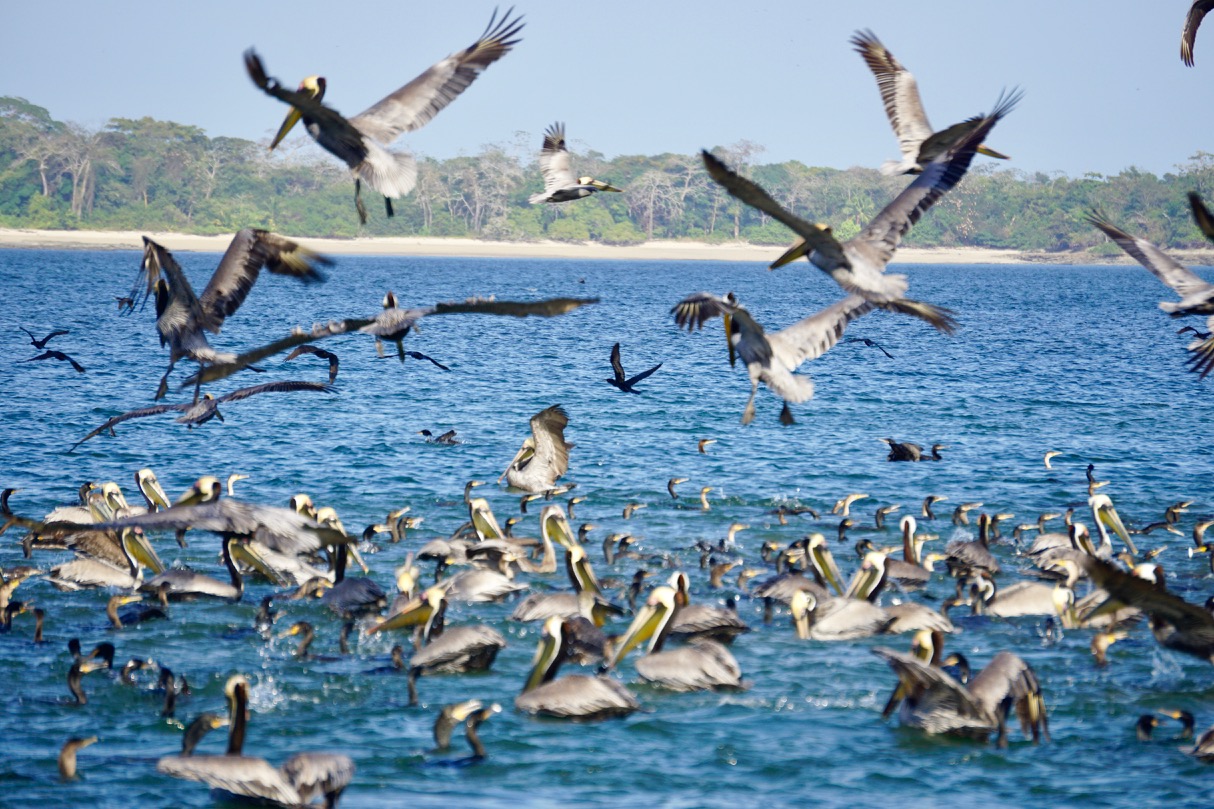
A walk to the far ends of the beach could pass for a special ornithologists’ edition of In the World of Animals. A shoal of fry has just entered the shallows—to their own misfortune and to our and the birds’ delight—and the pelicans, backed up by black ducks, stage a feast. The beating of wings, birds flying back and forth, plummeting like stones and taking off sharply, splashing, thumping and clacking beaks....
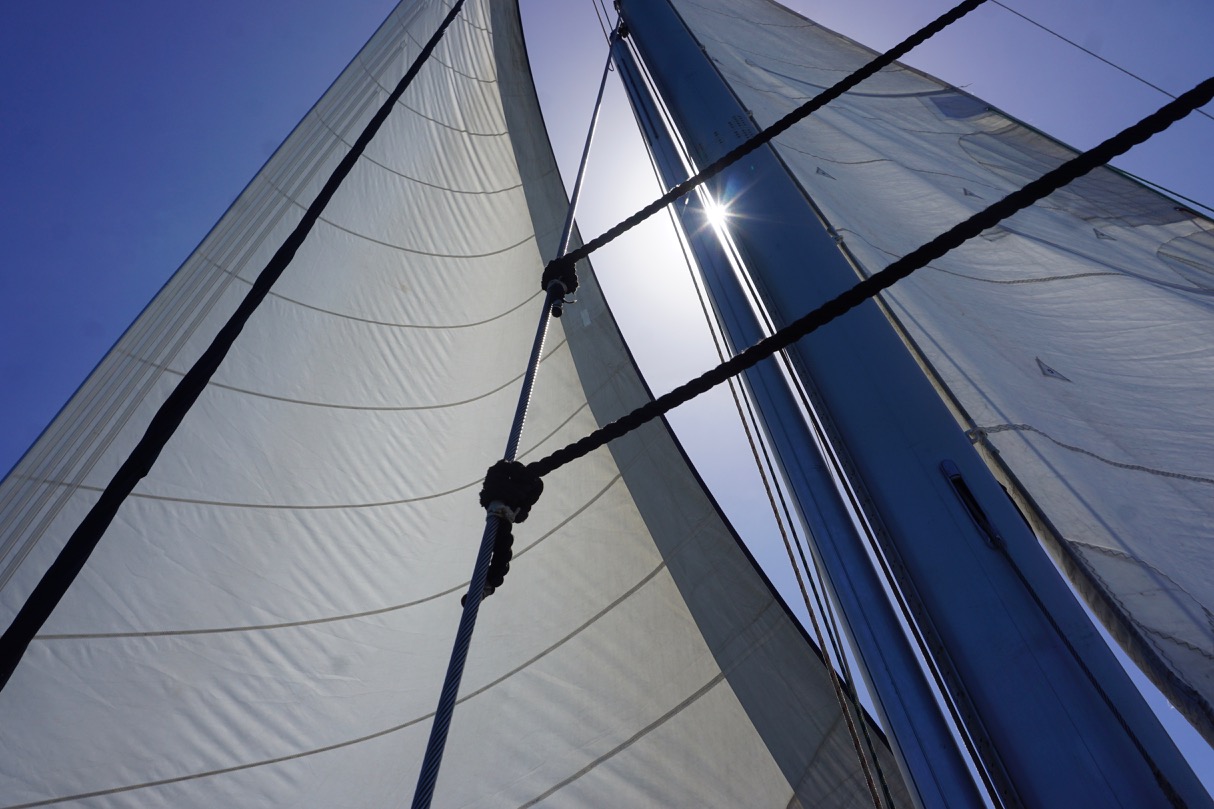
And so we name the island Bird Bazaar. Around the bend, a small bay full of boulders comes into view, where sated birds with no taste for hunting sit phlegmatically.
The sun has almost settled onto the edge of the sea, and we set off towards the dinghy at a skipping pace.
We have to eat dinner standing beside the dinghy, because there is nowhere to sit on the wet, guano-spattered beach. We snack on rice with tinned food and sauces, then set off to row back to the yacht against the wind and current. Just then Andrei sounds a steamship-like blast—either he has already lost track of us or he misses us.
Friday, 9 February.
The return passage from Las Perlas. An overnight stop at the northernmost island.
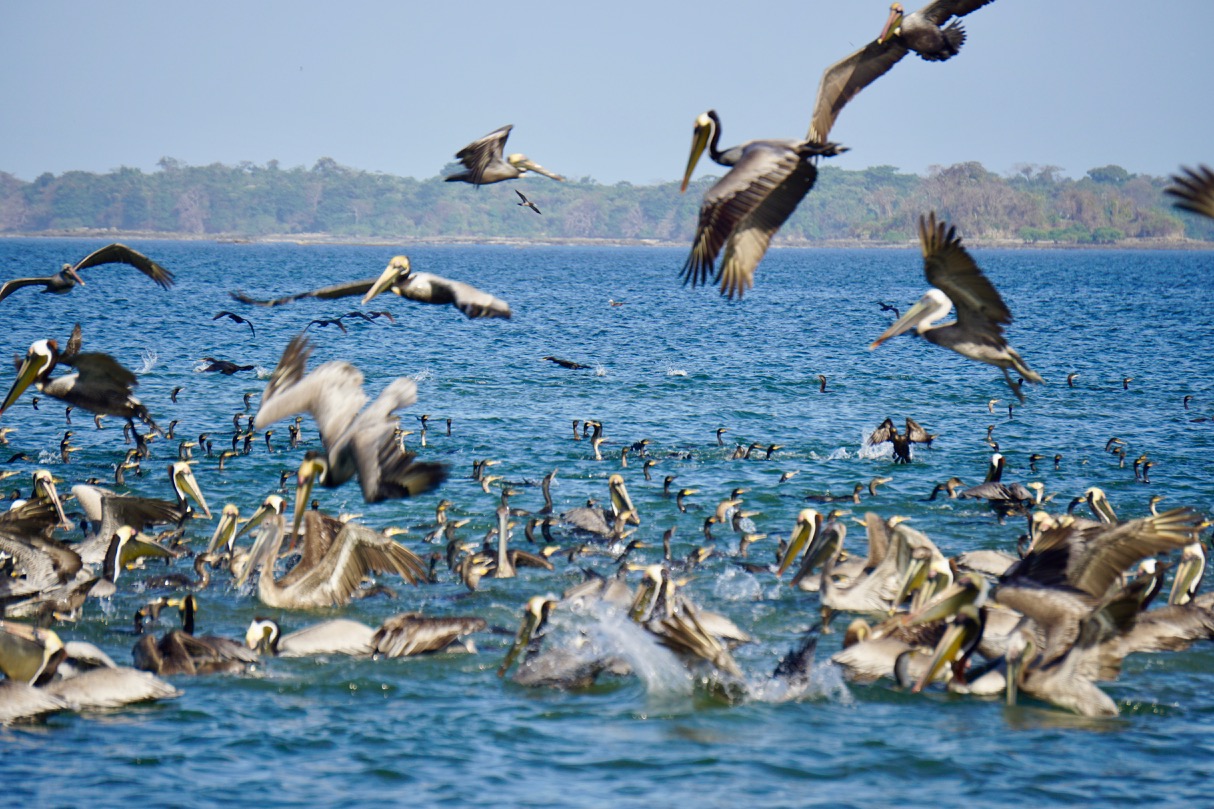
Since 9 a.m., Lady Mary has been gently tacking towards the outermost island of the archipelago. From there it is 30 miles to Panama. The wind blows softly into the sheltered lagoon. Pelicans and black ducks stage a raid on the fry. It is a good thing the first batch of little fish had time to frolic before the winged fishermen arrived and have now lain low like a mat; perhaps some of them will even make it to adulthood.
The islands are scattered thickly across the smooth ocean. Close-hauled under sail, we skirt the reefs, gybe practically on the spot—with a little wheelspin:))—and nearly run into one island, then the one opposite.
The islets are covered in seasonal trees, some of them resting after shedding their leaves. Delicate pink flower buds sprout from the bare branches, creating the illusion of Paris in spring J.
At the astronomical speed of 1.5 knots (about 2.5 km/h), we make our way towards Isla Pacheca. Straight ahead through the haze slumber inhabited Contadora and neighbouring Saboga, where the guidebooks promise diving and snorkelling. But water the colour of the Moskva River greatly reduces our chances of seeing coral and colourful fish. We never do work out why the water is that colour: perhaps because of mysterious currents and rivers flowing into it, or perhaps the devil only knows. We enjoy the views above sea level rather than below it.
Our sailing zigzags allow us to examine every curve of the bays, the golden beaches and the austere basalt cliffs in minute detail.
Flocks of pelicans circle overhead; among them, herons stand with the graceful dignity of foreign guests, while ducks scurry back and forth. We realise that Las Perlas belongs to the birds:).
The puffed-up self-importance of frigatebirds (alas, no photo...)
Once again we swim to Isla Pacheca without the captain or the dinghy, but this time we have fins. The landing could hardly be called gentle: we try not to smash ourselves against the reefs in the surf zone. Our side of the island is uninhabited, and we make our way over sharp rocks and a basalt slab to a beach, from which a concrete path leads to a private villa. Branches with birds’ nests hang over the path. Frigatebirds circle or rest directly above our heads.
And here, for the first time, we see the inflated throat pouches of magnificent frigatebirds from so close... Wouldn’t you know it! The first time I come ashore without a camera, and this is what I get! The scarlet balloons beneath their beaks are about as large as the birds’ bodies and prevent their owners from holding their heads normally, so their proud beaks point straight into the blue sky, while from the ground their eyes cannot be seen at all.
Spellbound, we photograph with our eyes a tree that looks as though it has been decorated with red baubles, then return to the shore—it is time to go home.
We must look very funny and awkward from the side, half-crouching in our fins and trying not to impale ourselves on the sharp rocks. And then there is little Lada: she has no fins, but she is wearing a life jacket, and we have to get her through the surf as well.
At last, our team crawls out into deep water from the narrow rocky nook. Dusk rapidly turns grey. The current that came in with the tide carries us not towards the shore but off somewhere past the yacht, no matter how hard our group in striped swimsuits tries to aim for the bow so that we can climb aboard at the stern. I push the young sailor against the current, while Alexander Pavlovich stays behind, covering our rear, but the yacht does not come any closer; it remains somewhere off to the right. The treacherous current carries us farther and farther away, and at some point I realise that little Lada and I will not be able to swim against it on our own.
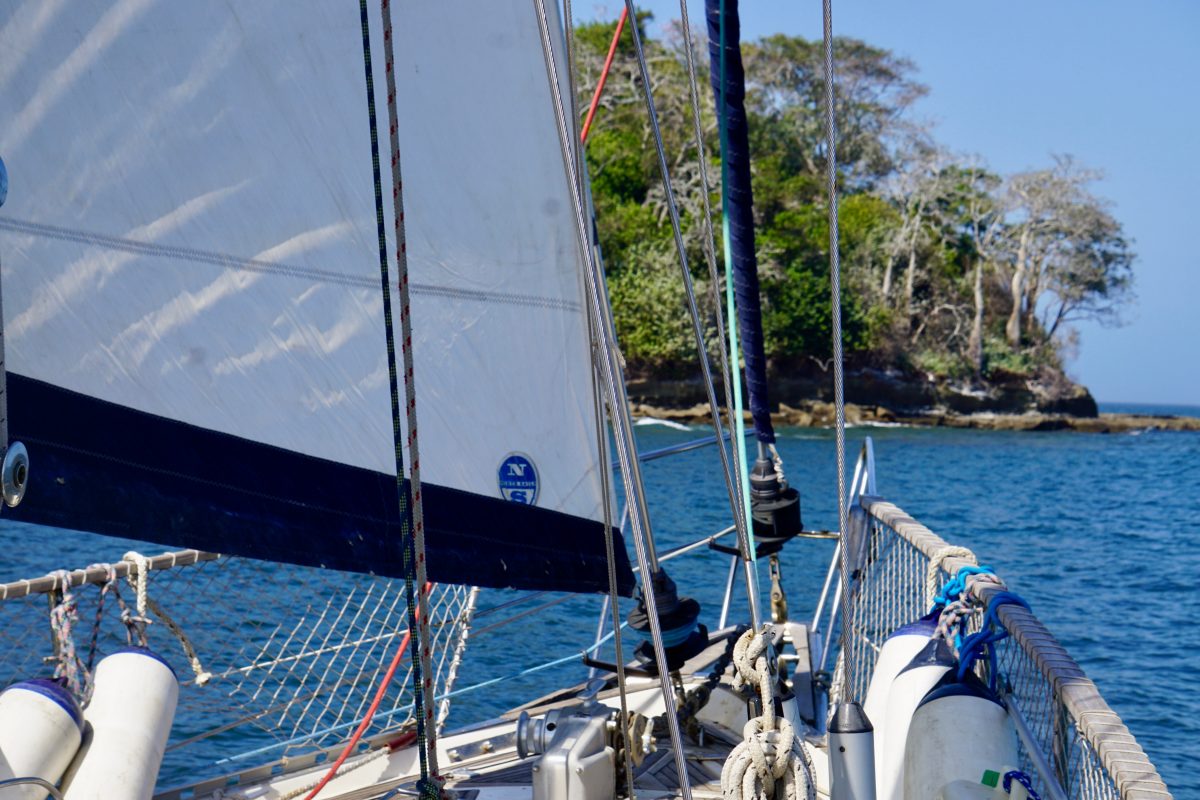
“Help!” I shout to the captain, and thank God he sees and hears us. Ten seconds later, the horseshoe lifebuoy with its 20-metre floating line lands almost directly in front of us.
Elena Stepanovna is the first to grab the horseshoe, followed by the young sailor and me. The captain hauls half the crew to the stern ladder. Breathless and happy, we clamber onto the deck.
That was a good workout:). Tomorrow we set off at dawn.
Weigh anchor!
7 a.m. Course set for Panama City. The holiday is over.
In places, the scenery looks vaguely Mediterranean: rather dry vegetation, white and yellow sandy cliffs. But the “Mediterranean” abruptly gives way to the volcanic Pacific, and you do not even know where the transition happened. I do not want to leave the deck at all; laptop in hand, I hop from one side to the other in search of shade, then sun whenever I start to feel chilly in the shade (!—a great rarity).
Flocks of birds fly past in formation, sometimes only 50 cm above the water, sometimes soaring skyward in perfect unison.
A round-the-world sailing regatta
Between two large islands straight ahead, bulbous spinnakers appear. The captain says it is a round-the-world regatta organised by ARC, a race held in stages. The leg to the Marquesas has just started.
The billowing, iridescent sails draw closer. At the front, a yacht flying the German flag races along with a snow-white spinnaker and dark-grey mainsail. The main fleet follows some distance behind. We pass a Portuguese crew only a few metres away and, looking them in the eye, wish them success in the race. There is something moving about being here aboard our yacht: we are the last people they will see before the thousands of nautical miles to Polynesia.
Then comes pure close-hauled sailing: now it is almost calm, now the wind pipes up. The fishing line crackles, and we land a well-fed tuna. At dusk, still underway and heading straight on, we grill it, accompanied by red wine and talk of Colombian guerrillas—Alexander Pavlovich knows a looot about them.
The next morning, we see our friends off to Colombia. Ordinary yacht life begins.
P.S. By the time of this publication, the crew has briefly visited Las Perlas again and is already on its way to the Galápagos Islands. The passage chronicles are being sent to the website via satellite. Stay tuned:).
Springtime to everyone!