
From the Travely-Family archive · Pacific Ocean
A Month in the Ocean: Provisions and Breakdowns Aboard
An original publication from the former Travely-Family website. This English translation was preserved from the technical-site archive without editorial rewriting.
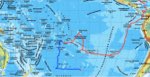
Yesterday we passed the last of the possible locations of Maria Theresa Reef. And we can state with full confidence: there are no phantom reefs in the South Pacific. More precisely, there are only phantoms. Today marks one month on passage. It has been 30 days since we left Bora Bora, and since that first conversation: “Why don’t we head down to the 37th parallel?” We headed that way the very next day. As of today, we have covered 2,500 nautical miles, half of them battling headwinds. Soon we will have headwinds again for a while. Another cyclone has arrived, and it spins the air masses round and round like a washing machine.
So we are making an eastward tack, continuing along the 37th parallel, and then, when the southeasterly wind arrives, we will bear away to the south. It has become damp and foggy again. They say that on the approaches to Patagonia, the air turns into wet cotton wool, with visibility from the mast to the bowsprit. We will be playing blind man’s buff without blindfolds. For now, it is merely damp and drizzling, and when you climb into bed in the evenings, every now and then you remember a third-class sleeper carriage on a Soviet winter train.
The sheets are damp and cold, a teaspoon rattles against a tea glass on the little table—on our boat, it is the tins in the lockers along the beds—and if someone pulled the emergency brake, it would be much like being on the yacht: everyone asleep would tumble against the wall, if there were one. But on the other hand, we are definitely better off. Our hair is not yet freezing to the windowpanes, the toilets are clean, and even the roof hardly leaks....
Thanks to a brief stop at a remote islet in the Austral group, the yacht is still full of bananas, coconuts and pamplemousses—something between a pomelo and a grapefruit. We conquered the papaya by cooking it, though as a side effect of that victory, the gas cylinder quickly ran out. A cylinder usually lasted us three months; this one died after two. We agreed to conserve the gas in the new one, as it is our last. But we will certainly reach land within three months, and even if it is uninhabited, we have matches: we will light fires on penguin shores....
We opened the first coconut, and it was so full of water and flesh that it provided an afternoon snack for the entire crew. Thanks to the captain’s brilliant method, the 60 kg of bananas distributed around the yacht are ripening one batch at a time rather than all at once. After 21 days in transit, some are still green. Here is the method: divide the bunches among plastic bags and stash them in places with different levels of light. Bananas are afraid to ripen in the dark, and some bunches are still lying there in suspended animation.
So the menu includes banana muffins, smoothies, and bananas both raw and fried. The Tahitian apples we bought six weeks ago are holding out to the death. True, only seven survivors remain; all of us share one apple a day. We should have bought more. The onions and garlic still look alive, as does half a bucket of sprouting potatoes, which we are saving....
While the bananas were still completely green, we used them to imitate stewed potatoes with mushrooms. Did you know that if you peel and slice completely green bananas into some kind of stew, you end up with a dish that tastes like potatoes? Brazilian sailors taught us this during an excursion on Fatu Hiva. They also taught us how to find and dig up cassava roots, which can also pass for potatoes. You cannot fool the young sailor, of course, but with no other substantial dishes for dinner, even she had to polish off a plate of banana-potatoes with onions and tinned mushrooms.
Breadfruit poised right at the limit of firmness also makes a marvellous potato substitute. Pick it a little greener and it will be hard and sticky with white sap; a little riper and it turns into sweetish dough. But if you happen to find one at its very firmest, a single fruit will turn into two large frying pans of fried potatoes in just 15 minutes. No wonder England mounted no fewer than two expeditions to Tahiti for it in the late 18th century. The first expedition ended with the mutiny on the Bounty; you can read about it by entering “Pitcairn” or “Bounty” in the search box on our website.
On the second attempt, however, the long-suffering Captain Bligh did manage to bring holds full of seedlings of this miracle tree to the West Indies. And Britain fed its slaves, while breadfruit trees began bearing fruit in the Caribbean as well....
But we have strayed from the subject. We are planning the New Year’s menu. We are saving eggs and one tin of carrots for Olivier salad. After rummaging through the lockers, we found feta cheese in oil, sun-dried aubergines also in oil, some artichokes, and a couple of tins of chicken sausage à la “Tourist’s Breakfast,” which looks as though someone has already chewed it once. That is the exotic selection. All the exotic things will go on the festive table, pimping up the usual dishes. Instead of champagne, we have a one-and-a-half-litre bottle of Fanta and two cans of Coke waiting for us the next morning.
Seawater is seeping into the port locker somewhere, and all the tins in the corner, with their reddish, rusty colour, remind me of my native Ural soil, my place of power. We will stick the little Christmas tree to the shelf with double-sided tape—the shelf everything flew off during that freak wave. On the bright side, after that we sealed the leaking hatches up tight. Seawater is still seeping in at a couple of other places. We are waiting for a dry calm so we can pour the last of the sealant into the suspected leak points—you cannot find them just like that; we need to unscrew a couple of stanchions and fill the bolt holes.
In the worst case, we will put a nappy underneath; we have some. We also need a calm to repair the genoa, our largest sail, yet again. We have taken it down and stitched it three times already during this passage. But it has torn again, and we cannot use it for now, otherwise the foot will flap around separately from the sail. It looks as though we will have to order a new sail once we reach the mainland. Along with the genoa, the foot of our budget is beginning to tear as well. While we have been in the ocean, the wind sensor came off the top of the mainmast.
At first it entertained us for two weeks by showing the wind coming from dead astern while we were battling straight into it; then it hung from its cable. A day later, it was no longer with us. Amen. Now we can only estimate the wind speed with a moistened finger. During the storm, the jib-sheet block fell apart, and the sheet itself chafed through. The captain replaced the former and spliced the latter. A wave knocked the solar-panel mounting loose a couple of times. The panels were unharmed....
The most entertaining repairs involve replacing the windvane self-steering cable. In five-metre seas, with a southerly wind and an air temperature of 17 degrees, the captain dangles behind the stern in his underpants, wearing a climbing harness, while Nastya and I, wrapped up to our ears, hand him assorted pairs of pliers. The ocean at these latitudes is by no means warm, and the water outside chills the fresh water in the tanks. It has been almost four months since the ciguatera, but when I wash, my palms burn as though from a chemical burn.
Almost the same thing happens to my tongue when I drink cold water. Ah, friends, do not eat reef fish in unverified places in Polynesia or the Caribbean. Ciguatoxin puts you out of action for about six months. Should I complain about the aching muscles as well? All right, I won’t. I will merely say that we have not caught fish even once since the ciguatera. Although we can now. But the captain has somehow fallen out of love with the gifts of the sea since then, while I have been indulging in tinned food. Once I finish the last of it, we will finally cast a line.
To be honest, the children and I dream of fried chicken and pelmeni. In Ushuaia, we will buy minced meat and make New Year’s pelmeni—so what if it is a month late? We will also buy felt boots, mittens and plastic sheeting to make a greenhouse in the cockpit. But it is too early to talk about that; it is still a long way off. During the night, we passed the 3,000-mile mark. We have 2,988 miles left before we make landfall, a month’s journey. On the other hand, it is only 833 miles to the oceanic pole of inaccessibility. In about eight days, we will be the people farther from any land than anyone else in the entire world! That sounds impressive....
And a few words about life aboard. The young sailor is devouring Harry Potter with unbridled enthusiasm. She has already started the fifth book. We tried to slow the process down after the second book. For several days, Ladunya tried reading piles of different literature, from Gaidar to Green’s Scarlet Sails, declared all of it boring, and threatened to settle down with Jules Verne as soon as she finished the Potter series. She half-heartedly did some work on her diary and multiplication tables, and reported that Peter the Great founded St Petersburg in 1703.
Then she assured us that she was not at all afraid to carry on reading about wizards—it was a made-up story, after all, and besides, she closed her eyes during the scary parts. In short, she forced us to give her access to the remaining volumes. Now she is teaching all of us the proper way to swish a wand while saying “Wingardium LeviOsa,” not “LeviosA.” We are learning—what else can we do? Nastya has read In Search of the Castaways for the third time—on the 37th parallel, God himself commanded it. In the geographical atlas, she marked the heroes’ entire round-the-world route to the nearest degree and worked out where the Scottish town of Dumbarton and the Irish Sea lie in relation to the port of Glasgow.
In short, she will soon be drawing the world map from memory. A circumnavigation certainly helps with that. The captain and I are slowly editing a video; we will upload it to YouTube when we reach the mainland. By the way, have you watched the new video that appeared on our channel a couple of days ago? It is about everyday life on a yacht when the weather is bad....
Friends, it is time to wrap this up—look how long it has become. Hugs to you from 37° 34′ south latitude and 134° 29′ west longitude. We moved the clocks forward by an hour, so once again the time difference between us and Moscow is exactly 12 hours. Wishing everyone a festive pre-New Year mood! Write to us!