
From the Travely-Family archive · Other Entries
The Ice Continent!
An original publication from the former Travely-Family website. This English translation was preserved from the technical-site archive without editorial rewriting.
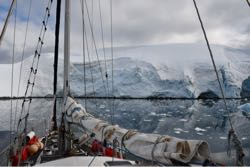
The Ice Continent! The ice conditions have grown more difficult: ice floes and ice mountains are no longer occasional sights that cause amazement. Now they are scattered in a checkerboard pattern, a mile apart. The roughly 40-mile passage from the Melchior Islands to the Argentine station Base Brown requires constant vigilance. At first, Andrey and I keep watch together on deck. Then Nastya takes over the watch. Icebergs of the most bizarre shapes drift past. Here are tongues of flame and the raised wings of a butterfly; over there, framed in blue, is a round window—a tunnel into a parallel world.
A realm of ice and blue water, of eternal winter. First the feet of islands, then peaks of snow and stone emerge from the fog. You never know where the clouds will part next. These openings are like windows into a looking-glass world, with rays from the blue sky sparkling on the icy peaks. The strait narrows and leads to a Chilean polar station. The wall of the outermost building is painted in the red, blue and white colours of the national flag. Judging by the abundance of penguins and the thick stench, the base is seasonal, and there has not been a single person there for a long time.
People could not survive here without gas masks. Penguins are lovely, of course, but it is best not to approach them from downwind. Soon we will round the corner and come abeam of the continental bay, Paradise Bay. There, beside the moraine of a continental glacier, the Argentine base Brown lies tucked away. Its little tower-like building looks like a toy, jutting picturesquely beside an imposing dark cliff. The cliff, in turn, also looks small against the gigantic glacier and mountain peaks almost 2 kilometres high.... From the large bay, the expedition ship Fram is departing; we think our friend Henrik works aboard her, a Pole we met on Easter Island in May last year.
Henrik was delivering the yacht Dana from Tierra del Fuego to Kamchatka, while also sailing an itinerary for his own company, Concept Yachting, which organises yacht tours with a purpose. From Easter Island to Christmas Island, for example. Henrik has worked in Patagonia, the Arctic and Antarctica for many years.... It looks as though we have missed each other after all. Andryukha was somehow too shy to call Fram on the radio and ask whether Henrik was aboard, so we continue on.... A couple of icebergs, a turn around the corner, and we are in the Snow Queen’s realm.
Walls of glaciers surround us on every side; black-and-white cliffs vanish into the Antarctic continent’s low grey sky. Three glaciers slide down into the water, with icebergs in every shade of blue. In this enchanted well, once again we must not only anchor but also secure ourselves with lines to the shores. Today the plan calls for only 2 lines, not four as last time. I will take the lines ashore while the captain is at the helm and the crew member pays them out smoothly. My task is to find a suitable boulder on land, pass the floating line around it, tie a bowline and return for the next rope....
On one side there is a huge rock, but on the other, directly beneath the glacier, we have to find something. Daniil Gavrilov, captain of the yacht RusArc Aurora, said that there was one rock among the pile, a sort of upright one, but the mooring line kept slipping off it. After hauling the hundred-metre line to the stony beach, I was the first of the crew to jump ashore on the sixth continent. The water is like a mirror, reflecting everything perfectly and motionlessly. Quiet pieces of ice drift towards the mouth of the bay; if they make it out on the ebb, they will escape into open water, but if not, they will return to knock against our hull and hang on the lines.
It is hard to row to the opposite shore. Our hundred-metre rope is not long enough, and I find myself in a contest of strength with Lady Mary—sliding stern-first away from the land. The captain extends the line with another rope, and only then do I have enough power to row ashore. I loop it around the more-or-less upright rock; it seems to be holding.... After warming up in the wheelhouse, the girls and I took to the oars and rowed deeper into the bay. Two fur seals are sprawled on an iceberg. Of course, they might be seals, sea lions or leopards, but somehow we have taken to calling them fur seals, so we will assume that is what they are.
I will not describe how beautiful the ice is as it floats across the bay’s frozen glass; once we have communications again, we had better embellish our Antarctic reports with photographs. The underwater parts of the ice descend into turquoise depths. It is so pleasant to float in the dinghy that I want to move away from the yacht, lay down the oars and slooowly watch the icy reflections drifting past the side. When we returned, Andryukha set off to mark his own landing on the continent and glide across the mirror water of the icy well too.
The mountains are so high that our modem has no line of sight to the satellite’s orbit, so we spend two days without communications. But we can hear radio traffic between the Russian ship Akademik Vavilov and Brown Station. Zodiacs—large black rigid-bottom inflatable boats—come from the ship, which is lying in the outer roadstead. Foreign tourists come to gape at the mighty glaciers, which occasionally crack ominously. A lone mountaineering penguin scrambles up a snowy slope. From above, out of the fog, comes the roar of avalanches—or perhaps it is also the glaciers rumbling, the ones that begin almost at the very summits.
It would be nice if nothing enormous collapsed into our bay tonight, otherwise we will have to make a run for it. The captain warns us that we must be ready to cast off the mooring lines and even abandon the anchor chain.... In Antarctica, an anchor watch is needed around the clock. I volunteer to keep watch all night. I set the alarm for every hour. But I run out on deck more often than that, pushing away the constantly moving ice floes.... Our second night in Paradise Bay was even more entertaining than the first. On the eve of 8 March, the ice floes joined forces with small icebergs half the size of the yacht, and I did not have enough strength to push them away.
A small iceberg dropped by to wish us good night. And it liked us so much that it practically glued itself to the hull, affectionately tapping out in Morse code: Greetings from the Titanic—aa-oooh-boom-crash. Andryukha and I rack our brains for some way to dodge it. We start the engine, haul ourselves away... A leopard seal, drawn by the bright deck light, kept trying to climb onto an ice floe beside the iceberg. Judging its size brought the drifting Chelyuskin survivors to mind. Together, the floe and the iceberg extend the full length of the hull plus the bowsprit.
The larger pieces of ice cannot get past the line, so they line up along it, resisting the current and collecting smaller floes for company. You push the iceberg away, and 10 minutes later it is knocking against the hull again. And so it goes all night. For some reason, the peak of their activity comes precisely when you least feel like leaping around the deck brandishing a boathook. The captain stays behind to repel the ice attacks; he is the strongest of us. And for another half the night he churns the blue sea with the line, using the engine to swing the ropes in every direction and drive the ice away.
As for me, I lift my head from the pillow at every new grinding noise... At dawn, the captain goes to bed. When I step out on deck, I discover a handsome iceberg by the bowsprit, with that same nocturnal leopard seal snoring on it. It did manage to climb onto the floe—and was apparently so pleased before going to sleep that taking close-up photographs is somehow... aesthetically unappealing. Judge for yourselves: what is that brown smear, extending from, pardon me, the leopard seal’s very backside, doing on the blue ice crystals? I do not even know how to show people photographs like that. Or is it all right because it is natural? I called the captain, and that was when he enlightened me.
“Marinochka,” he says, “this is my present to you for 8 March. Cool, isn’t it?”
Well, how could I possibly say no? While we were festively preparing to weigh anchor and cast off the shore lines, a female leopard seal arrived on another floe. She was clean, fluffy and aesthetically pleasing, but far from the camera. And she also lay down to sleep.... The girls rowed out to remove the lines from the rocks. They were the only members of the crew who had not yet landed on mainland Antarctica. At high tide, they had to untie the ropes underwater. We try to pull Lady Mary closer to shore using the engine and a line so that we can snap a photograph of the girls on the continent.
We will soon leave this well and regain our connection with space—our mothers have probably given us up for lost by now. To be continued!... Our dear readers, friends near and far! Thank you for congratulating 75 percent of our crew on International Women’s Day! Even in the Antarctic autumn, we felt the breath of spring back home. Thank you for being there for us!... And special thanks to you, true members of our shore-based brotherhood, for supporting the expedition through PayPal.me/TravelyFamily! We thank Sergey K. from Moscow and Dmitry S. You motivate us not to surrender to the ice and inspire people to make their dreams come true!