
From the Travely-Family archive · Cape Horn
A Resort in the Roaring Forties
An original publication from the former Travely-Family website. This English translation was preserved from the technical-site archive without editorial rewriting.
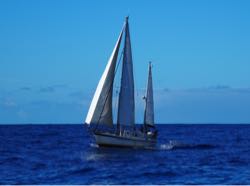
A Resort in the Roaring Forties. “Hooray! We can breathe a sigh of relief—we’ve finally entered the Roaring Forties, Marinochka! Now we’ll really get moving! And look how warm it’s become,” the captain laughs. And we do breathe a sigh of relief; the captain even went out on deck without a jacket. Because it really is warm—we even opened the forehatch to air the boat. We furl the sail without snow, the zone where we might encounter icebergs is astern, and we now run the heater for 2–3 hours instead of 12. Soon we’ll have enough diesel just to charge our gadgets, and we’ll be able to live without heating..............................................................................................
Do you know what you really can’t cross an ocean without? Sails, you think? An engine? Food?....
You can’t cross an ocean without duct tape. Say a storm hits, Force 10–11, like the one described two reports ago. It rips off a couple of solar panels, tears away the netting along the side and a couple of jerry cans, smashes a stopper on the backstay, plus a few other little things. You repair some of it and learn to live with the rest, provided your actual den hasn’t suffered too badly. But it does suffer, robbing you of all comfort, when seawater lashes against the closed portlights above your bed. Well, it doesn’t exactly pour in, of course, but it sprays.
And you can’t get rid of the effects even after the storm: a salty bed is always a little damp, and a very salty one is also acrid and prickly. Waves slosh across shelves that used to be dry, with the plant collections the young sailor and I gathered in Tierra del Fuego floating in them. Salty muck runs onto the bookshelves and into the clean laundry. In short, seawater behaves abominably in living quarters. Then the storm dies down, and you dry and wipe everything, rinsing with fresh water whatever you can. But there is still more than a month to go, and we’re bound to catch another couple of storms along the way.
So it’s all going to pour onto the bed and shelves again, you think gloomily. But there is a way out. For mankind invented duct tape...........................................................................................................................................................................................................
Once calm weather arrived, the captain unscrewed the mounts from the solar panels killed by the storm—the only souvenirs they left us. Then he found and fixed the fault in the watermaker. He had repaired the windvane’s broken control line a couple of days earlier, immediately after the storm. And where does the duct tape come in, you ask? By way of an answer, the first mate went out on deck with a bucket of fresh water, paper towels, duct tape and scissors. She washed the portlights, dried them, and taped over every seam around their edges.
No more leaking. They should be grateful we’d run out of sealant, or we would have sealed them shut for good. We’ll see—perhaps they’ll hold until the Cape of Good Hope. At the next bout of rough weather, we’ll report whether the windows can take the hit..........................................................................................................................................................................................................
The sailor tidied up the galley and washed the deck, while the young sailor mastered macramé and sorted through the bead stash.....
If only the weather were always like this—it’s pure bliss sailing across the ocean. Another couple of knots would be nice, of course. But 4–4.5 miles an hour is still better than two. We’re rolling, naturally, but so moderately that even the mugs stay on the table. And the ocean is beautiful. There—a plastic bottle just floated past. Nearly a thousand miles from the mainland, and it is still alive and kicking. Small mottled birds are sitting on the water around us, like the ones we saw in Antarctica. They won’t swallow it. But some whale might.
Not that the people who throw plastic into the sea care about that...........................................................................................................................................................................................................
If this weather lasts a little longer, the captain may even sit down to edit the film about Antarctica. We really ought to finish it before Africa. It’s a pity we couldn’t land in the Falklands—we wanted to upload a couple of videos to the channel from there. Now he’s bored without anything new. We’ve broken the 2,000-mile mark to Tristan da Cunha: it’s 1,952 miles away on our overall course! Cape Town is another 1,600 miles farther. That makes 36 days under way in total—lovely. Leave us some comments, guys, because we’re bored too, even though this is only our 9th day in the ocean.
Sending all of you a big hello from the Roaring Forties! After winter in Antarctica, they really do feel like a resort, especially in the lull after a storm..........................................................................................................................................................................................................
A huge thank-you for your support, love, warmth and faith in us. We thank our staunch support ashore and member of the shore team, Dmitry S. from the Leningrad Region, for the awesome motivation and substantial contribution to the expedition through Paypal.Me/TravelyFamily!......................................................................................................................................................................................
You can once again follow the expedition in real time on our website under the Route tab, where our Iridium track is displayed. Fixed it! The same map, with the track and details, is available at bit.ly/iridium360. And our coordinates are also updated periodically on marinetraffic.com (MMSI 273334590).