
From the Travely-Family archive · Other Entries
What Dreams May Lead To. A Thriller with Elements of Melodrama
An original publication from the former Travely-Family website. This English translation was preserved from the technical-site archive without editorial rewriting.
What Dreams May Lead To If you are a novice sailor, a voyage on a sailing yacht can bring some unexpected discoveries. Not at all the ones you dreamed of when you heard the words “sea” and “yacht.”
When I stepped aboard my own sailing vessel, I imagined that during a storm (God forbid) I would dash around handling the rigging with aplomb. And the rest of the time, just as skilfully but at a more leisurely pace, I would set and furl the sails, master the sextant and other navigational gadgets, write a great deal, read, and so on and so forth. And off we went to cross the Mediterranean lengthwise. In winter.
After four months of life at sea and a succession of three-day passages, exhausted by seasickness and our first thousand miles, I wrote in my diary with a trembling hand (March 2014):
4 things Jules Verne never told me about:

1. You get seasick even if you have never, ever suffered from motion sickness before. On a yacht you get seasick SO badly that it is almost incompatible with being alive. Always, whether under sail or under engine. A mild-hangover state (to which the captain is immune, while the rest of us have resigned ourselves to it) turns into a severe-hangover state depending on the strength of the waves and wind.
Nastya and I had the pleasure of experiencing the latter for the first two of the final three days of our passage from Rome to Sicily. It was hard even to sit up in bed, because the urge to puke hit straight away—pardon my French.
We were sailing in 30–35 knots of wind (close to storm force).
And if, lying like a vegetable in the aft cabin at night, I suddenly stopped hearing my husband’s feet pounding overhead, I would begin to fear in earnest that he had long since been washed overboard and our ship was hurtling on, uncontrolled and under full sail, like the Flying Dutchman (another object of my childhood dreams, which, as everyone knows, came to a bad end).
This time Nastya got seasick even in her sleep. At two in the morning, the poor child could barely make it to the side in time to summon Ichthyander properly from the depths.
One small detail: if you summon him at night in squally winds and five-metre waves, you may meet him very soon indeed. At the bottom. So while running, you have to manage to put on a life jacket and clip on to the shrouds. Not to mention such trifles as getting dressed (+10°C and rain) and tying your long curls back in a ponytail...

Remember the law of universal gravitation and take a look at the yacht’s heel )
2. Sleeping is impossible too
Unless a fore-and-aft-rigged vessel is sailing downwind, it will inevitably be heeling hard.
What does heeling hard mean? It means sleeping on the wall (fortunately, the berth meets it along three sides).
That would be fine, except that under these circumstances only one person can sleep there, and only someone who loves sleep more than life itself:). Because all your other bedfellows (read: children aged twelve and two) topple on top of you. Or, God forbid, you topple on top of them. We often lie crosswise on the berth, with our heads towards the higher side, but first of all, that means sleeping upright—or, when we tack, standing on our heads...
Take another look at that heel )
3. Something is crashing and banging all the time
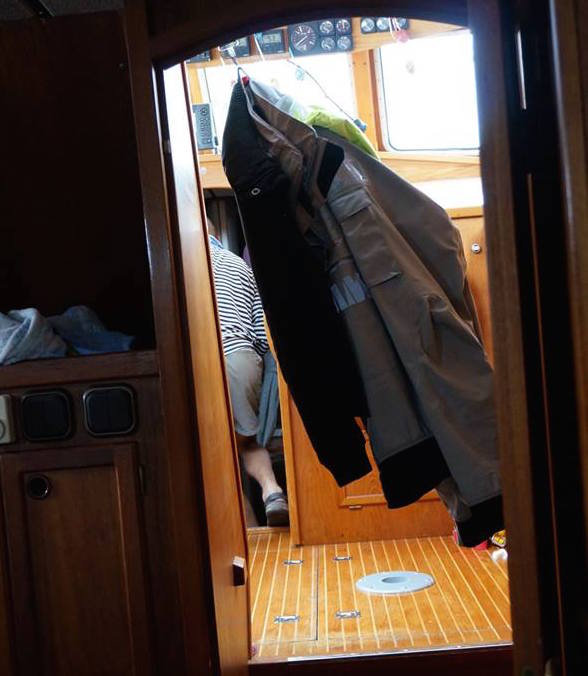
When the boat is rolling, everything that has not been lashed down tight and padded with all manner of rags rolls about and rattles. On top of that, the sails flap and the rigging hums (the ropes and wires, that is). And the boom swinging across during a tack (you know, when the sail, together with the great club it is attached to, was pointing one way and then suddenly flies the other way of its own accord) shakes the entire vessel worse than an earthquake...
In the midst of this whole... dream, only Andryukha is functional. He monitors the situation all night, bounds around the deck and cranks the winches.
“How does Nastya study on board?” people ask us. The answer is: studying under these conditions is simply unrealistic. On this passage, my daughter’s and my attempts merely to discuss reducing fractions to a common denominator petered out after fifteen minutes, because any movement of the vocal cords triggered the gag reflex...
4. Another interesting experience is loneliness
When you race around the sea in winter, even if you stop in ports, they are foreign ports, among strangers speaking a foreign language, and an overwhelming sense of loneliness descends on you. You miss your family and friends terribly. You want your mum; you want to have a chat with a girlfriend... It feels as though no one in the whole wide world needs you. The first month was especially hard for my elder daughter and me; then we gradually got used to it.
The only person waiting for us anywhere in Europe was our friend Masha in Rome. But we sailed away from her, so our next stop in the port of “Love and Friendship” will not be for another month and a half, in Siberia.
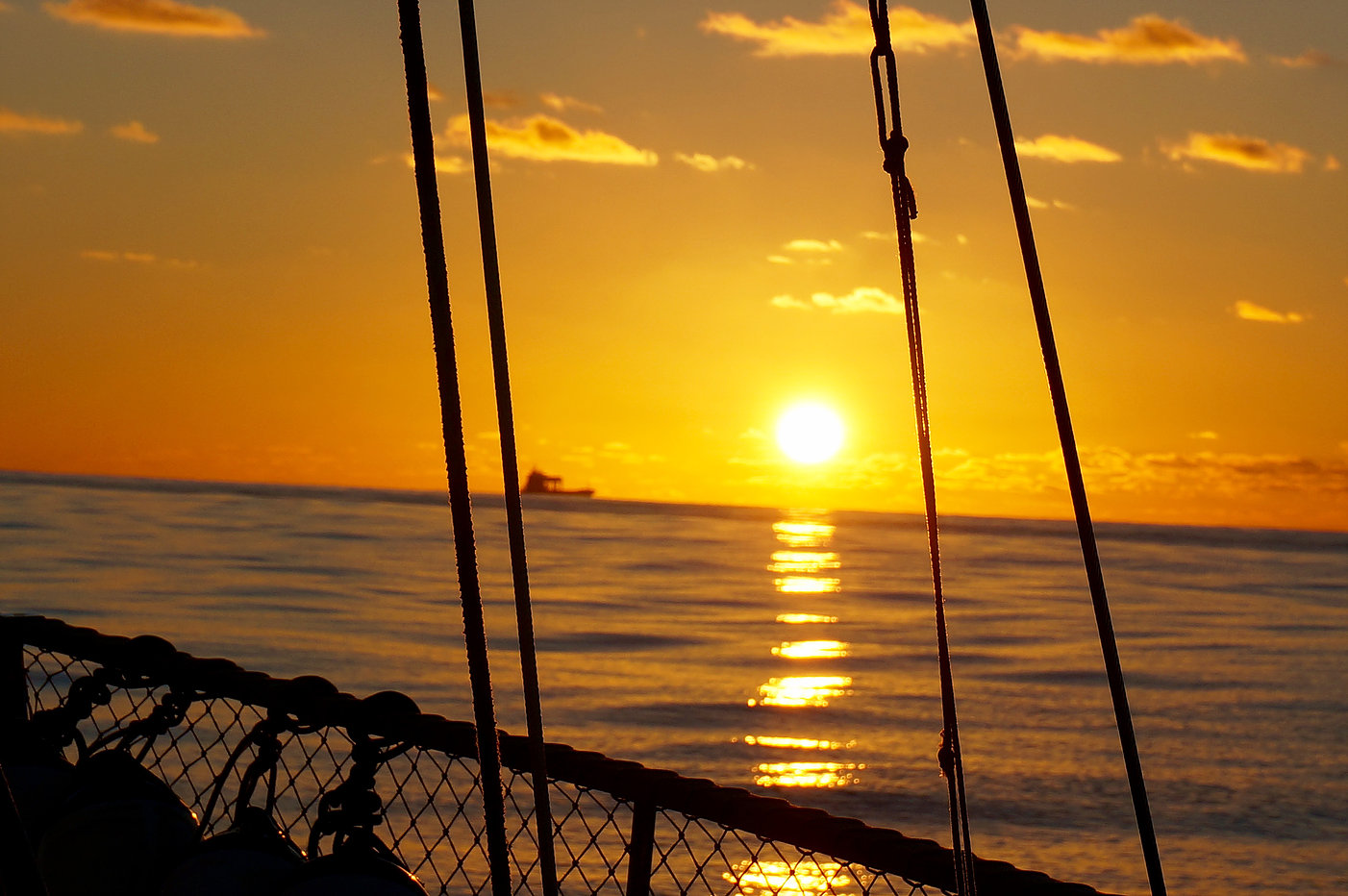
The feeling of loneliness only intensifies if, out on the open sea, it suddenly occurs to you that land is actually just two kilometres away....Straight down.
That is why you begin to feel warmly towards the crews of vessels passing on the horizon: it is precisely then that you realise that, apart from you and your crew (=family), there really are other people in the world. I wonder what brought them here—necessity, a calling, dreams?
Dreams and the sea. And people
So there we were. Winter. The Mediterranean. Waves. More than a day from shore. Nastya and I would lie there, moaning, periodically crying and praying, and I would say, “Nastya, you know, most of the people we know are jealous of you right now.” ))) Because most people’s idea of being on a yacht is like the one described here— Montenegro by Sea