
From the Travely-Family archive · Central and South America
Colombia–Panama. Passage Chronicles
An original publication from the former Travely-Family website. This English translation was preserved from the technical-site archive without editorial rewriting.
Colombia–Panama. Passage Chronicles
The drug traffickers’ route. From calms to squalls, a broken mainsail fitting, a headwind, anchoring in pitch darkness among reefs. Now we are illegal immigrants in Panama
The next stage of our circumnavigation has begun: Panama and the transit through the canal into the Pacific Ocean.
As we left Cartagena, we kept catching the last scraps of mobile reception for another few hours, and that was the last contact we had for the week that followed.
“Be careful,” the old Cartagena hands warned us. “This is the drug traffickers’ sea route. They travel at night with no lights. God forbid you should run into them.”
That cheered us up no end, and we sailed into the night. The first mate even persuaded the captain to motor for a while, because every day we spend wallowing in calms cuts into our time in San Blas, the archipelago of the Kuna people.
The night and morning winds argued among themselves for a long time, which manifested itself in slatting sails, the traveller car roller persistently rattling against the bulkhead, and frequent changes of tack. A broad reach finally won, and we continued south-west towards the San Blas archipelago.
At 10:30 a.m. on the second day, Lada and Andrei proclaimed at the tops of their voices, “Land!”—and now we are already peering at a chain of grey hills embossed along the horizon beneath the edge of dismal clouds. The Panamanian coast is rapidly taking on clear outlines, and even the sky above it is brightening. No more than 20 miles remain to the San Blas islands, and, if the pilot books are to be believed, we are heading for the most beautiful place in the archipelago.
Everyone aboard is busy with something
We are reading the Panama pilot books carefully, doing a physics assignment, listening to the fairy tale The Seven Underground Kings, and translating interview questions into English.
Is it time to celebrate our arrival?
Evening is drawing near. According to the pilot books, it’s 20 miles. Yes. But judging by the strengthening, bloody, headwind, we’ll be lucky to reach even the first little island before dark. It is 12 miles away, the wind and waves are coming straight from there, and there are about two hours left until sunset.
Over the past twenty-four hours, the wind has blown from every direction in turn, making a full circuit around Lady Mary as she stubbornly fights her way south-west.
At first, the headwind was not particularly stressful—there was just a little more heel, and waves periodically washed over the bow—but by lunchtime the wind had come directly onto the nose, and we began zigzagging from tack to tack.
I dislike a headwind not only because of the heel, the pitching, the whistling and the waves on deck. I dislike it because it wears you out as if you were racing along at 8 knots in near-storm conditions, while the speedometer delivers the dull truth: 2–3 knots. With the same strength of following wind this morning, we were making 6.5 without breaking a sweat. (We have a heavy, non-racing boat; 6 knots is an excellent speed for her.)
Will we make it or not?
The archipelago is thoughtfully protected by nature with barrier reefs and reefs of other kinds.
“If we don’t make it before dark, we’ll tack out to sea for the whole night and approach the islands in the morning.”
Meanwhile, the Panamanian coast, which had begun to emerge, dissolved into the inky clouds. And the wind ought to have blown all that blackness away by the time we arrived, because it was coming from exactly that direction, but for hours now we have been sailing right along the edge of this—pardon me—shithole, and it seems frozen in place. And, for good measure, it keeps spitting stronger gusts at us.
Dog the hatches. Reef the sails. Second reef—no, third. Watch for half an hour. Back to the second.
“Maybe we should reef the genoa?”
“Too early.”
“Yeah, you said that last time too, when we got caught in that storm off Cartagena—”
“Reef the genoa.”
We tear along under a scrap of genoa and the mainsail with the third reef in. The captain tries starting the engine. We shut it down again. With the engine we can at least go where we need to, but more slowly. The head sea won’t allow it.
What’s going on inside? I go down to the galley. There is water on the sole: the hatch is giving way before the fury of the waves. I look into the forward cabin; everything should be all right in there. Yesterday Nastya dogged the hatch tightly, and it is also covered from outside by the dinghy.
The next wave smacked me in the face, twisted in astonishment in the dimness of the forward cabin. Good heavens! The hatch is slightly open, the bedding and pillows are soaked through, and the brave stuffed dog curled up in the corner has been snuffling through a salty nose since at least last night.
Well, here we are.
“Young sailors, where are we going to sleep tonight?”
We never did solve the mystery of who opened the hatch and forgot about it. Everyone swears they never so much as touched the hatch cover with a finger.
Duck! The mainsail’s coming down
The sun is setting into the clouds, and the island is still 9 miles away.
“Mum, what should I put on? I’m cold.”
That’s little Lada. Ha—the first time in six months aboard the yacht that we have needed to put something on to keep warm. Although there is hardly any rain, the wind is hammering away for all it’s worth, the waves are disrupting our plans, and the first mate is already wondering whether to send the younger sailor below before something happens.
And then the sail comes flying down on top of us.
We recently removed the lazy bag for repairs, so the mainsail comes down beautifully, its halyards tracing unimaginable aerial dance steps.
“The halyard!? What is it?”
“No, not the halyard—the sail.”
We gathered the mainsail into a heap. The ring with the halyard remained at the masthead. Sensing that it can now get away with anything, the genoa alone keeps trying to bear us away towards the shore. We need to set the mizzen. Right—and the awning is there, and it is sewn on: our awning’s final swan song J. Now it can only be removed once, until we get a new one made. And without an awning under the blazing sun, it would be worse than going to the beach on the first day after winter.
“Furl the genoa, start the engine!” the captain orders.
The young sailor routinely switches the battery selector to 2 and turns the key.
We have almost entered the island’s lee. It does not shelter us from the wind yet, but it flattens the waves. And Lady Mary flies into the wind at 6 knots through the water, 5.5 over the ground.
In the thick dusk, we skirt the shoal between the first little island of the San Blas archipelago and the hills of the Panamanian coast.
We will spend the night here.
Torch, anchor. 50 metres of chain. Full astern. It’s holding. Foam growls along both hulls astern. Full astern again. With the chain taut, we do not bounce back as far as the foam, but the torch beam is already picking out coral heads on the bottom.
“Take in 10 metres of chain!”
“Aye, sir!”
And we take in the chain, hoping we will not have to re-anchor. Half a day of a hard beat to windward has exhausted the girls. On top of that, Nastya banged her ear against the bulkhead in the swell, Lada is hungry, it is pitch-black, and, well, everything.
I promise them a warm shower from a plastic bottle, Olivier salad and a “squirrel film”—that is what our family calls light films the whole family can laugh at.
It is high time for a break after two seasons of Narcos, when Lada watched her own films by herself. We did not let her watch Narcos, after all.
A misty morning
We are holding well. There are 3–4 metres under the stern. The waves whisper tenderly on the reefs. The Panamanian coast winks at us with a couple of small villages, while the two little San Blas islands are dark; the crabbers’ solitary torch does not count.
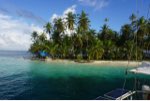
Last night it seemed there was not a single structure on the islands; morning gave up the night’s secrets: there are one and a half houses. The roofs are partly covered with corrugated metal, partly with palm leaves. Reed walls, a plastic chair under a palm tree. The window is curtained with something bright red bearing lettering that looks like the name of a well-known drink. A guy with dark features is gathering coconuts. As for electricity, there is just one light. J
Once, there was no corrugated metal on these roofs, and there were loincloths instead of black shorts. And no plastic chairs or Coca-Cola.
Otherwise, little has changed. And I am glad the islands are so small that there is no point bringing cars, concrete or even a bicycle here. Otherwise, the sight before our eyes would be completely different.
I’m off on my morning photo hunt.
Sunshine to everyone!