
From the Travely-Family archive · Pacific Ocean
How the First Mate and Nastya Sailed the Yacht
An original publication from the former Travely-Family website. This English translation was preserved from the technical-site archive without editorial rewriting.
How the First Mate and Nastya Sailed the Yacht.
Squall-force winds and a gigantic catch. The strange ways of the trade winds and a reunion with friends.
I Go to Haifa (have you read that book?) 🙂
We decided that Nastya and I would sail the yacht away from Fatu Hiva. The captain would take on the role of observer: we’ve been living aboard for five years, yet we’ve never once sailed her on our own.
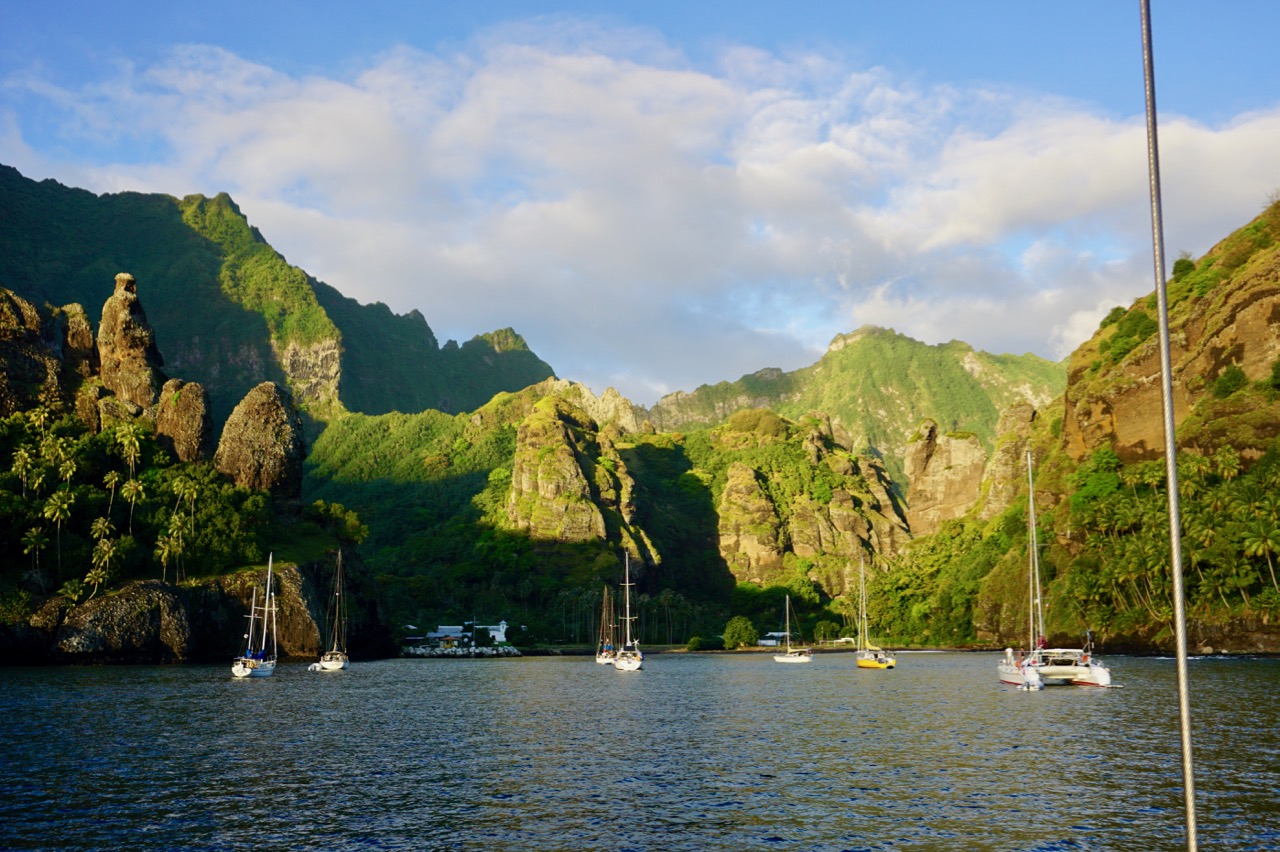
The evening before, we plotted a course for the nearest island, Tahuata, about 45 miles away. We said goodbye to the policeman, Poi, his wife, and his jolly mother-in-law, who had treated us to fruit and fried taro (as well as internet access). We also said goodbye to our neighbours in the anchorage—the catamaran AZYU, with two little girls aboard—and agreed to meet up on Tahuata. We manoeuvred among the rocky wings of Hanavave Bay, hoisted the mainsail, and set a north-westerly course.
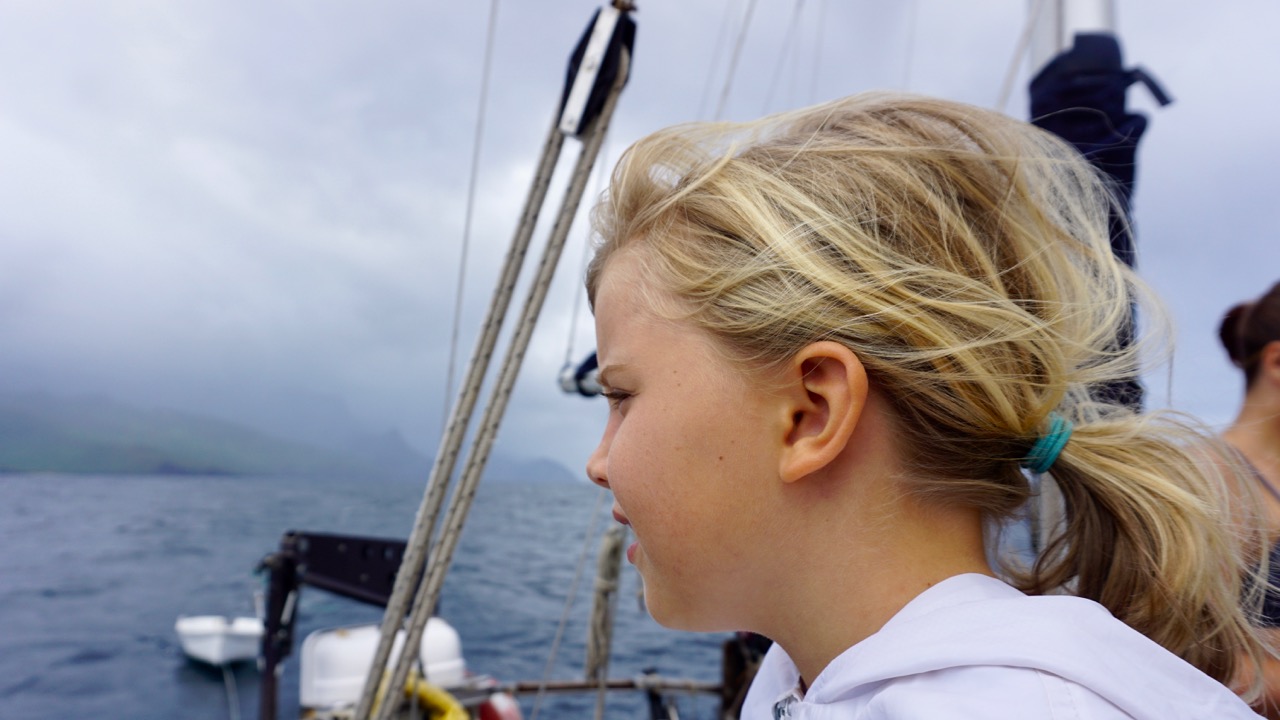
This is the young sailor and me the day before we sailed out of Hanavave Bay on Fatu Hiva. We’ll add a couple more photos of the bay at the end.
The captain’s assistance was strictly advisory:
“Are you planning to use the windvane?”
“You bet!”
“If I were you, I’d hoist something else as well.”
“What would you hoist if you were us? The genoa? The staysail?”
“...Hmm... What is there to hoist? There’s no wind yet...”
And indeed there isn’t. We motor for half an hour to get out of the wind shadow of the high island, hoist the genoa and, under the captain’s ironic gaze, busy ourselves with fine-tuning the sails. Sheet the genoa in a little, ease the main. Air is spilling from the upper part of the mainsail—what do we need to do? Correct: tension the boom vang. Adjust the windvane a little more...
Nastya and I furrow our brows under this hitherto unfamiliar mental strain. The kettle is boiling, the porridge is steaming, and our mouths are watering. What can you do—force of habit: once we’ve set off in the morning, it’s time for tea and breakfast. The captain booms:
“Where’s my captain’s tea?”
“Coming, coming, darling, you’ll get it.”
That’s how it usually goes. But today the captain neither puts the kettle on nor takes the helm. Nor is he demanding his tea with quite the same authority today. Meanwhile, everyone’s stomachs are rumbling... It’s awful how badly we want tea! And porridge... mmm... millet porridge.
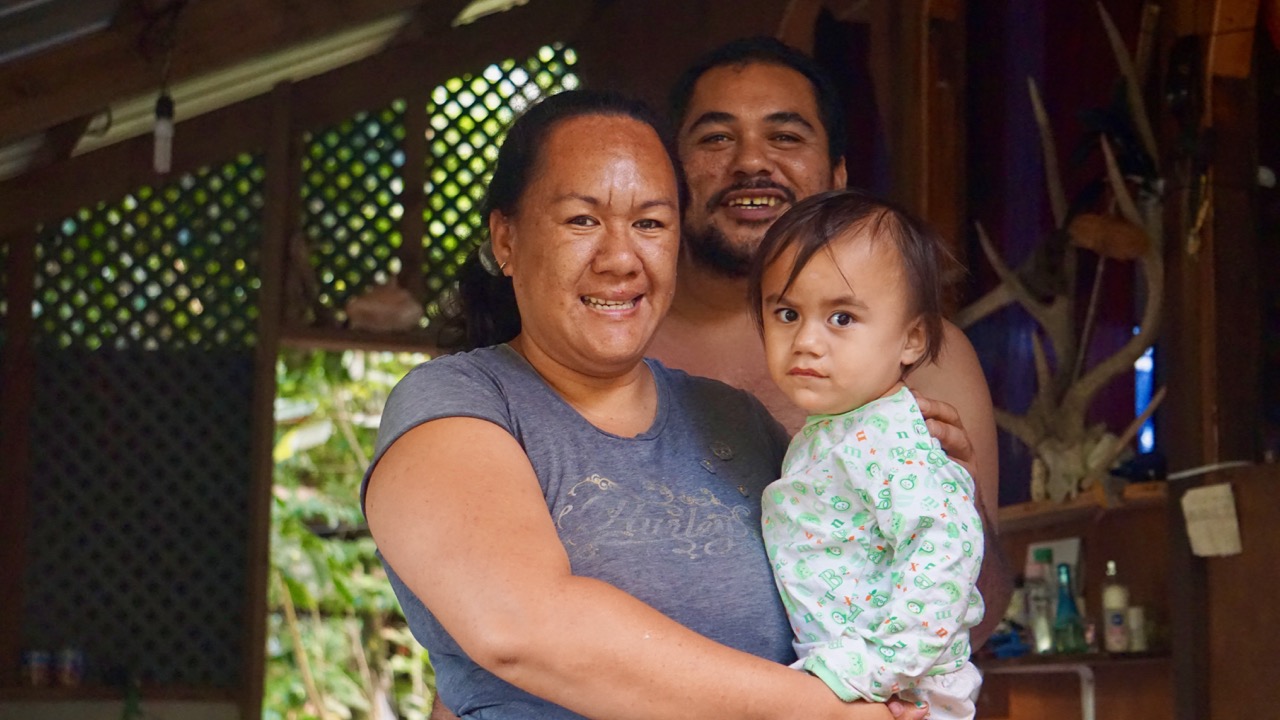
This photo has absolutely nothing to do with that—it’s of some native Fatu Hivans. Hope you don’t mind? 🙂
This is Poi, his wife Reva, and their little son Pascal. Their family provided us with all our internet access and authentic dinners.
The Squall
In between hauling on lines, I finally pour myself a mug (the captain, naturally, got his ages ago—what else could we do?). I’ve only just raised it to my lips when... whoosh—it blows! Dark clouds have been roaming around, and a squall has come out from under one of them. Thirty knots (1 knot = 1 nautical mile per hour), from a standing start. Tea can go to hell. Porridge too. Ladushka has wedged herself onto the deck beside the mizzenmast, balancing two plates—hers and Nastya’s.
“Well, bloody hell!” I think. “That’s me luffing up, then!” (In other words, I’ve turned the boat’s bow into the wind.) “Bloody hell, listen to it whistle!”
“Are you going to reef the main?”
And Lady Mary is bucking along, hands on hips. We’re flying at 8 knots with a heel on. The tea is flying too, spilling everywhere, and the porridge has gone by the wayside.
“Andryukha, will you take the helm?”
“I will. What else can I do?” After all, our captain today is supposed to be a sort of half-trained sailor.
“What do you mean, what else can you do? Steer!”
Nastya and I dash up to the deckhouse through the salty shower to put the main on its second reef. Ease, tension, catch, tie... The halyard snags on the spreader (that metal thing sticking crosswise from the top of the mast—not very far, mind you; don’t confuse it with a yard). Forward, back, jump, wash our faces in salt spray, untangle it. Done. Now we reef the genoa... We’ve shortened sail and settled onto our course. The squall smirks, blows once more for good measure, and flies off to chase the clouds.
That first mug of tea goes down a treat.
“Oh, look, look!” the young sailor shouts. “The catamaran crew have left the bay!”
Sure enough, our friends have hoisted sail. Well, they’ll get there fast: they have 47 feet of length and two hulls. For example, the passage from the Galápagos Islands to the Marquesas takes ordinary yachts 25–35 days, and the particularly fortunate can take as many as 60; the catamaran AZYU made it in 15. If only we could do that...! Nastya and I dream again. And then the fishing rod starts screaming!
The Biggest Fish
“What,” I say, “shall we furl the genoa?”
“Yep! And pass me the fighting belt too.” Well, the captain had only sworn off sailing the boat, not fishing.
We furl the genoa.
“What’s our speed?”
“Six knots,” I drawl in surprise.
“Drop the main.”
No problem for Nastya and me—we’ll drop it. It’s always easier to tear something down than build it up. And the fish we’ve hooked—whew! (The internet refused to upload its photo here; it only allowed it onto our Instagram:). Follow us; it’s good over there too.))
The rod is bent in an arc. Good thing that after our failed attempt to catch a two-metre marlin, we lashed it down more securely; it used to be rather flimsy.
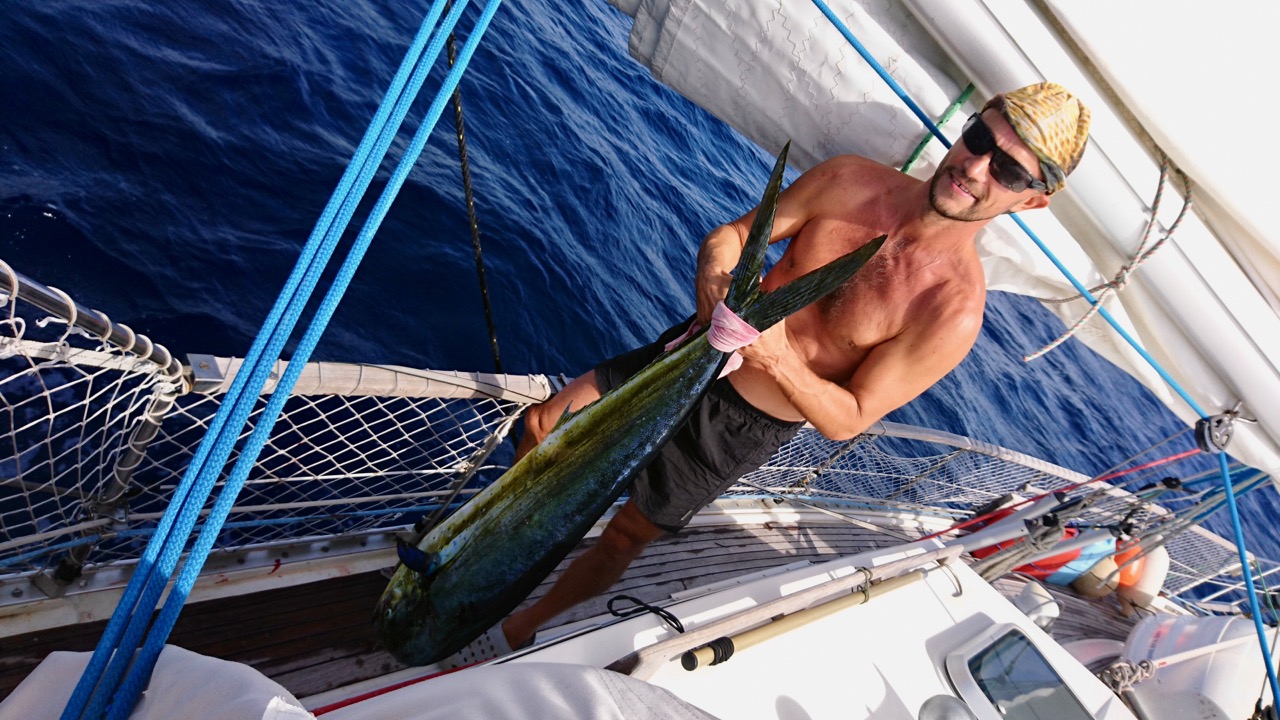
Andryukha spent about 40 minutes fighting the fish. A huuuge mahi-mahi, beautiful and radiant, blue and yellow. You almost feel sorry driving a hook into the side of something like that. I always feel sorry for them. Makes you want to give up eating fish altogether (.
“Lada, bring the rum!”
Not for me—for the fish. So it won’t suffer.
Meanwhile, the catamaran has caught up with us. They call over the radio:
“We thought something had happened, so we were racing over to help.”
“A fish happened—a huge one, up to the captain’s chest. We’re inviting you over for a barbecue tonight.”
“Hooray!” they cry aboard AZYU, before disappearing into the blue distance.
A New Island and a New Squall
By lunchtime, we too are abeam of the new Marquesan island. The first bay is the main one. Jungle, several houses, a cross on the mountain, even some sort of chimney. Nope—our friends aren’t here, and after Fatu Hiva it’s not particularly beautiful either. One mast is sticking up in the second bay, but it isn’t them either. We continue on. The wind deceptively dies, then immediately picks up directly on the nose. We start the engine. The captain-turned-sailor and I take turns steering. Then, out of a ravine—whoosh! We have no sails up by now, but it blows a proper 36 knots.
The catamaran crew recorded 40 in the same spot. Under the pressure of the wind, Lady Mary alters course all by herself, heeling to port. We don’t even have to turn the wheel to round the headland. On these southern Marquesas, the trade wind behaves very suspiciously. The kilometre-high mountains appear to shelter you from it, but in places the wind breaks through the blockade and comes crashing down in gusts of 30–40 knots. And where there isn’t a gust, the easterly trade wind blows from the north-west. We ran into the same strange carry-on later on Hiva Oa, when we tried anchoring in a north-western bay. But more about that later.
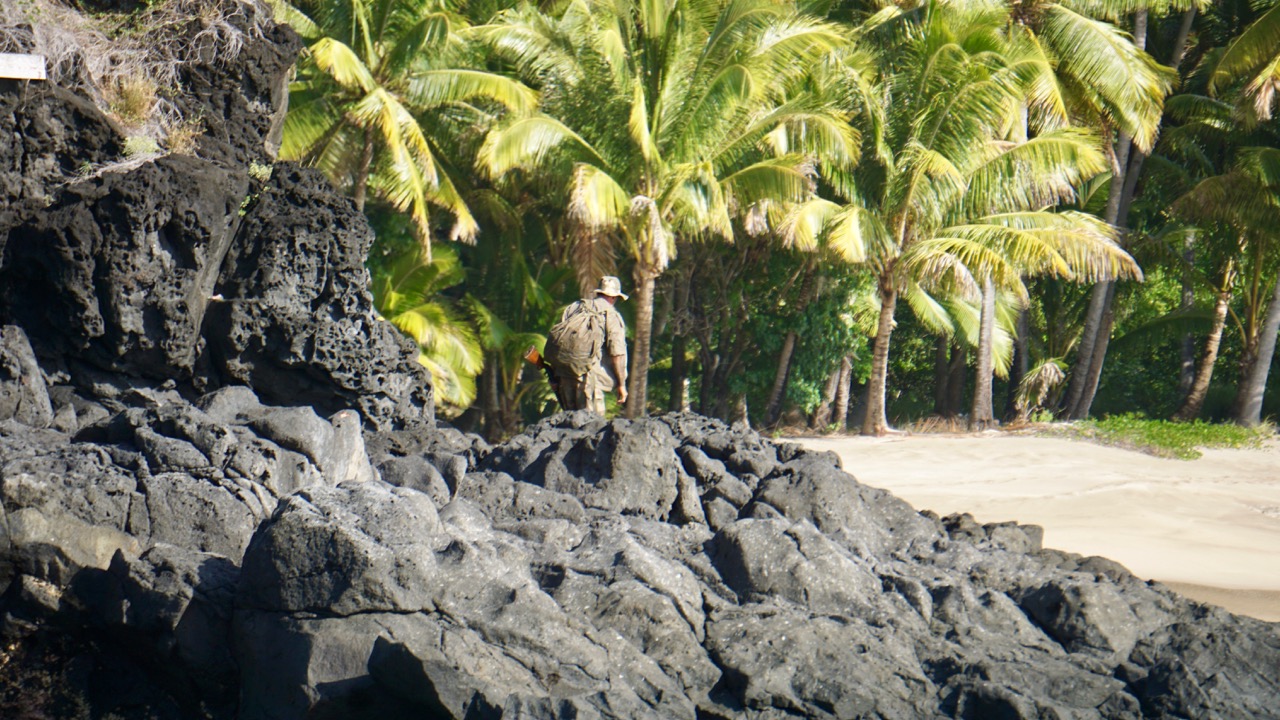
A Marquesan hunter with a rifle in our new bay on Tahuata Island
The next bay opens onto a sandy beach. Hooray! We haven’t had a beach anchorage since Panama. On shore there are just two or three little houses sheltered by coconut palms, and no one around. To the left, in the bluish haze, lies Hiva Oa, only 6 miles away.
Our Lot Are Here
There are only four yachts in the bay, and they’re all our friends! The yellow boat belonging to the French couple Didier and Chantal is called “Mahana,” but we simply call them “the Yellows.” The second is the catamaran AZYU with the children, and the third are “the Manaia crew,” our old friends (at sea, if you’ve shared as many as three anchorages with someone and become close, they’re already old friends), Tommaso and Rosetta. We became friends back on Easter Island. Then we met again in the Gambier Archipelago, where Rosetta, having no granddaughters of her own nearby, knitted Ladushka a beautiful pink dress. We waited for them on Fatu Hiva, and now they’ve waited for us here.
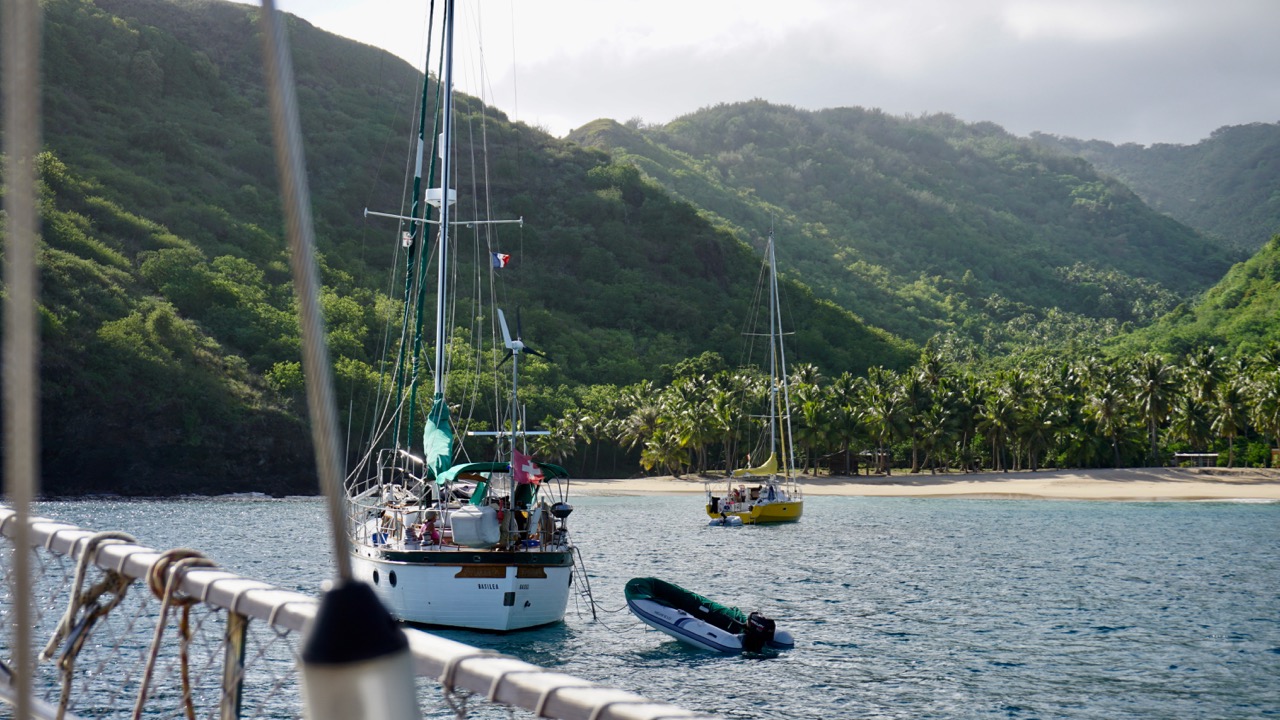
Manaia and Mahana—the boats belonging to our friends
The families with children are already swimming.
“Can I?” Ladushka asks, looking hopefully into our eyes.
“Go on, jump!” And the young sailor dives over the side without waiting for us to anchor.
Having assessed the situation, Jérôme, the catamaran’s captain, rightly decides that we should all have the barbecue together—and there is no better place for a large gathering than their cat. That evening, every crew heads over for an international barbecue party. Twelve people stuff themselves on half our mahi-mahi. It takes us another four days to finish the other half of the catch.
To be continued!
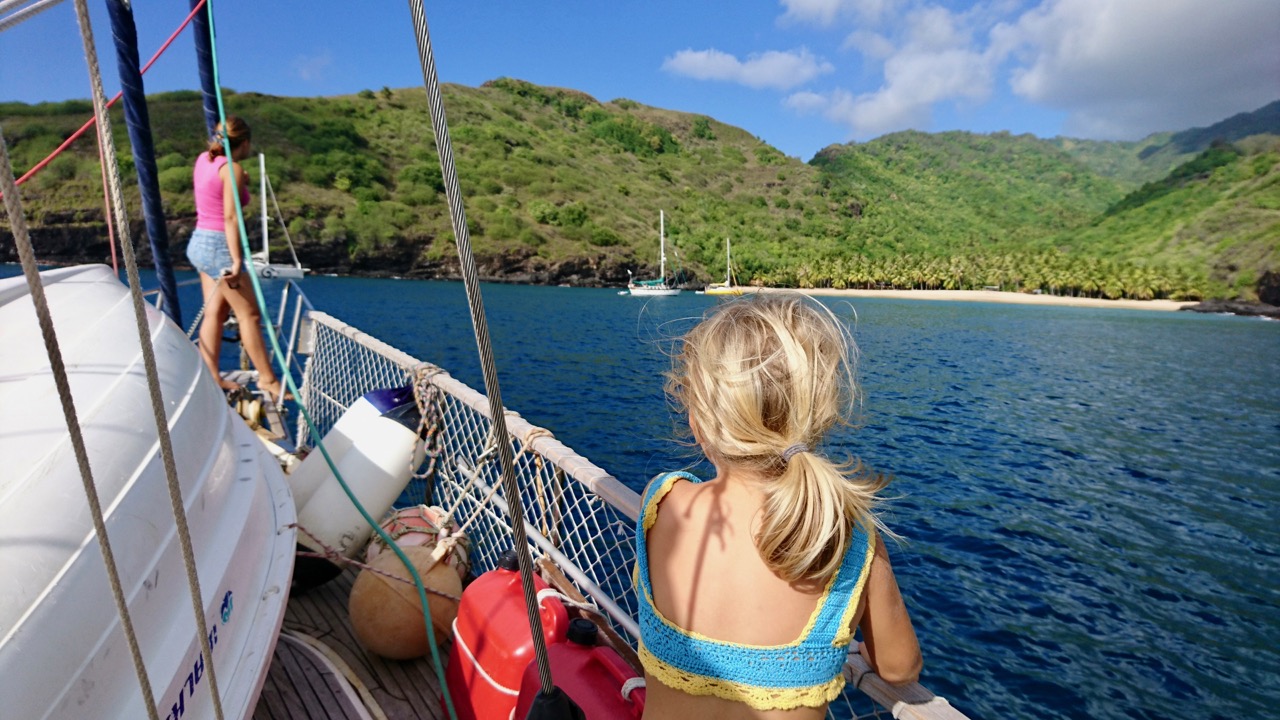
Entering the new bay )
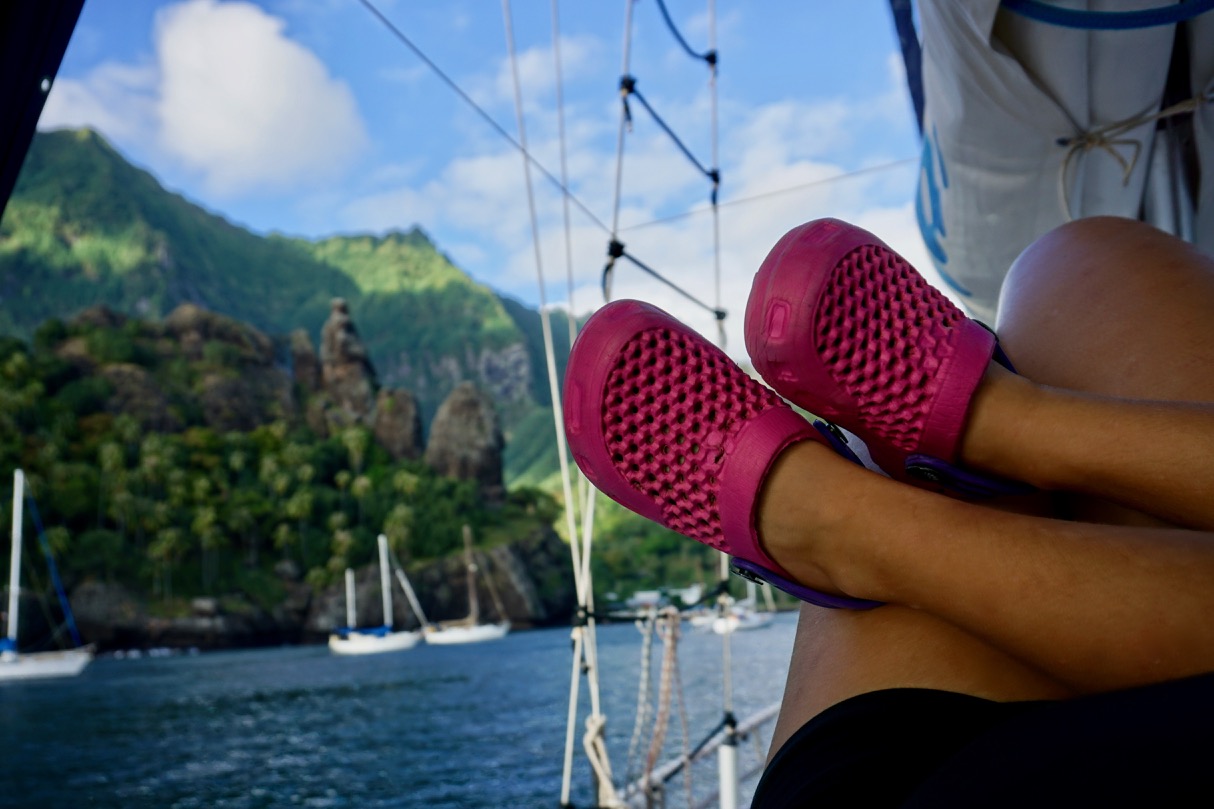
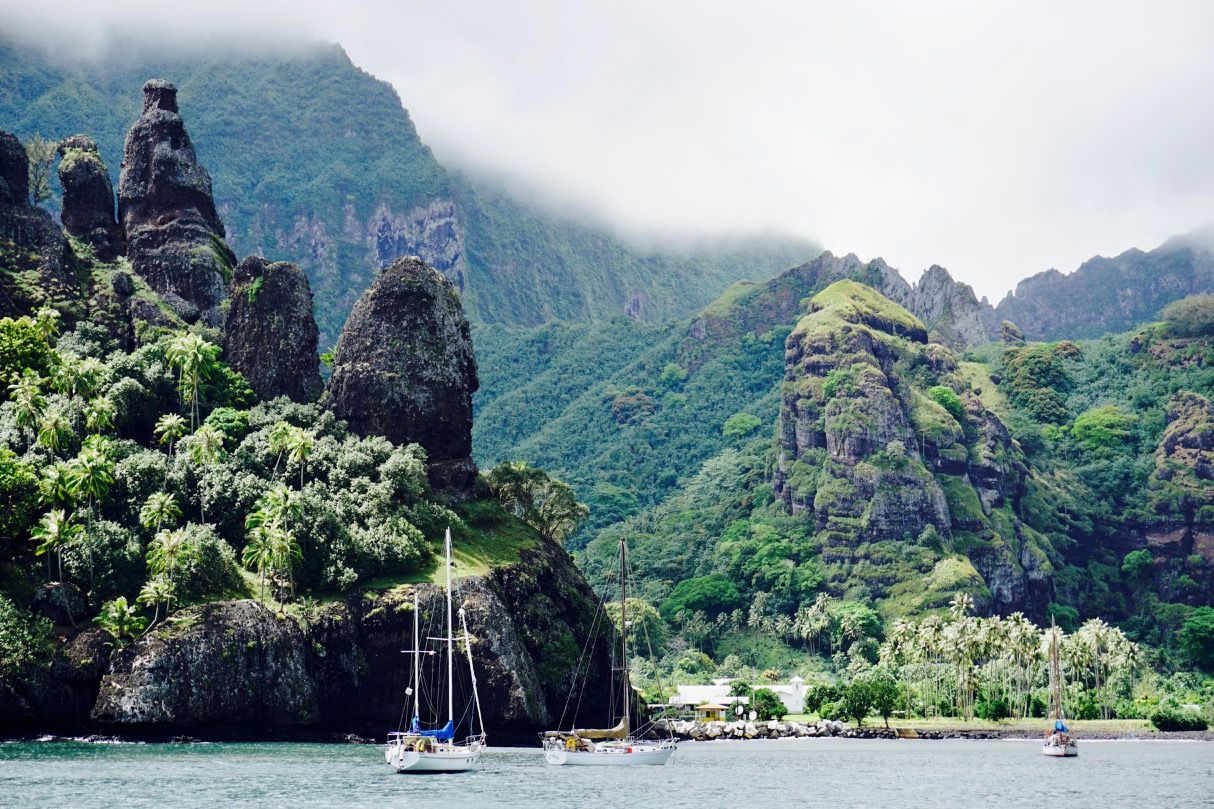
The Fatu Hivans say that the rocks at the mouth of the valley are the heads of their TIKI gods Bay of Virgins, Hanavave Valley, Fatu Hiva