
From the Travely-Family archive · Pacific Ocean
How We Sank the Dinghy
An original publication from the former Travely-Family website. This English translation was preserved from the technical-site archive without editorial rewriting.
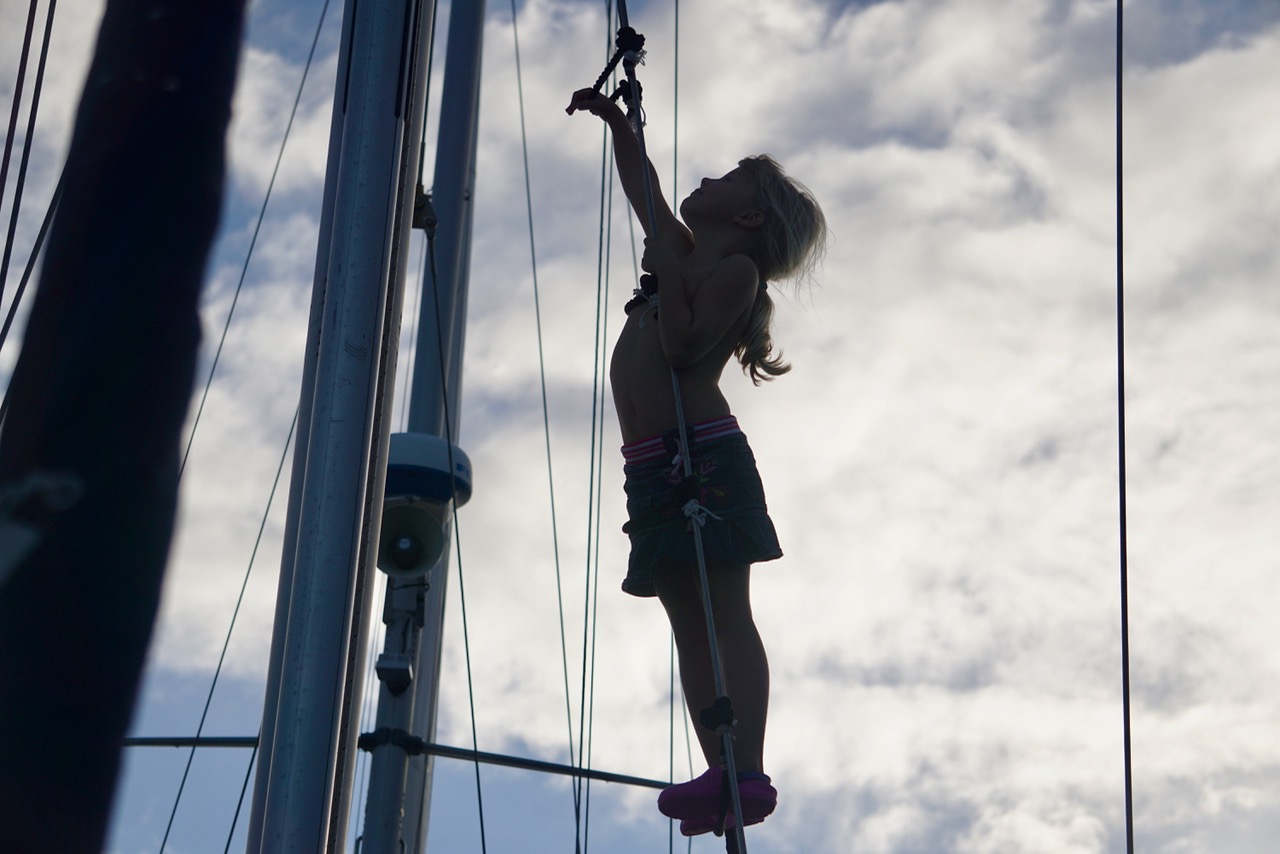
How we sank the dinghy. An extreme landing experience. Pitcairn Island, in the middle of the Pacific Ocean.
Why did you sink the little boat?
There was a brand-new gramophone in it, And a portrait of Edita Piekha, And a smoking lounge. (from a song)
It seems a shame to waste time on chores while waiting for the weather to improve, when there it is—the hard-to-reach paradise of little Pitcairn Island—within walking distance. We plucked up our courage and approached from the west, heading for the second jetty, from which it is a long trek right across the island to the village. Over hills and potholes, it works out at about 7 kilometres.
A quad bike appeared on shore: some couple had come to fish.
We loaded a large backpack for our finds and the camera tripod into the dinghy. The smaller backpacks went on our shoulders, and the young sailor got a life jacket. I suggested that the captain and crew member do the same.
“I can swim ashore without a life jacket,” Nastya said.
“You see, without a life jacket you’ll only be a liability, but with one you might actually be some use. That’ll be one less person to fish up from the bottom.”
In the end, I put on a life jacket myself, so I would be less of a liability if anything happened.
We crept towards the jetty, periodically letting the high waves pass. The fishermen who had arrived realised that there would be no fishing today and stood ready to help.
We threw them a line, and Nastya scrambled ashore. Teleporting Lada took a long time. The low jetty slopes towards the water and is covered in long, slippery strands of slimy weed. Barefoot, Nastya could not take the young sailor from us, because all her strength was going into keeping her balance. The burly fisherman pulled the rope too hard, and when the dinghy, which had risen on a wave, dropped back down, it was left hanging bow-up. Even on what counted as low waves, the vertical movement was about a metre and a half. We did finally manage to toss little Ladunka ashore into the arms waiting to catch her. I struggled awkwardly for another minute, then leapt out onto my knees and went sliding across the slippery jetty.
“Andryukha, throw me the flip-flops!” It was impossible to stand barefoot.
I secured the dinghy’s bow with a springy arrangement of rope and elastic. Chris (his name was Chris) secured the stern. Andrei bobbed about in the waves, tying two fenders to the starboard side (those inflatable white things that you wedge between the hull and the jetty). The plan was to hold the other side off with an anchor. The captain tried in vain to throw it farther out. The anchor would not hold and kept dragging.
About 40 minutes later, we were already tensing up by habit whenever a big wave arrived, trying not to be swept away by its force and not to lose the mooring lines. Andrei tried different ways of tensioning the ropes; he was just about to get it right and climb out onto the slippery platform.
And then they came. Enormous waves, in sets of six to eight. In the little nook, almost entirely unprotected from the outside world, everything suddenly came violently alive. It was as though the bellows inflating the ocean’s lungs had been moved right up to this tiny jetty. Andryukha soared into the air with the dinghy. The plastic squealed horribly as it caught on the edge of the concrete, and the dinghy splashed back down at an angle to the sea.
“Andryukha, another wave!” I shouted from the jetty, standing knee-deep in water and trying to hold the mooring line wrapped around a bollard.
The dinghy reared up, the captain went flying between the seats, and the wave receded. Our brave dinghy and captain met the next wave broadside on. Bang! The bow line snapped. Andrei found it on the bottom and managed to throw it ashore; Chris and I hurriedly secured the shortened rope. Luckily, it had a shock-absorbing system fitted to it: part of the rope hung in an arc, while a thick elastic cord stretched across it like a chord, cushioning the jerks.
The third wave swamped the stern, heavy with the outboard, and the dinghy filled more than halfway with water.
What were we supposed to do!? Nastya and I, and even Chris, were right there, but grabbing the dinghy and the captain and hauling them ashore did not seem possible—the surf was heaving the little boat up and down through two metres.
The rocks smashed the enormous swell into splinters of foam, but they did not kill the wave completely. The next roller came over the dinghy’s side. Now it was impossible to haul it ashore—we first had to bail out a tonne of water. Andryukha tried to free the bailer from beneath the floating fuel tank. Chris emptied everything he had caught out of his bucket before we frightened off the fish, and threw the bucket to the captain. Nastya noticed that the GoPro on my head had long since stopped showing any numbers—the battery had died. As always, in fact. After four years at sea, our equipment was malfunctioning desperately: batteries ran flat, cameras switched themselves off...
Meanwhile, the dinghy and captain were sinking. Although now its promised unsinkability was evident: filled to the gunwales with water, outboard and captain, the dinghy remained afloat, wallowing level with the surface of the water.
“What do we do? Andrei, give us orders!” Instead of answering, the captain went flying somewhere between the seats and the fuel tank that had floated free.
“Dad, are you alive?” There was blood on his cheek.
“Alive.”
Andrei untied the tank and, as the dinghy surged upwards, handed it to Chris. The oars and flip-flops flew ashore (one flip-flop sailed over the far side of the jetty into the water. And now Chris’s wife had a job too—catching it before it found the natural exit from the little cove into the ocean)...
We had to take the 30-kilogram outboard from the flooded dinghy, which was still bucking on the waves, without smashing it against the concrete. Chris and I braced ourselves on the slippery jetty, trying to catch the valuable cargo without sliding into the waves.
“Grab the rope!” That was to me.
As the dinghy leapt, Chris took the outboard and I pulled the loop upwards with all my strength. We moved a metre back from the edge, and then mighty Chris dragged the engine towards the dry rocks. The captain worked frantically with the bucket. Under the strain, the dinghy’s floor had come loose from its fittings, but that was a minor detail. The big waves did not appear to have any intention of subsiding. By then, we no longer paid any attention when a roller swept over the jetty. We simply gripped the mooring line wrapped around the bollard more tightly and leaned into the wave, as if into a savage winter blizzard.
The captain managed to bail out half the water, and while the dinghy was relatively empty and light, we had to contrive to haul it out. As the ocean drew breath, the captain jumped ashore. And immediately went sliding on bare feet over the weed, back towards the sea. His flip-flop was still floating in the quiet little nook on the other side—what a throw that had been!
“Nastya, flip-flops!” Our daughter gave her father her own, and the captain gained at least some sort of grip on solid ground.
“One! Two! Pull!” On the wave, the dinghy itself wanted to leap onto the jetty; we only had to help it a little. The bow of the dinghy was on the concrete, but the water drained towards the stern and pulled it down. The next wave would push it forward at first, but if we hesitated, it would suck the little boat back into the sea.
“Wave! Pull!” We threw all our weight onto the ropes, and the dinghy, kicked up by the roller, shot ashore. We grabbed it from all four sides and hurried it away from the surf.
“My God, Chris, thank goodness you happened to be here!” I said to our rescuer.
It took us a while to exhale and take in what had happened. Another couple of minutes to savour the thought of returning to the yacht. Then to realise that the outboard had swallowed salt water and declared a boycott on the crew...
The dinghy was dragged well up the shore, and the captain furrowed his brow thoughtfully. Chris told us that two weeks earlier the storm—the very one we had ridden out hove-to in the middle of the ocean—had torn away that information board over there, which had stood 4 metres above the road, and carried it a good hundred metres. The support beams were 10–12 centimetres thick. It had stood about 20 metres from the shore. Lovely weather that had been.
Our rescuers drove home, taking the crew member and young sailor with them. I stayed with the captain to keep his spirits up. Chris was supposed to return with tools.
While we had been having all this fun, our old Easter Island friends had arrived at Pitcairn—William and Ilias, 20-year-old Swedes from the little yacht Astrid. And now the cheerful lads were already bouncing ashore in their inflatable dinghy. We went to receive our guests. But there should not have been any particular problems for them—the lads had a light dinghy, and if they timed it correctly, lifting it onto the concrete would be easy....
And in the evening we still had to get back... if only we had something to get back in...
To be continued!