
From the Travely-Family archive · Other Entries
How We Set Out for Hiva Oa but Ended Up on Nuku Hiva
An original publication from the former Travely-Family website. This English translation was preserved from the technical-site archive without editorial rewriting.
How We Set Out for Hiva Oa but Ended Up on Nuku Hiva (also known as Nuku Giva—the name used by Krusenstern—and Nuku Iva, as the French and the locals pronounce it)
Our days with friends in a bay on the island of Tahuata meant the beach, long conversations, and visiting one another aboard our boats—as well as swimming to shore in masks and fins, a respectable 200 metres or so. Well, Nastya and I did once row up to the surf line, and what had looked from the yacht like the faintest breath of a swell turned into a serious undertow and backwash )))—I haven’t put that very clearly, but we immediately lost all desire to land. To the surprise of the crabs and the children—Laduska and Azai—who were already ashore, we pointed our oars the other way )). Three days later, early in the morning, to the rustle of rain, all our friends weighed anchor and set off for Hiva Oa, the main island here in the southern Marquesas. Of course, not as important as Nuku Hiva, but still.
We thought we would stay another day, but changed our minds over breakfast—why were we here when everyone else was there? So we dashed off to Hiva Oa too, though not to the main bay at Atuona like everyone else, but somewhere on the north-west coast.
Real heroes always take the long way round
However, north-west Hiva Oa turned out to be precisely the side of the Marquesas we had not missed one little bit. The trade wind had changed its mind about blowing from the east and was whistling straight into the bay from the north-west; there was zero vegetation on the brick-coloured cliffs. Only a dark-grey pebble beach was edged by a forlorn cluster of palms and shrubs. The water was as murky as the Katun in summer.
What to do? Carry on north-east against the trade wind, which would most likely start blowing again once we were some distance offshore? No way. Stay here? A waste of time. There was not much time left before hurricane season; we had to manage everything we had planned in Polynesia.
To hell with it, we thought, and the captain set about repairing the windvane steering—the control line had snapped. We stayed for about an hour and a half, secured the galley so that nothing would go flying during the 75-mile passage, and set a course straight for Nuku Hiva.
That evening, we used the satellite to tell our friends about our unexpected change of plan and prepared to stand watch..
Nuku Hiva
Nuku Hiva is the principal island of the Marquesas archipelago. There are twelve islands in all, six of them inhabited today. In 1804, thirteen years after the island was discovered by Americans, Ivan Fyodorovich Krusenstern arrived in Taiohae Bay. What do you know about him, apart from the famous line from the Prostokvashino cartoon—“a man and a steamship”? And yet Krusenstern was none other than the captain and leader of the first Russian circumnavigation. The expedition’s second ship was commanded by Lisyansky. And this was the first scientific expedition to the Marquesas. All previous visitors had occupied themselves with shooting the natives and spreading afflictions ranging from diseases to mosquitoes. Yes, yes, those were brought by Europeans too.
Arrival. The young sailor inspects the anchorage
Krusenstern left fascinating observations on Marquesan life in his reports and journals, while the artist Georg Heinrich von Langsdorff produced the most accurate drawings of Marquesan tattoos from the pre-European period. We were reminded of this by Teiki Huukena, the author of a book on Marquesan tattoo art. We spent almost two days in his company and posted the fruits of our conversations on our Instagram:). Check it out!
Arrival
The high Marquesas Islands catch the plump trade-wind clouds like morsels on a skewer; the clouds then gather into storm clouds and pour their accumulated moisture onto the land. The sun shines in the gaps between the islands, but along the shores the weather is completely different.
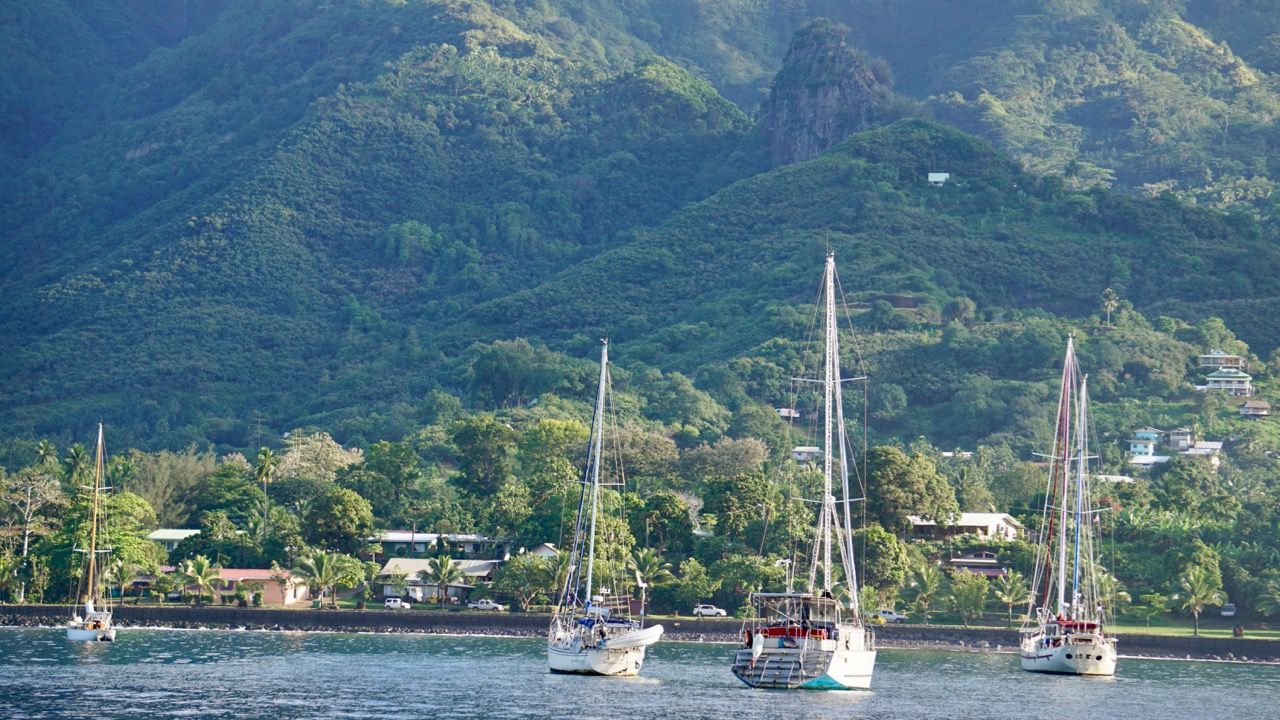
We arrived at the principal island of the Marquesas under overcast skies and drizzle. We circled around the large bay. About twenty yachts showed no signs of life; everyone was huddled inside their saloons. Who wants to drink coffee on deck in the rain?
The quay
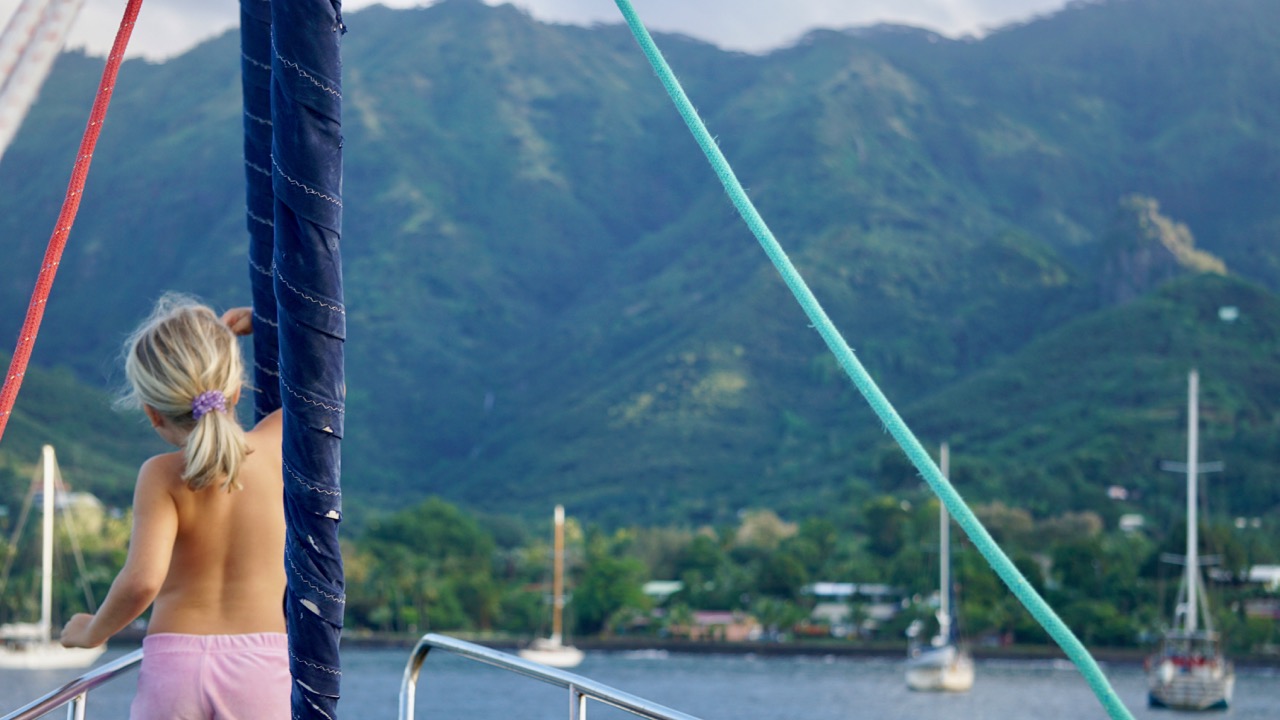
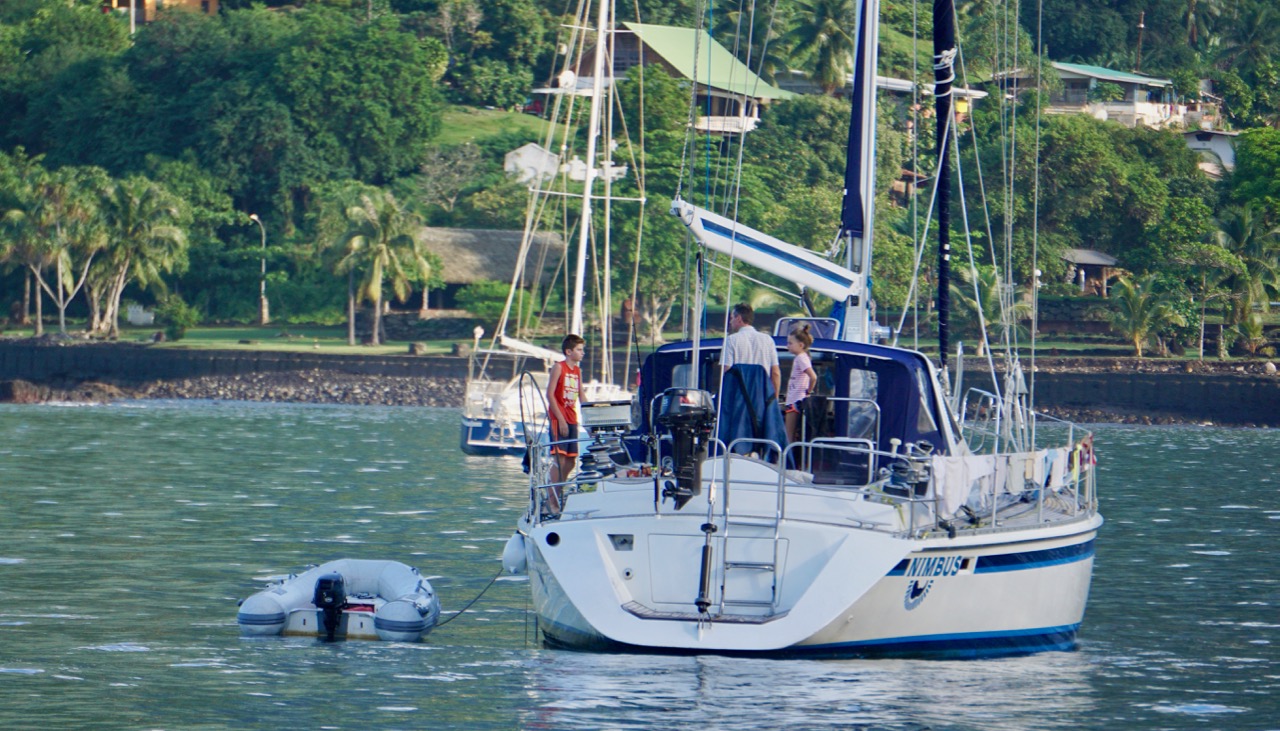
Our sleepy young sailor poked her little face out of the hatch as we entered the harbour and immediately told us where we should anchor.
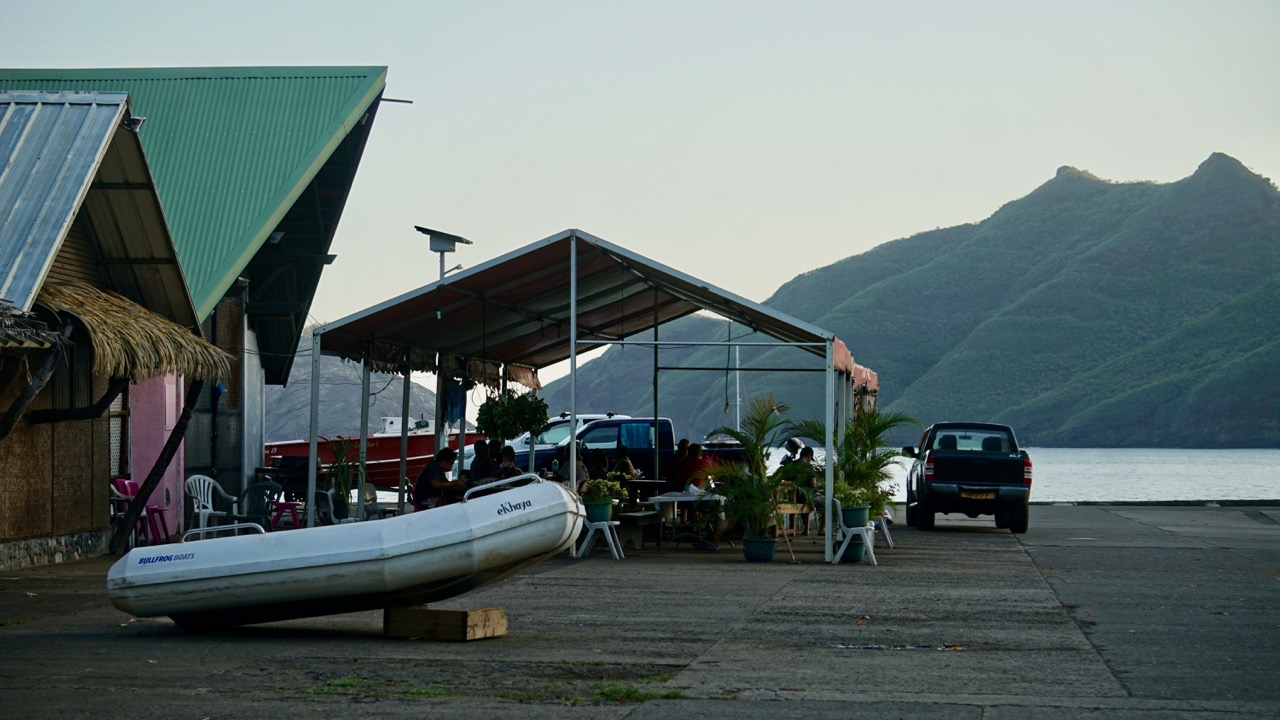
Nastya let go the anchor, I lowered the mainsail, and we began quietly looking around. Mist hung over the mountains. Laduska counted no fewer than five waterfalls; I saw only three. Pretty little houses were scattered across the green hills. Cars trundled lazily along the waterfront, and now and then dashing chevaliers galloped past bareback on miniature horses. A pebble shore, a gentle roll on the swell...
Do you know what is unexpected about the Marquesas? There is no blue water and no white sand. None whatsoever. But there are sharks ). Here on Nuku Hiva, they feed them by the quay. Fairly big ones, as long as a fully grown person is tall. Naturally, for form’s sake, we went swimming there a couple of times that same day, but somehow we did not feel like it after that:).
An attempt to clear in We arrived on Friday and, just in case, made an attempt to finally formalise our relationship with French Polynesia. The sleepy, cosy gendarmerie had the gendarmes’ houses right beside it, along with a barbecue, a hammock, and bedrooms. A notice on the door said that clearance had been handled until 11 a.m. that day, and the next chance to clear in would be on Monday morning. Fine, then: another two days added to our visa.
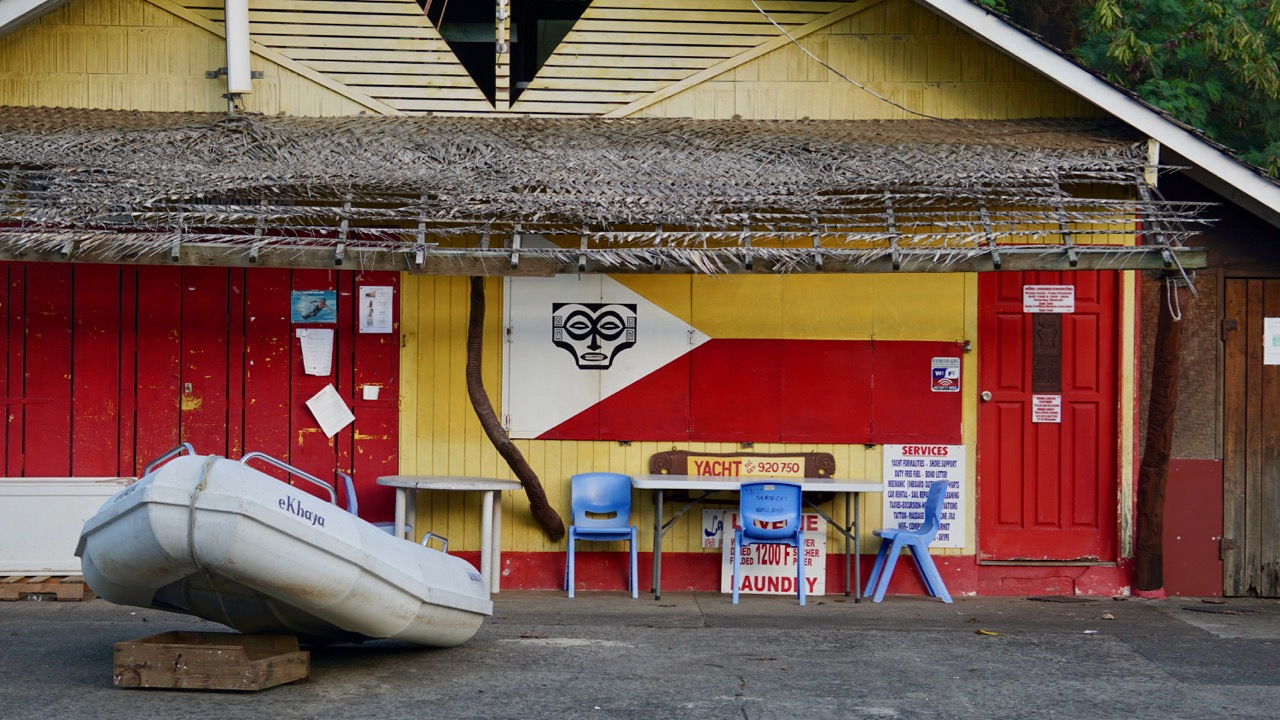
And off we went to explore Taiohae—the capital of the archipelago, that is.
Do you know what is interesting? We cannot shake a certain Panama City feeling, even though this is a village, not a city, with only a thousand inhabitants, perhaps fewer. Nuku Hiva’s main harbour is large, and the water is rather murky... Why is it that colour? Sediment? Microorganisms? Anyway, after Fatu Hiva and Pitcairn it somehow seems very... we could not even find the word for it ).
So we are settling in and waiting for clearance time—but what if Immigration does not believe that it took us almost two months to get here from Pitcairn? What then?
🙂
To be continued!
For how to get here, see Visa for French Polynesia