
From the Travely-Family archive · Antarctica
To the Antarctic Circle
An original publication from the former Travely-Family website. This English translation was preserved from the technical-site archive without editorial rewriting.
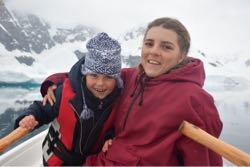
To the Antarctic Circle. We head out into open water, steering around countless chunks of ice. Today’s plan is a passage of about 35 miles southwest to a bay with the proud name of Port Lockroy. There is apparently an American base there, with a museum and a little souvenir shop. Back in Tierra del Fuego, Denis Davydov, first mate to Nikolai Litau, gave our young sailor a stuffed penguin bearing the name Lockroy. Later it was joined by a little grey Korean penguin from Sergei, head of Bellingshausen Polar Station. Now a whole penguin gang is aboard with us, plying the waters of their native Antarctica.
Meanwhile, their living relatives leave their marks on the white snow. The penguin colonies’ favourite spots are visible as dirty pink stains on the white. The thing is, penguins feed on red krill, tiny shrimp. After they eat such a brightly coloured chitinous layer, penguin droppings glow scarlet on the lifeless slopes. But when the white turns yellow, that means seals have left their mark here: leopard seals, sea lions, elephant seals and fur seals. Year after year, their haul-out sites become covered in yellow; fresh snow falls on top and is compressed, and the seals lay down another yellow stratum... C’est la vie.
But there is still incomparably more white and fluffy stuff in Antarctica. Lady Mary entered the snowy reaches of the beautiful Gerlache Strait at the same moment as the bright rays of the sun. Here there are real mountains, and snow clings to them from the foot right up to the summit, undeterred by either the steep slopes or the savage winds. How wonderful it would be to film the yacht under sail against all this snow-white splendour! But we don’t have a drone, and nobody particularly fancies launching the dinghy and rowing out and back. Gusts strike without warning, and no one can be bothered with dinghy-rescue operations. So we have no photographs under sail beside the snowy mountains—just an ice expedition. On deck, we drink fragrant tea from a thermos, accompanied by festive sweets and breathtaking scenery.
“For some reason, I thought Antarctica was just snow and ice, with no mountains at all,” Nastya says.
And I realise that I, too, had imagined the icy continent as simply a smooth dome of snow over a mass of rock. Nastya declares that Antarctica is now among her favourite places, alongside Colombia, Easter Island and Pitcairn. Ladunya has no objections.
Port Lockroy. “Look, the penguins are walking uphill along the path!” I point to a high snowy slope where little black figures are moving in a row like dots. Andryukha picks up the binoculars.
“Those aren’t penguins. They’re people.”
And they are! Twenty little people walking across the snow dome mean there must be a ship in the roadstead. And there she is. Funny—it’s the Akademik Vavilov again. Somehow we don’t call each other on the radio; we just see one another, and that’s it. No greetings between compatriots off the Icy Continent.
The Port Lockroy base occupies a small rocky island in a bay surrounded by glaciers. In Ushuaia, various yachtsmen shared their charts of the region with us. The iPad is full of modern sailing directions and vintage ones. The coolest version came from the yacht Pelagic Australis; they must have been using it as long as 30 years ago. On the screen are scans of a hand-drawn chart. It shows how to lie in various places, with the boat’s hull sketched in and lines run ashore. Everything is to scale and properly oriented to the cardinal points.
Following this hand-drawn chart, we enter a tiny excuse for a bay in the flat little island; an anchorage is marked here. The depth sounder shows about 2.5 metres. While we are looking for somewhere to run our lines, a fellow in a blue jacket breaks away from the group of tourists brought over by Zodiac from the Akademik Vavilov and comes towards us, hopping over penguins as he goes.
“Don’t go this way, go that way!” the owner of the blue jacket shouts in English. “Or snow will fall on your head and you’ll be completely dead!”
Well, what he means is that it is high tide now, and at low tide there will be no water here at all.
“Okay,” we say. “Thank you.”
And without delving into the details drawn on our retro chart, we back out of the little inlet towards a larger bay.
The captain takes careful aim for a long time, and we solemnly make our way around every islet, shoal and chunk of ice. We circle the penguins clamouring on shore and finally drop anchor in 14 metres of water. We are holding fast. We really do have a good anchor: it holds where others drag.
The Port Lockroy base has already closed for the winter. All its black buildings—two rectangular ones and one shaped like a tank—can only be viewed from outside. Hundreds of penguins and a couple of dozen tourists wander along paths trampled into the rock. The latter arrive regularly aboard ships like our Akademik Ioffe, Akademik Vavilov and Polar Pioneer until the beginning of April. Then winter will descend upon Antarctica. The penguins will head out into the ocean for six months and return only in spring to produce new offspring.
For now, the inhabitants of the icy continent devote themselves either to eating or moulting. When changing their plumage, they stand in the windiest places for three weeks, little ruffled barrels waiting for their old feathers finally to blow away. The birds do not dive into the water, eat or drink. That is how things work for them: either swim and eat, or moult.
According to our observations, penguins are more active in the evening than in the morning—especially if it is a sunny evening. The pot-bellied little sacks in tailcoats that, for whatever reason, do not yet—or no longer—need to change their plumage suddenly scamper nimbly over the rocks, shout something and wave their little arm-wings, then waddle purposefully towards the water and plop into their evening bath. They seem not to be birds at all, but enchanted little people. They bustle about like this until twilight. Unlike our previous overnight stop in the ice well, there are no whales here. At least, no one is breathing from beneath the water, and there are no sleek black backs or imposing fins gliding between the floes.
Nastya and I prepare dinner while Andrei tidies the deck. Our young sailor puts away her belongings and toys in their corners. Mists drifted beyond the river. And with them came ice floes and little orange feather-boats.
“Pay megabucks out of your own pocket just to sit with your arse in freezing water!” comes the captain’s sympathetic cry from the deck.
“Who’s there?” Laduska runs out in nothing but a turtleneck to wave. Several kayaks carrying foreign tourists have paddled up to the yacht to ask how such heroic people as us ended up here with children.
“Oh, somehow or other...”
“Are you on holiday aboard the yacht?”
“No, we live here. We’re sailing around the world,” the captain replies modestly.
Smiling, the kayakers disperse among the floes. And the ship’s bell rings for dinner. Nastya has baked her signature delicious chocolate cake out of nothing and decorated it with pieces of pineapple. For the evening film showing, we put on the first episode of The Master and Margarita. Ladunya immediately spotted the connection between Woland and Voldemort, endured half an hour, then asked to go and watch a children’s film about Goldilocks on the iPad.
“I’m not interested in your Master,” she says. “You’ve got some kind of devil in it...” and leaves.
Nastya and I divided the night watch between us. Until 4 a.m. she pushed away the ice floes; after that, I did. Fortunately, there was less ice than the previous night. A couple of times we had to fend off large floes; the others bumped softly against us and were carried away by the current of their own accord. We had not run any lines ashore, so the mini-icebergs had nothing to snag on—and we were not especially interesting to them anyway. The current had piled all the ice closer to the penguins. Ice floes aren’t stupid either: we came and we’ll leave, but they have to live here with those penguins.
Andrei checks the latest weather forecast. A storm will arrive in a few days.
“Well, we’ll stay here tomorrow, then set out across the Drake Passage. We’ll catch the edge of the storm right by Cape Horn.”
“But what about Vernadsky Station?”
“We don’t have time to make it to Vernadsky.”
“What do you mean, we don’t have time?” we say, crestfallen. “How many miles is it from here?”
“Thirty to thirty-five,” says the captain.
“So maybe we could set off first thing tomorrow morning? Spend the night there and then head out into the Drake?”
“Well, I don’t know...” the captain drawls.
At that point I temporarily leave him alone, intending to resume our discussion about going to the Ukrainian Vernadsky Station before bedtime. The idea has to settle in the commander’s mind and line up with the weather forecast. We so desperately want to visit our Slavic brothers again. To speak Russian, listen to the polar explorers’ yarns and eat black bread and salo. And to hug every one of them goodbye—warmly, in our own way, without perfunctory smiles and kisses. And they have a sauna there too. A real one.
O Supreme God of the polar ice, meet us halfway and lead the icebergs away from the narrow straits! Tomorrow we shall fight our way through to our own people...
These chronicles were transmitted from 64 degrees 50 minutes south latitude and 63 degrees 29 minutes west longitude.
Friends, what a pleasure it is to read your messages on the website and your comments! Thank you for your warmth and support—it truly warms us and helps us carry on. We appreciate every one of you! May all be well with you, and may your dreams be sure to come true!
And separately, from the depths of our great polar souls, we thank the shore-based part of our team for keeping the expedition going through PayPal.me/TravelyFamily! Today the satellite connection let through only a notification that funds had arrived, but we cannot yet see who sent them or how much. We shall discover that secret only when we reach the mainland, and we shall thank each of you by name. Hugs from the southern polar latitudes!