
From the Travely-Family archive · Pacific Ocean
To the Dwelling Place of an Extinct Tribe. Ritual Platforms and the Mysteries of Fatu Hiva Island
An original publication from the former Travely-Family website. This English translation was preserved from the technical-site archive without editorial rewriting.
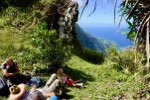
To the dwelling place of an extinct tribe. A dangerous descent. Ritual platforms and the mysteries of Fatu Hiva Island.
“The difficult descent begins here,” Audrey warns us.
The vanguard of our group rises from the rest stop and disappears around a rock. We take three steps and, breathless from a gust of wind, freeze at the edge of the abyss...,,,,,,,,.,,,,,,,,..,,,,,,,,,,..,,,,,,,,,,...,,,,,,,,.,,,,,,,,..,,,,,,,,,,..,,,,,,,,,,...,,,,,,,,.,,,,,,,, The razor-sharp ridges of Tauaouoho and Namana form an impregnable wall separating the windy east coast from the sheltered western valleys. The villages of Omoa and Hanavave, which have survived to this day, slumber beneath the shelter of the cliffs. Only the anchorages in the bays are assailed by winds, forcing us to keep a vigilant eye on all the stuff on deck (we have already failed to keep an eye on a tray and, it seems, a pair of sports sandals).
In the ridge between our village, Hanavave, and the Hanahoua Valley, there is the eye of a needle—a hole running right through the rock and, by some miracle, lying about a hundred metres below the crest.
In pre-European times, several warring tribes lived on Fatu Hiva. According to legend, they knew how to pass through this eye, at an altitude of 800 metres, from their own ravine into ours. Somehow, the ancient rock climbers would descend into the sleepy valley and catch the people of Hanavave unawares. The old people said that this tunnel was strewn with human bones—though how could they have ended up there?
The secret of reaching the little window in the pointed ridge was lost long ago; there are not many people on the island, and only two inhabited villages. And extreme-sports enthusiasts, it seems, have not yet made it to this unique hole in the ridge.
The only route to the abandoned village of Ouie runs over a pass on the central plateau. The trail was hacked out in time immemorial. Most of our group is already making its way towards the valley hemmed in by mountains, while the captain, our young sailor and I are still right on the lip of the pass...,,,,,,,,.,,,,,,,,..,,,,,,,,,,..,,,,,,,,,,...,,,,,,,,.,,,,,,,,..,,,,,,,,,,..,,,,,,,,,,...,,,,,,,,.,,,,,,,, Powerful gusts flatten the grass beside the precipice. Sheer peaks prop up the clouds. The zigzag of the clumsily traced, slippery trail stitches across an almost vertical wall which, oddly enough, is densely covered in rainforest.
Steps made of vine-like roots, clayey slurry and stones barely give us enough purchase to stay upright. Our trainers slide through the mush. The young sailor braces herself with a staff, the captain spots her from below, and I stand ready to help from above.
“Squish, squish”—the captain takes a couple of steps and stops to wait for Lada.
“Slosh, slosh. Ouch!”—that is our young sailor.
“Splat, splat. Oh Lord!”—and I take my place beside her.
We move slowly through the endless tunnel. Little Lada begins by groaning, then starts whining, and by the end of the steep section she is even wailing a little, frightening away the scorpions and birds.
The crack of branches and dull thuds make us freeze. Great chunks of rock are flying down through the thicket above us. We look around, trying to work out which way to jump if the rocks reach the trail. But they become lodged somewhere among the roots, and our little group continues to scramble onwards...,,,,,,,,.,,,,,,,,..,,,,,,,,,,..,,,,,,,,,,...,,,,,,,,.,,,,,,,,..,,,,,,,,,,..,,,,,,,,,,...,,,,,,,,.,,,,,,,, “Just a tiny bit farther, come on, just a little. Otherwise we’ll have to spend the night on the slope.”
“Russians never surrender, remember?”
That is our challenge and response. When we come alongside our yacht in the dinghy and someone is aboard, we shout:
“Russians, surrender!”
And the answer comes from the deck:
“Russians never surrender!”
And our young sailor honestly refuses to surrender for another quarter of an hour. After that, I launch into a heroic song:
Whichever way the wind may blow, the clouds will follow where it goes, the obedient river flows along its bed.
But you are human, strong and brave!
Shape your own fate with your own hands.
Walk against the wind; don’t stand still.
Understand: no road is ever easy!
Our young sailor, still whimpering slightly, gathers up her clay-caked feet and begins to step more firmly. The two-hour near-vertical descent will soon end in the valley. The ground has become drier and the plants are different. Black hills lie ahead. Volcanic ash crumbles beneath our feet, and thickets of reeds tangle us up and lead us off the trail. It smells of sunshine and dry grass.
Above the sloping ridge within the valley rise two stone giants, frozen in a kiss. There must surely be some legend about them, carried away by the cannibals into their stone crypts—or into the ritual cooking pot? In our terms, into the grave.
The valley plunges steeply down to the ocean’s foaming edge. Driven by the trade wind, the swell rolls seven thousand kilometres without encountering any obstacle between South America and the Marquesas Islands. All the accumulated power of the wind crashes against Fatu Hiva’s rocky east coast.
But it is still a long way off. Naturally, I am trudging along at the back: every bend forces me to take out the camera yet again, though at the previous bend it was solemnly promised a quiet evening in the bag...,,,,,,,,.,,,,,,,,..,,,,,,,,,,..,,,,,,,,,,...,,,,,,,,.,,,,,,,,..,,,,,,,,,,..,,,,,,,,,,...,,,,,,,,.,,,,,,,, We catch up with the marathon-running French contingent. Chantal looks stunned: on one of the trail’s zigzags, she somersaulted head over heels, miraculously without striking her head on a single rock.
A little farther, and we reach a stream. Once, a powerful torrent flowed here, but now only one channel babbles merrily. The trail is marked by low cairns—little pyramids of stones. Wherever there is no marker, I build a new pyramid.
The breadfruit trees that had begun to appear end just as suddenly, leaving only wild coconut groves everywhere (distinguished from non-wild ones by the heaps of old fronds and nuts). And there are also little groves of fleshy noni, which people in Thailand have turned into a decent business: they bottle its vinegary, sour juice and sell it as an anti-cancer remedy.
A break in the palms inspires our young sailor to take a few more steps. Meanwhile, I have become lost: without noticing, I have wandered off the trail towards the ritual platforms, their stone foundations green with moss among the roots and ferns.
But where is the trail??
“Andryukha!” I shout into the thicket. “I’m lost!”
“How lost are you?”
“I’m so lost that I’ve lost the place where I got lost!” (Hello, KVN.)
“Well, come over here, then. Forget that platform. Are you coming or what? I’m leaving.”
I had to abandon the platform (who needs ancient platforms these days?) and hurry towards the bivouac.
Beyond a bank of pebbles, the surf roars, leaving no hope of reaching this place by sea. The only accessible route to Ouie is the trail along the edge of the precipice. We have not yet procured any food, the group is hungry, and the drowsy sun is already becoming entangled in the tops of the palms.
“O-o-oh,” Nastya drawls, looking over the shelters. “There’s something about this place I don’t much like.”..,,,,,,,,.,,,,,,,,..,,,,,,,,,,..,,,,,,,,,,...,,,,,,,,.,,,,,,,,..,,,,,,,,,,..,,,,,,,,,,...,,,,,,,,.,,,,,,,, How a Polynesian fishing camp is laid out (or is it a hunting camp?), how to obtain food from whatever is at hand, settle in under polythene, catch crabs at night and stay for one more night. And what became of the ancient tribe—in the next report.
The coordinates of Fatu Hiva Island (Pacific Ocean, French Polynesia, the Marquesas) remain 10.27 south latitude and 138.40 west longitude. (Friends, for those who asked—we have discovered the secret behind the discrepancy in the coordinates! Here, the figures after the points mean minutes, not hundredths of a degree. The satellite encoding does not transmit degree and minute symbols, so we use points.)
Goodness to you all!