
From the Travely-Family archive · Pacific Ocean
Fatu Hiva. One Day to Go
An original publication from the former Travely-Family website. This English translation was preserved from the technical-site archive without editorial rewriting.
Fatu Hiva. One day to go. An unusual catch and Bastille Day celebrations. They’ve come up with a clever system here in the Marquesas...
They’ve come up with a clever system here in the Marquesas: the first island when approaching from the south and east is Fatu Hiva, while the port of entry is Hiva Oa, another 50 miles farther on. The rules require yachts to sail straight past the promised land after a long passage. Then, if they wish, they can slog back upwind, adding another 100 miles to the logbook for the round trip.
We, of course, are aiming for the first island. A launch carrying gendarmes patrols the place, checking for anyone who hasn’t cleared in. Caught? — A fine, and welcome to Hiva Oa for inspection.
Like Kolobok, we got away from Grandpa, and now we’re trying to get away from Grandma:). We’d already reached French overseas territory in the Gambiers, where we stayed for three days without officially registering our presence, thereby gaining ourselves as much as ten extra days on our visas: the week it took us to get there, plus three days at anchor. Our Polynesian visas are only valid for three months, and we don’t want to burn through them pointlessly out in the ocean. And we left Pitcairn with the date left open and a parting word from the constable: “Fill in the departure date yourselves.”
So in theory we could keep hiding from immigration among the atolls for another month or so. No longer than that—the hurricane season arrives in November. And the gendarmes aren’t fools either: sooner or later they’ll nab us. But calling at Fatu Hiva is sacred. Our beloved explorer Thor Heyerdahl chose this very island in 1936, when he was a 22-year-old dreamer, as the place where he would become one with nature. He deliberately searched for somewhere with as little civilisation as possible. And he found Fatu Hiva. He left everything behind in Norway and married a fellow dreamer named Liv, aged twenty.
And off they flew and sailed to become one with nature, living without ports or airfields, razors or clocks—and they didn’t even bring any medicine. They lasted a year. They dug up cannibal skulls, figurines and various delightfully authentic headdresses. They also got hold of the stock from Paul Gauguin’s own rifle. He too had become one with nature before them, only on the more populous island of Hiva Oa, where sailing yachts now clear in. And there, as mementoes of the genius, remain a grave beneath one palm tree and a museum beneath another.
People in those days, it must be said, were dying like flies in Polynesia. By the 1930s, 150 years after the Europeans arrived, the Marquesan population had fallen from 70–100 thousand people to two thousand. They’d have been better off carrying on eating one another—the decline would have been smaller. But the white man ruined everything. Civilised missionaries and adventurers brought in all sorts of diseases and unsuitable food, and away it went. We’re reading and rereading Heyerdahl’s book Fatu Hiva as we approach. Compared with his adventures, most modern exploits barely qualify as an excursion with an accredited guide.
So, 70 miles to Fatu Hiva. We’re slowing down so that we don’t arrive at night. They say kilometre-high cliffs disappear into cloud there, while their bases plunge into the ocean almost vertically. Greenery like velvet, waterfalls from the sky, four-metre sharks, coconuts dropping on your head. And to complete the picture, today the former cannibals are celebrating Bastille Day with Polynesian dancing. In short, everything is exactly as it ought to be in the middle of the Pacific Ocean.
In the Gambiers we were told that the festival would carry on almost until 22 July (the Bastille needs a proper celebratory soaking), so if the internet has made it here since the cannibal days, there’s a chance we can cook up a hot-off-the-press report from the scene and attach photographs of Marquesan sirens dancing the French Revolution....mmm... We’ll definitely manage it someday.
Meanwhile, we are celebrating the national holiday of all France in the most accessible way at sea: by stuffing ourselves.
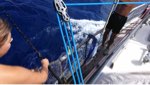
The fishing rod started rattling, and the captain’s agility was rewarded with an unusual catch: we caught a vivid blue sailfish from the marlin family, with a sharp, needle-like bill and a fan-shaped, rayed dorsal fin. On the whole, all that beauty has now been reduced to fried and stewed protein. The lentils will be ready in a moment, and then we’ll sit down to feast. It isn’t every day that the expropriators of Polynesian lands stormed the Bastille, so it must be celebrated )). And the captain has decided to dry the fish’s ten-centimetre spike of a nose. He just hasn’t yet decided whether he’s going to stick it in his nose or, after all, in his ear.
Dear folks, thank you for your comments and kind words! Get yourselves some paper charts; those of you who aren’t geographers, cast your minds back to algebra lessons on the coordinate plane, and—This is how great journeys begin, honestly!
We’ll keep posting our current coordinates: 11.27 south, 138.08 west. And an enormous thank-you as well to those wonderful people who click the Thank Us button on our website (the notifications reach us even in the ocean). We’re delighted that you appreciate our experience and our honest labours.
Be as happy as can be:). Wishing everyone summer and faith in yourselves! —