
From the Travely-Family archive · Cape Horn
The Only City on the Strait of Magellan
An original publication from the former Travely-Family website. This English translation was preserved from the technical-site archive without editorial rewriting.
The Only City on the Strait of Magellan
Epigraph:
— “You need a psychotherapy session,” I intone, mystically waving my hands over the captain’s feet sticking out from under the blanket. “The influence of your past-life experience, in which you were dying of hunger during the siege, combined with Mercury in retrograde, is compelling your subconscious to buy tonnes of food for a rainy day. We shall work through your subconscious and bring it back into consciousness. Ooooooh!”
We did not wait for the keel to make its ceremonial entrance through the cabin sole; we moved out to anchor. That first evening and night, the boat bucked so violently that we feared for the fate of the glasses on the table, and even rolled around on the double bed. It was supposed to calm down by morning, and the captain solemnly announced that I would spend a second day at home—that is, aboard the boat—and stand a working watch, so that if the yacht dragged anchor, she would not have to face her doom alone.
And off the captain went ashore with the sailor. He also took the mobile phone, along with the internet, on the pretext that he needed to top it up. He still hasn’t put any money on it to this day. Why’d he take it, eh? (in the accent from the cartoon about the bogatyrs).
Punta Arenas
The city on the Strait of Magellan was founded in 1848, when bourgeois revolutions were flaring up one after another across Europe. Here, at the back end of the world, nobody cared about revolutions. Chile and Argentina, though, could not agree where to draw the waistline—in other words, which part of the strait and the surrounding territories would go to the left and which to the right. Around Tierra del Fuego, among the fjords, they still have not reached an agreement, and Argentina resents Chile for it: supposedly, a couple of little straits there used to be ours, and you squeezed us out of them. Never mind; the time has not yet come to divide up Antarctica, where the sectors respectively claimed by Chile and Argentina as theirs overlap by 50%.
But we digress.
Returning from an evening walk around a city from which nobody had expected anything remarkable, my entire crew—the captain, sailor and young sailor—exclaimed:
“Great little city—beautiful. The houses and the square are just like Europe.”
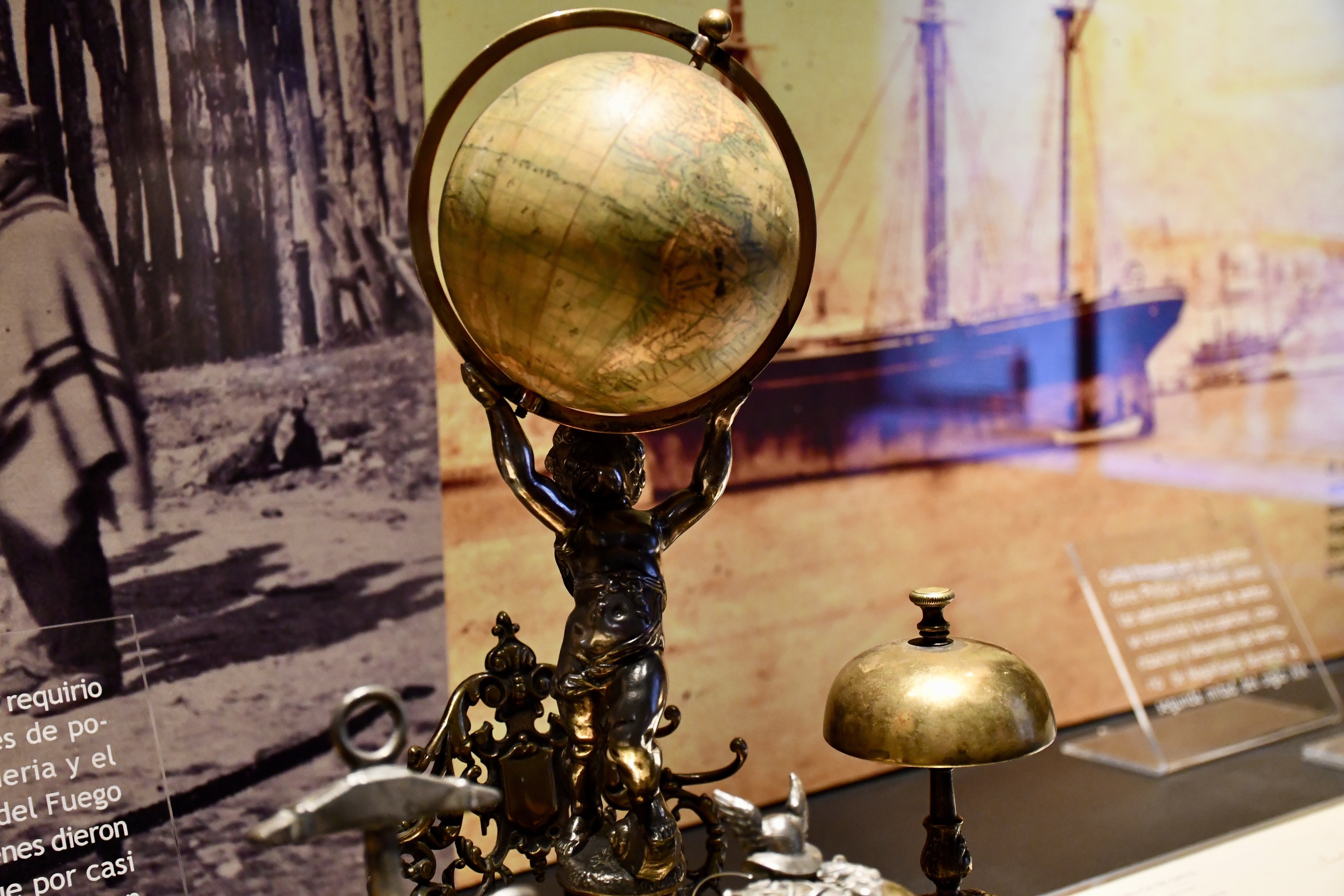
And indeed, a couple of streets are pure Madrid, only with fewer storeys and a narrower roadway. The mansion—or rather, palace—of one of the first and foremost distinguished settlers, a man named Braun, now houses a museum. Most of the house has retained its original furnishings, immersing you in the luxury of the turn of the twentieth century, while several rooms are devoted to exhibits of sabre-toothed tiger remains, antique rifles and spyglasses—the history of the Strait of Magellan. The influential Braun family had Russian roots: according to the museum records, they came from Courland, on the Gulf of Riga. In the early 1900s, the family married into another local noble family, the Menéndezes, and together they began propelling the region towards prosperity.
Another couple of palaces around the main square and several colonial streets are also worth seeing. It is pleasant to stroll around the town. It is a shame we regarded this stop as purely technical, so I consider stumbling upon the museum a tremendous stroke of luck.
Russians on the Strait of Magellan
On a tip from our friend Sergei in Ushuaia, we went to visit Kristina. She, her husband Aníbal and their baby daughter live in a house on a hill. We met as though we had known one another for years. Aníbal grilled steaks so good you could swallow your tongue. Heartfelt conversation, a walk and a shower made our day, despite all the running back and forth to the pier, which we first had to leave in the middle of the day, and then leave all over again that evening...
Kristina is from Vladivostok. One day, through Couchsurfing—when you host guests for free because it is interesting—she took in a group of motorcyclists who had already travelled halfway around the world, with the other half still ahead of them. Among them was Aníbal, an Argentine who had long since settled in Chile. After three days of walking around Vladivostok, Aníbal said to her:
“Come with me.”
“Why not!” said Kristina, and leapt onto the iron steed behind her prince from the end of the earth. Ten years have passed since then.
The couple organise jeep and motorcycle tours around Patagonia. They have several jeeps of their own and 14 motorcycles, and work mainly with Russian-speaking clients. So if you want to explore Patagonia from the saddle of a motorcycle or behind the wheel of an off-roader, Kristina is the person to contact. Here is her Facebook account:
https://www.facebook.com/motrenka
Provisioning....
“You need a psychotherapy session,” I intone, mystically waving my hands over the captain’s feet sticking out from under the blanket. “The influence of your past-life experience, in which you were dying of hunger during the siege, combined with Mercury in retrograde, is compelling your subconscious to buy tonnes of food for a rainy day. We shall work through your subconscious and bring it back into consciousness. Ooooooh!”
Only psychotherapy allows you to complain about your relatives’ shopaholism without symmetrical cuts being made in the area of your brain.
In the morning I even had to cry when I assessed the volume of our provisions and our ability to get through them before some of the food started rotting. And I had sent them shopping on full stomachs, too.
“You’d have done better to buy me a ticket home and a pretty dress instead of stockpiling all this. I told you not to buy tomatoes!... Grumble, grumble... And you hauled back a whole bucketful. They’re winter tomatoes here now, pinkish and translucent, the sort that grow fluffy mould before they even make it home from the shop... Grumble, grumble...” Then I waved my hands mysteriously, and everyone laughed.
Anyway, here is the phenomenon I have noticed: every time, we buy more food than before. Our current supplies will last us at least six months without resupply.
Our Young Sailor Is on Fire
After two shopping trips to the Punta Arenas supermarkets by dinghy came two hours of sorting through fruit and vegetables and hauling bags of groceries aboard. We spent another day, or perhaps even two, sorting out the dry goods; we still have not stowed everything away.
“Dad, maybe we could finish tomorrow? It’s dark and time for bed,” Ladunya suggests.
“Only the last eight bags left, don’t worry.”
“Are you tired?” the young sailor asked solicitously.
“Me?! Tired?! Normal dads never get tired.”
“But you’re not normal—you’ve taken your children to Cape Horn...”
The following day brought sunny, windless weather, and we went alongside the fishing vessel Arctic Wolf. It all began with an innocent radio message from Captain Eduard: “Come over; I’ve put together a little buckwheat for you, and a few other things...”
The gifts turned out to be an order of magnitude more than a little buckwheat, and the weather allowed us to remain alongside for half a day and visit a genuine floating fish-processing factory.
But that is a story for the next report. I hope we manage to send it.
J
Friends, thank you for being with us! Tonight, on the ebb tide, we are setting out through the Strait of Magellan for the Falklands. We expect the passage to take a week.
We are keeping in touch by satellite. Leave comments; they make the world a brighter place.
You can follow the expedition in real time on our website under the Route tab, where our Iridium track is displayed. Every two hours, the radio beacon sends a signal to the satellite; the points on the map are combined with the weather forecast, provide a basis for calculating our speed, and are presented as an attractive, informative graphic. The same map, with the track and details, is available at:
bit.ly/iridium360