
From the Travely-Family archive · Pacific Ocean
Passage to Easter Island. Days 17–18
An original publication from the former Travely-Family website. This English translation was preserved from the technical-site archive without editorial rewriting.
Heave-ho, heave-ho—we just can’t haul it in How we fished for marlin. A Pacific Ocean passage to Easter Island. Days 17–18. The Turnip, Hemingway-style.
~~~~~ _/) ~~~~~ _/) ~~~~~ _/) ~~~~~ _/) ~~~~~ _/) ~~~~~ _/) ~~~~~ _/) ~~~~~ _/) ~~~~~ _/) ~~~~~ _/) ~~~~~ _/) ~~~~~ _/) ~~~~~ _/) ~~~~~ _/) ~~~~~
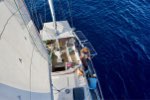
The deck of Lady Mary presents a tragicomic scene: Nastya is racing around the deck, juggling a camera, a rope and a gaff, while the captain strains at the fishing-reel handle. The aforementioned reel is rattling away, paying out through the closed drag. The first mate goes sprawling in the passageway after banging her back, her legs flying under the guardrails. A cold wind whistles straight into our faces, and the yacht bucks over three-metre waves. The young sailor, wearing only her knickers, tries to keep her footing by the companionway, brandishing an open bottle of rum.
We are into the second hour of active fishing. The cap has skinned his hands and has already spent some time dangling astern in a climbing harness. The first mate has bruised her back and legs. The windvane self-steering gear dangles helplessly on a snapped line. And we wonder which would be better: to win and then figure out what to do with 40 kg of meat, or to let the enormous marlin get away.
Today we crossed the Tropic of Capricorn. Perhaps that is where the realm of ocean giants begins? In the morning there was a nice plump little tuna. Enough for frying, fish soup and sashimi. By lunchtime the navigator read 23 degrees south, and the rod started rattling. Seasick in the headwind and heavy swell, the female contingent of the crew rejoiced with considerable restraint. The children were fed up with fish, and the first mate was fed up with the pitching—never mind the fish.
Meanwhile, we furl the genoa, then the jib, while the fish stubbornly pulls astern. Andryukha straps on the fighting belt and orders us to ready the gaff. The whitish body of a large mahi-mahi—about a metre twenty—appears among the waves. About 15 centimetres longer than Laduska. And I reckon you’d have no chance of hauling Laduska in with a fishing rod...
Having drawn the fish alongside, the cap hands me the rod and takes aim at its big blunt head with the gaff. But something goes wrong. The gaff slips and catches in a gill. The fish jerks, wrenching the implement from his hands. The cap grabs the line, which suddenly goes slack between his fingers. The monster vanishes into the watery depths with our second-most successful lure still in its lip. The sunken gaff turns out to be buoyant and waves its black handle goodbye to the crew.
Man overboard manoeuvre—or rather, not man but gaff. I point imperiously towards the gaff handle, Nastya starts the engine and gets out the landing net, Laduska wisely disappears into the saloon, and the cap takes the helm. Nastya is the one who has to catch a metre-and-a-half pole standing vertically in the water with the landing net. I have the hardest job: holding the fishing rod and keeping my pointing finger trained on the sunken implement.
On the second attempt, Lady Mary manages to edge over it sideways. The cap leaves the helm and hurries over to the sailor, who has begun an interception operation—climbing onto the side deck to hook the gaff with her foot. At last I stow the rod and dash into the thick of things, hoping to catch my daughter at least by her braid. By some miracle the gaff is rescued, none of the crew is drowned, and, while mourning yet another lure, we quickly fit the gaff with a retaining line.
The clock is hinting at dinner, while nausea is hinting that there will be no dinner. Because of the freezing cold here on the Tropic of Capricorn itself, we decide to wash in the cockpit rather than on deck. Lada has already had her evening shower. Squinting at the orange sun, the first mate has brought herself some water and a terry towel...
Nothing foreshadows disaster when suddenly the line screams.
“Ease the genoa! Go forward—we’re taking down the jib!” come the captain’s orders.
Swearing under my breath (forgive me, Lord), I shiver with cold by the jib on the foredeck. Judging by the strain, this giant is bigger than the last one. Reeling in the line takes obvious effort, and its end is still a very long way off.
“Oh! We’ve caught a swordfish!” the captain cries in delight.
“And what are we going to do with the sword?” the young sailor perks up.
“We’ll make you a sabre!” the first mate assures her.
But the sabre is pulling the captain towards the mermaids. Half an hour later, the lathered cap finally hauls the catch up to port.
“Mother of God, a marlin!”
And, like The Old Man and the Sea, we are losing to our catch three–nil.
The catch is as long as Nastya, or more—the span of the cap’s outstretched arms, at least. And our cap has long arms.
On spotting the gaff poised over its sword-like snout, the marlin surges with all its dolphin-like strength and dives underwater... And once more astern, then alongside, then back again. Racing after the catch is complicated by the operation tie the line—untie the line—tie another line: we have, after all, fitted safety lines to the rod and gaff. In the process we replace the gaff’s little line with a proper sheet led through a winch. The 20-knot wind and three-metre waves have not gone anywhere.
Ladka brings rum to ply the marlin with drink, and a knife to butcher the carcass.
“Maybe it would be better not to catch it? How are we going to get it aboard?” the captain wonders.
The giant reads our minds and joyfully dives beneath the hull—no chance of hauling it out from there, what with the propeller, the rudder and Iron Felix (the windvane) with its rather flimsy construction.
“Oops! It’s snapped a line on our windvane!” the captain reports, and tells the sailor to fetch the climbing harness.
The marlin swims forward under the hull. Lady Mary, harnessed to the marlin, joyfully breaks into a gallop. Andrei, dangling astern in the guise of a burr stuck to the backside of the galloping horse, fishes the line out of the embrace of the windvane blade. Then he comes back up to the rod. We are into the second hour since the bite. Sunset is approaching.
“Run to starboard with the gaff!” the captain commands.
I bound across the sea-swept deck, try to brace myself against the side and go flying out feet first. Braking with my back against the coachroof, I collapse into the passageway. Groaning optimistically, I squeeze out to the captain:
“I’m fine, ready for battle.”
“Nastya, the camera! The marlin’s alongside!”
The sailor rushes below for the camera and has barely switched it on when she hears a new order:
“Nastya, move the line from the shroud to the winch!”
The sailor bounds towards the companionway, tossing the camera between the young sailor with the rum and the cushions, then races to the winch.
“Hold the gaff!” That is for me.
Wedged between the side and the coachroof, I clutch the gaff in a death grip and stare into the marlin’s enormous eyes. Nooo, it’s even bigger than Nastya...
“The gaaaff!” the captain shouts.
And I realise that driving this implement into a head larger than my own, especially one squinting at me with a violet eye, would mean committing murder. More likely attempted murder, since I am hardly going to pierce the fish’s armour. I’ll only injure it for nothing. But I have no time to think it over: the moment is lost, and everything begins again.
Getting its second wind, the marlin dives under the yacht and heads astern. The solar-panel mounts creak, though not for long.... We do not even have time to speculate whether they will be ripped off or not before the line decides everything for us and snaps. The marlin disappears into the depths together with the pink silicone squid.
Curtain.
Epilogue.
“Aaaargh! How could that happen! Aaaargh! We let a beauty like that get away!” laments the captain, who had dreamed of catching a marlin. “Though maybe it’s for the best. How would we have got it aboard?”
“Oh, come on, don’t be sad. What were we fighting for? Forty kilos of stew meat. And what was he fighting for? He was fighting for his life! Justice won. And it’s a good thing, too. How would we have got it aboard?:).”
“And where would we have put it?” Nastya joins in. “We’d have been at it until morning.”
“And the whole boat would have been festooned with fish!” the young sailor laughs.
“Aaaargh! How could that happen! Aaaargh! We let a beauty like that get away!” the captain laments.
And that is how, in half a day, we managed to miss out on about 50 kilograms of pure fish meat and lose two lures.
In the evening, the satellite mail comes through. Our friends from the children’s flotilla heading for the Marquesas write:
“We have good news—we caught a huge fish. And bad news—the fish dragged the lure off into the ocean.”
“And we have news! Exactly the same. Twice!” we reply.
Friends, your comments and letters have arrived like balm to our souls, which the marlin had ripped out! Hurrraaaah!!!
We have no energy left for dinner. After their showers, the girls get seasick. And the sailor grimaces in annoyance:
“How does bliss turn into total disaster so quickly?!”
“Into a pain in the arse!” I chime in at the same time, prancing from the table to the bulkhead.
“Yes. Mum has a better way with words.” Nastya nods in satisfaction.
Nothing much has happened today. Nature is being sick.
Tomorrow morning we will approach the uninhabited island of Sala y Gómez. There is an anomalous magnetic zone there (like the Bermuda Triangle), an underwater rock and a chart that is not the most accurate. The crew can hardly wait.
We covered 115 miles in twenty-four hours. Current coordinates: 25°34′S, 104°46′W. 269 miles remain to Easter Island.