
From the Travely-Family archive · Pacific Ocean
An Uninhabited Island with a Magnetic Anomaly. Day 19
An original publication from the former Travely-Family website. This English translation was preserved from the technical-site archive without editorial rewriting.
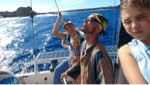
An uninhabited island with a magnetic anomaly. Passage to Easter Island, Day 19
The electronic chart of the Pacific Ocean around Easter Island and its uninhabited neighbour says: look for Sala y Gómez Island not where it is shown on the chart, but five miles farther east. Amen.
_/) _/) _/) _/) _/) _/) _/) _/)
At Easter Island latitudes, dawn breaks at nine. From half past nine, the captain’s eagle eye was fixed on the ocean east of the island’s charted position. An unusually large number of birds told us land was near. The birds circled curiously above the masts, settled on the water and tried to peer into the crew’s bright eyes. It seems humans are rare visitors here.
Morning tea in the cockpit (if a yacht is a floating dacha, then the cockpit is its front porch, with benches and a table. Except that instead of a table, we have a helm sticking up). Two-metre waves manage to make life miserable even with the sea astern. They hit us squarely on the beam, and when they really get carried away, anything that has not fallen onto the deck in the previous 19 days chooses this very moment to do so.
The captain climbed the mast. Came back down. Picked up the binoculars and, at last, the long-awaited cry:
“Laaand!!!”
The land turned out not to be where one usually sees it—just above the waves beneath low clouds—but much lower. And closer.
“I can’t see it. What does it look like, Andryukha?”
“Like sharp waves sticking up.”
“Oh! Right!”
Several sharp, motionless angles protruded from the restless blue.
For some reason, the depth sounder showed three and a half metres.
“A whale must have swum under us,” Andrei reassured us. “It’s still nearly a kilometre deep here.”
As we approached Sala y Gómez, the protruding rocks acquired more detail. Land appeared between them, and even the red-and-white pillar of the lighthouse.
Up close, the island looked more substantial than two rocks and a sandy isthmus. The isthmus was made of great grey boulders and rose considerably above the water, while the jumble of volcanic rocks was much more extensive.
Boobies flew over, puzzled, to make our acquaintance.
Hoping to find shelter from the wind and high seas, we rounded the islet from the south-west. But this scrap of land offered no protection. Turquoise waves broke against black basalt tuff on every side.
In calm weather, it would be possible to anchor. The depth sounder showed 16 metres, but there was no point stopping now: it would be impossible to land on the island without getting yourself killed. There was nowhere to come ashore—rocks and surf foam everywhere.
“Oh! Why don’t we take some photos and send them in for the Wikipedia article about the island?”
“Let’s!”
And we circled under sail, changing tacks.
We reeled in the fishing line, afraid we might catch a frigatebird for lunch. Then Nastya spotted a big fish in the water, so we paid the line out again. But the frigatebird noticed the bait once more and prepared to dive.
“Girls, would you like chicken for lunch?”
“Nooo!”
“Nastya, you were sad that there aren’t any chickens in the sea, only fish.”
Having decided we had no need for chicken, we launched a supersonic attack on the feathered bait hunter. Our young sailor began by whooping, then switched to long steamship blasts. The sailor and I shrieked and growled menacingly. The captain put two fingers in his mouth and filled the neighbourhood with a mighty whistle while pulling in the line: “You won’t catch it, you won’t catch it!”
We don’t know which part of this cacophony put the bird off, but whatever it was, it saved its life.
After completing another lap of honour, we established that this scrap of land had neither a sandy beach nor palm trees—not even a blade of grass. The birds were the only sign of life. We did not find the magnetic anomaly either; perhaps we did not look hard enough.
Time to set a course for Easter Island. The chickens fell behind, and the captain cast the line again.
The low islet quickly disappeared from sight, and on the horizon appeared the first ship we had seen in the last thousand miles. We were crossing the shipping route from Chile to somewhere like New Zealand. Because Easter Island’s economy could neither afford nor make use of an oil tanker like that, even in half a century.
190 miles to Easter Island.
In our excitement, the crew worked out that we could now eat not one apple per person per day, but one and a half. But the latest weather forecast put a damper on our apple feast. Northerly winds for several days. That meant we would not be able to anchor off the west coast of Rapa Nui (the local name for Easter Island), by its only village. We would have to seek shelter from the northerly wind in the south. There are anchorages there right beneath the gaze of the stone statues, and landing ashore should be possible. But we would not be able to reach any food supplies until we moved the boat to the village.
So we are rationing the apples again. We allocated two a day for the entire crew. Fried the last aubergine. As for fresh produce, we still have 4 tomatoes, 8 onions, garlic and a head of cabbage. We’ll live!
We decided to replace the apples with tinned pears, which just happen to be six months past their expiry date. And the tin is bulging. This should be fun (don’t worry, we still have a million tins of fruit that haven’t expired).
We hope to reach Easter Island on 9 May.
Current coordinates: 26°29′ S, 106°06′ W.
May your gardens be in bloom, friends!
Happy Radio Day to all radio folk, from the heart of the Pacific Ocean! While I have the chance, I’d like to send greetings to the editor-in-chief of Altai-FM, my dear friend Evgeny, under whose command I served as a DJ. Zhenka, I’ll be back yet (this is where there should be a laughing emoticon)).
And greetings too to my colleagues from Piter-FM, class of 2013, and the team at Yacht Radio.
“You’re brilliant!”