
From the Travely-Family archive · Pacific Ocean
Easter Island: Our First Foray Ashore and Its First Mysteries
An original publication from the former Travely-Family website. This English translation was preserved from the technical-site archive without editorial rewriting.
Our first foray ashore did not happen straight away—we spent several days waiting for a weather window. Here: the only village, the moai statues, people, shops and gardening. Sent via satellite link.
“Andryukh, film me!” I hold out the camera, ready to shoot, to the captain.
“I already got you twenty years ago.”
“Twenty years ago any fool could have got me! These days it takes a brave man.”
“Don’t worry, Marinochka! In another twenty years, the only people who’ll be able to get either of us will be gerontophiles.”
We are filming snippets from our first walk around Easter Island. The village of Hanga Roa (actually, Anga Roa—the initial sound represented by the letter H is not pronounced in Spanish) is the only settlement on this lonely scrap of land. Around 6,000 people live here. Our slow tender throws up clouds of spray as it crawls between two breaking waves. Surfers frolic in their curling blue. They are naked; we are in jeans and windbreakers. It is calm in the nook reserved for fishing boats, with two ropes stretched a couple of metres above the water.
The boats are parked bow to shore, with their sterns hauled out to the ropes. It is a good thing the dinghy has two lines. We rig ourselves between them too. Right by the quay are the backs of the first statues. They are not the most colossal specimens, but they must be three metres tall. One is half-ruined by the winds. In its base, the other conceals a bottle containing a hundred-dollar bill—a cache from the TV programme Heads and Tails. Or rather, it used to. In the four years since then, our compatriots have found it. And we set off in search of the place issuing money, SIM cards and provisions.
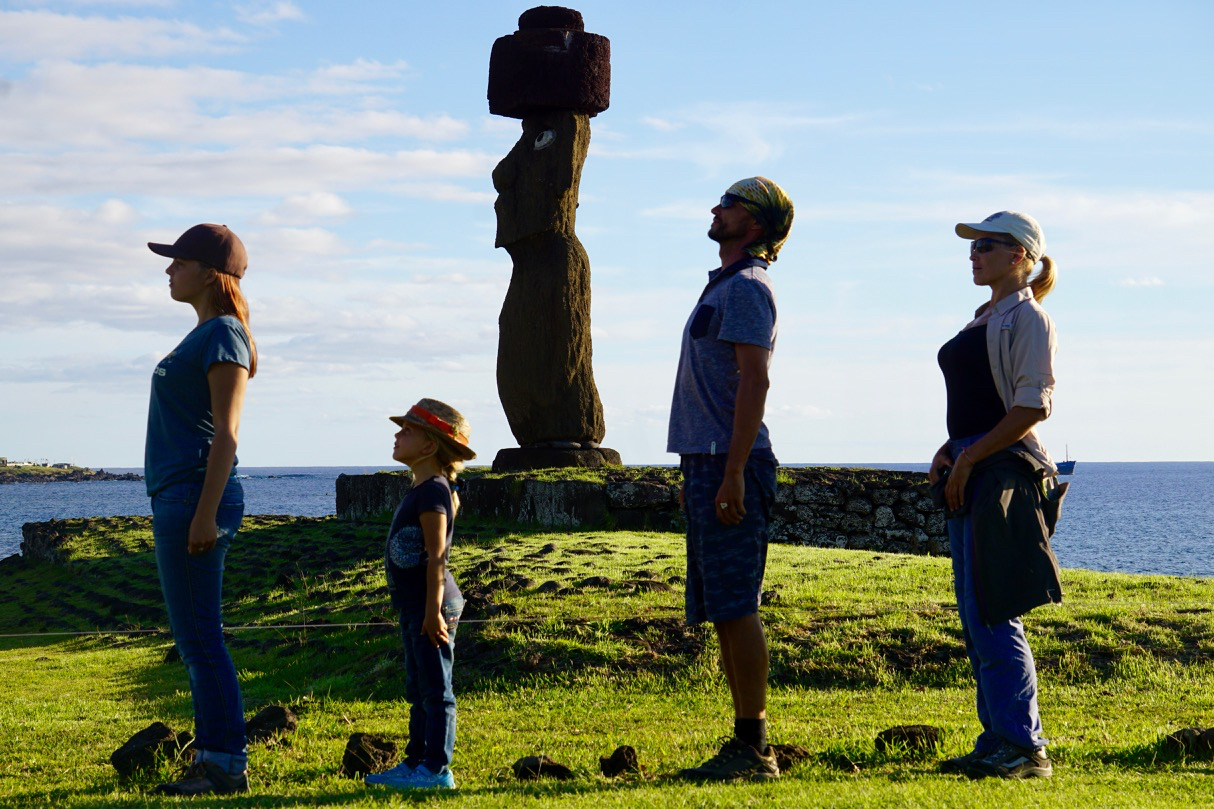
Rapa Nui is the local name for Easter Island. After reading everything we could find online and in our home library, I had pictured the island as rather bleak and bare. All the trees had disappeared before the Europeans arrived. This shifts one’s perception of the homeland of the stone giants from gloomy and mystical to gloomy and mundane.
“Well, did they really have to use up all the forests for scaffolding? Forests and scaffolds—the wordplay works better in Russian.” Yet the real Rapa Nui did not live up to those expectations. Trees are still in short supply on Easter Island, though not as desperately as they were 300 years ago. Since the first Europeans arrived, little patches of woodland have appeared. It is hard to call these strips forest, but just about possible. The livestock pens are made of wood, the fences of whole tree trunks. That is strange for a place that suffered an environmental catastrophe after losing its forests.
The Only Village
Hanga Roa does not so much live as flow through time. The occasional car and pretty little houses among curly-topped trees, bushes of colourful Chinese hibiscus, lots of dogs. Very clean. The people are warm and welcoming. It makes you want to stay longer. The bell of the little church strikes every hour—lest the Rapa Nui people accidentally forget that they are Catholics now. The small supermarkets stock enormous apples at $13 per kilogram and mandarins at eight. In a stylish music shop, one wall is hung with traditional Polynesian instruments—ukuleles of various kinds. The man behind the counter is teaching a boy to play guitar and lets our Nastya play a few passages on the synthesiser. We buy a CD of Rapa Nui music and continue on our way.
Passing a surf shop and a playground, we descend to our first piece of ancient heritage. Hands, faces and turtles are carved into boulders of red volcanic tuff.
“Andryukh, do you think it’s modern?”
“Unlikely. Why would anyone on an island covered in ancient statues go to all that trouble to make new ones look old?”
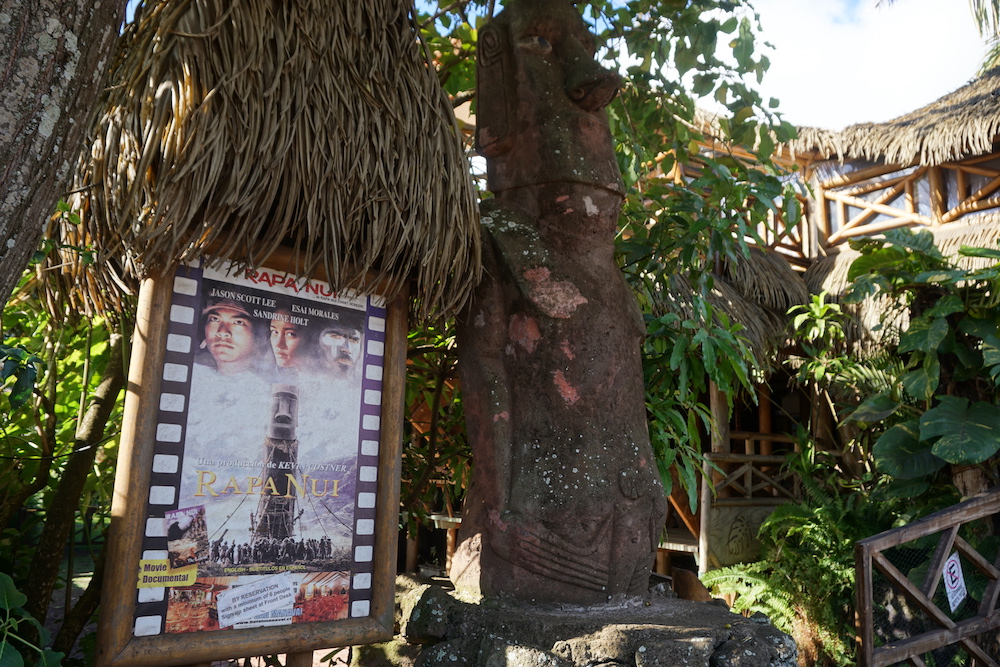
The cinema is showing the film Rapa Nui.
People sunbathe on a little beach among palm trees and wide-eyed stone faces. The national park blends seamlessly into the village and continues with it along the shore. Through the cemetery, where the memorials resemble Rapa Nui statues and rongo-rongo tablets bearing ancient script, we approach an ahu platform. Horses graze along the path. Five and a half silent statues, exactly like the postcards. The wind whistles, blowing microscopic particles from the outer layer of the petrified Rapa Nui ancestors. The sun bakes but does not boil you as it does in the tropics, where you are drenched in sweat after a three-minute walk.
The surf booms and whispers with the surfers, who have arrived on bicycles with boards on their backs. Easter Island always has waves. And surfers. Meanwhile, the ancient moai stare inland through empty eye sockets. Their faces are mute.
Statues Are for Grown-Ups
“I’m tired of these statues, they’re boooring! I’m tired and I want to go to the playgrooound!”
After three kilometres of walking, the junior crew member exhausted her reserves of optimism and began to whine. I explain that we will stop at the playground on our way back, but for now it is onward and onward, like Fedora’s runaway crockery. Andrei came to the rescue by identifying the end point of our route: a solitary statue about a kilometre and a half ahead. At that, the anguished wails abruptly ceased and Lada dashed off along the cliff. A new playground appeared beyond the scrawny trees.
“Phew.” I calmly take out my camera—at last, the junior crew member is occupied. But when I reach the playground, I find her bored little face peering out from beneath a wooden climbing frame. Wrong kind of playground. On to gardening matters. The plateau we have reached contains not only a children’s playground but also the fruits of the tree planters’ labour. Shaggy, half-pine-like trees cluster by the slope, and their offspring have been planted around the perimeter and near the cliff.
“Ah, it’s been ages since I last shifted rocks!” This brings us to the moment when I ask the captain to film me, and he replies that it all happened twenty years ago ))). I begin arranging boulders around the saplings so the poor things do not get trampled. Laduska perked up and joined me in saving Easter Island’s forest. Anything to keep a child amused, as long as she is useful. And after the gardening, the path to the final statue no longer seemed so difficult to the junior crew member, and we thoroughly enjoyed the walk. Photographic mania.
As usual, I bring up the rear. The long legs of the tripod stick up behind my back, a bag with a spare lens hangs from one shoulder, and the camera is on my chest. With a thoughtful squint beneath the peak of my cap, I look exactly like a photo-video maniac. Every wave and sheaf of turquoise spray, every burst of snow-white foam against black rocks, creates an irresistible need to immortalise that exact moment. The others walk three times faster and wait for me at rest stops.
At the final statue, the captain built a cairn symbolising the wonders of balance. The metre-high column of little stones, with gaps running through it, was photographed an instant before its perfectionist builder destroyed it by adding another stone. While filming the ocean and fireworks of spray on the way back, I discovered that the camera had accidentally switched from automatic to manual mode, while my hands had failed to make the necessary adjustments. What I had spent half the day assuming was natural overexposure from shooting into the sun turned out to be gigabytes of hopelessly ruined video.
Easter Island is a place you need to walk around for days on end. In good shoes, armed with a thermos, sweet buns and a windbreaker. If, of course, you want to grasp even a tiny bit of its soul rather than simply tick the “Vasya was here” box. That evening, we were told over the radio that the weather window was closing again. Tomorrow we will not be able to land in the village. In the morning we are leaving for another anchorage, one that will buck along with the ocean as it rushes off somewhere and once again fling us and the yacht’s other contents from side to side. More about that in the next report. Happy travels, everyone!