
From the Travely-Family archive · Pacific Ocean
Easter Island. 21 Days in the Ocean
An original publication from the former Travely-Family website. This English translation was preserved from the technical-site archive without editorial rewriting.
Easter Island. 21 Days in the Ocean
“Come on, come on, hurry up and become a human being!”
“That means, at sea, hurry up and become a sailor!” Nastya and I bawl as we bounce around on the wheelhouse roof. For the second time in an hour, we take down the mainsail. Twenty-five knots right on the nose (a headwind blowing at 48 km/h). Four-metre waves. The port is closed.
For our arrival at Easter Island, the winds have decided to put on a dance. They are swinging all the way around, strengthening to 30 miles per hour. First, we need to anchor off the southern shore. During the night, the wind will shift from northerly to southerly, and we will have to move to the north. But the high cliffs block the VHF signal, and there is no way to reach Pascua Radio: they cannot hear us. We are not allowed to anchor off the island without checking in on arrival.
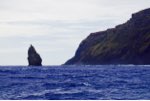
The first moai statues greet us off the southern shore. Ah, what a pity—we will not get to meet them just yet. Well, what are another 20 miles? We head for the village of Hanga Roa.
“Pascua Radi! Pascua Radio! This is the sailing yacht Lady Mary!…” We try to contact the harbourmaster’s office all the way there, but there is nothing but silence in reply. A cargo ship and a naval vessel are lying off the main village. The latter is of very strange affiliation: French flags at the stern and bow, and the Chilean flag beneath the port spreader (meaning that the vessel is French, but the crew is Chilean).
At last, a sleepy voice answers over the radio:
“State your call sign! The port is closed; anchor on the other side of the island!”
“Pascua Radio, which bay would you recommend? And what about the forecast? Ours says the wind will reverse direction during the night.”
“Proceed to Anakena Bay” (the very place where, a thousand or more years ago, the legendary Hotu Matu‘a and his party from Polynesia—the first settlers of Easter Island—came ashore).
And this is where we pull a fast one: we head from the western shore to the northern one via the south and east. The landlubber border guards and everyone ashore cannot get their heads around it—why sail 30 miles instead of 15?! But we know why! We are tired of fighting our way into 20 knots of wind and four-metre waves. We decide to round the island with the wind behind us. Proper heroes always take the long way round.
And proper border guards send an escort after such heroes. The naval vessel of uncertain affiliation weighs anchor and slowly follows us, its very presence hinting that we had better not try anything funny. For the next two hours, we sail under constant surveillance, noting that the military men conduct their radio communications in French.
Night falls. At eight in the evening, we pass the same point we passed at ten in the morning )). We look back at the headland beyond which lies Hanga Roa, the port closed to visiting yachts—and the headland has vanished! Clouds billow, and a fine drizzle chases down our brave ark. The wind howls as it kicks Lady Mary along so hard that our old girl accelerates to eight knots. The entire mysterious island is swathed in wet cotton wool.
“Andryukha, maybe to hell with it? Let’s tack out to sea—I don’t fancy anchoring at night in an onshore wind like this.”
While the captain monitors the situation, we sing heroic songs about “Sail and soul are one!” and “For you are Human, strong and brave!” Our frustration at the bad weather and the prospect of being unable to anchor for another half-day gives way to fighting spirit. Oh well, we battled through the ocean for three weeks; we can hold out for one more night!
The wind builds to 30 knots, and a starless night blankets everything. Easter Island sinks into the murk of the cyclone. The captain decides to head out into the ocean until morning.
We wipe the salt water from our faces, shed our jackets and prepare to ride out the storm hove-to. At least tomorrow will bring déjà vu: we will experience the joy of arriving at Rapa Nui all over again.
Happy Great Victory Day! Peace to our entire planet!
Coordinates: 27°02′ S, 109°11′ W
To Grandma Galya
To the Bogotins
To Grandma Sveta
SV.Sokolova40@mail.ru