
From the Travely-Family archive · Pacific Ocean
Passage to Easter Island. 12 Days in the Ocean. New Plans from the Crazy Castaways
An original publication from the former Travely-Family website. This English translation was preserved from the technical-site archive without editorial rewriting.
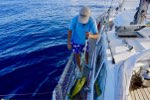
Passage to Easter Island. 12 Days in the Ocean. New Plans from the Crazy Castaways While the children are asleep, the ship’s senior officers have decided to crack open a little tin of Brie to go with our tea and coffee. I’m turning the metal lid from the cheese over in my hands. The captain stares at me in bewilderment:
“Throw it away—why are you holding on to it?”
“Yeah, but what if a fish eats it and dies?”
“If you crumple it up, it definitely will. Throw it like that—as a disc.”
“Yeah, but what if a big fish swallows it?”...
I always feel like a barbarian when I throw empty food tins into the ocean, and especially their lids. Every time, I cast a spell so that nothing takes a fancy to one before it reaches the bottom.
Overnight, the awning tore itself into two little half-awnings. After a mini-breakfast, we take it down. Goodbye, shade! The wind tries to wrench the awning’s flaps from our hands.
“Hold the edge!”
“Wait, I need to pull the pole out first.”
The captain pulls a two-metre metal tube out of the awning.
“Right. Otherwise it’ll fall into the sea, smack a fish on the head, and the fish will die.”
“Or someone will swallow it.”
“And then it won’t be able to poop. And it’ll die too.”
We laugh together and think how lucky we are to have each other. Weell, that’s what I personally think; what the captain thinks remained a mystery, because the fishing rod suddenly started screaming.
We drop the awning and take down the mainsail: the fish on the line is a strong one. The sail pulls us forwards, while the monstrous-whale-fish pulls us back. We need to kill our speed. Triumphantly, I grab the gaff. But the captain looks glum and starts reeling three times as fast. It gets away. It bit through the 18-centimetre lure right by the point where it was attached to the line. Just how big was that monster’s mouth?
We put the awning away. Now I’m exercising my willpower, trying to make myself sit down and sew it up.
At noon, the anticyclone chased away the clouds and brought sunny, near-calm conditions. Another banana cake is browning in the oven. Because the 20 kg of bananas—which aren’t actually bananas at all, but plantains, savoury cooking bananas like potatoes and sweet potatoes—are planning to rot unless we save them.
Judging by our correspondence with the flotilla that left for the Marquesas, banana cakes are top of the charts among all the crews in the second week.
Incidentally, the flotilla messages back and forth 3–4 times a day, reporting in meticulous detail who has a hole in their sail, who is sailing what course, how many fish they’ve caught, and what colour and size the waves are.
“Andryukh, why are they in touch so often? Can’t they manage without one another? Or are they afraid to be alone?”
We decide it’s both. It’s more fun and safer in a crowd. We’re used to drifting around on our own. Over time, we’re turning into travelling, daredevil homebodies:). And, in principle, we can go for weeks without any contact with the outside world. The other day, we had communications problems; the only thing that bothered us was that our families would worry. We searched for a way to call Mum, and our genius captain fixed everything.
But two weeks of silence from the outside world no longer frightens us. Solitude becomes familiar with time. On the one hand, you rejoice in any company like a child, while on the other, you’re perfectly content without it. Interesting metamorphoses of the mind.
There’s no one within a thousand miles. Even the birds, fish and dolphins disappeared when the anticyclone arrived. But the full moon, Saturn and the Southern Cross appeared instead.
Oh my goodness! Without the awning over the stern, you are so close to the sky that you become part of the Milky Way. It feels as though someone up among those stars can see you. A living swell, a path of moonlight as wide as our ark, the captain on deck writing a letter to Mum. The young sailor is singing away in the wheelhouse:
What year is the lad from, What ship did he sail on?...
Nastya is delighted that her evening shower on deck hasn’t frozen her limbs off—we’ve crossed 17 degrees south latitude. It’s deep autumn here.
And what a relief that the headwind is over. Friends, thank you to everyone who cast spells for a following wind! You managed it after all:).
The nearest land, Easter Island, is 820 miles away. Although we’ve decided to stop off somewhere else along the way. That’s what the change in the wind has done to us.
There’s an uninhabited island 170 miles from Easter Island: Sala y Gómez.
Easter Island is the most remote inhabited island not simply from other land, but specifically from inhabited land. Because the nearest person to the Easter Islanders lives on Pitcairn Island—the very island where the mutinous ship Bounty found her final resting place. Pitcairn is 1,120 miles from Easter Island.
So, anyway. Sala y Gómez Island.
“What do you know about it?”
Neither do we. There’s something suspicious about it. About 800 metres at its longest point. And uninhabited.
We want to see whether palm trees grow there.
We’re laughing at ourselves.
That’s all the news from aboard for now.
Coordinates: 17.27° S, 99.00° W.