
From the Travely-Family archive · Family, Children and Life Aboard
Homeschooling on a Yacht
An original publication from the former Travely-Family website. This English translation was preserved from the technical-site archive without editorial rewriting.
Homeschooling on a yacht.
If you are sure that switching your child to homeschooling will free them from routine and leave them heaps of spare time, you are mistaken.
If you are sure that it is impossible to study properly without going to school every day, you are mistaken.
The story of our misconceptions. Experience and arguments.
Schooling and homeschooling
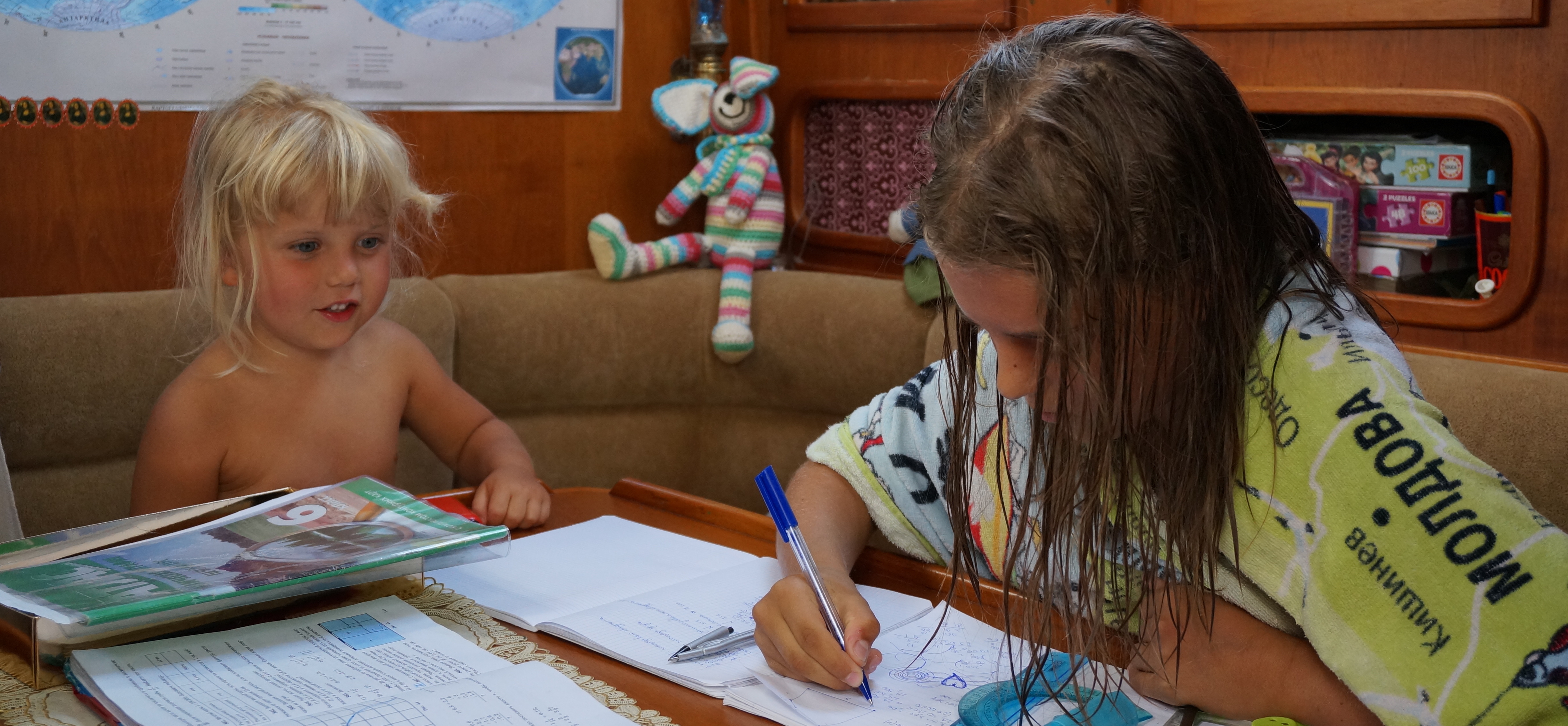
I am not an ardent advocate of homeschooling (hereafter HS), nor am I a fan of the school education system, because I know both firsthand.
For those accustomed to heaping shame on Russian schools, I will say that our teachers are not tasked with turning children into cogs in the system, and that is not what they teach at teacher-training institutes and colleges. For the most part, good people work there, enthusiasts in their field who urge teachers to see every child as an individual, to stay ahead of their development and lead them forward. I personally verified this fact during three years at a teacher-training college and later at a pedagogical university. It is the system itself that is cumbersome and slow-moving, and there are excesses at the local level too.
One advantage of Russian school education is that it is among the best in the world. When a Russian pupil joins the same grade at a European, American or other foreign school, they know many times more in virtually every subject than their new classmates. Yet they are less free in their thinking and less successful at finding unconventional solutions than their foreign peers. Sadly, that is the case.
If you dislike the drilling and levelling-down at an ordinary school, do not expect your child to turn instantly into an inquisitive genius after switching to homeschooling and start eagerly mastering every subject in the school curriculum. Giftedness is innate. Parents who write about their child’s sudden, incredible success after leaving school for homeschooling, achieved with minimal time and effort, are very lucky: nature blessed them with a capable child.
Our previous experience of homeschooling ordinary children up to the ages of 14 and 4 is described here:
Homeschooling on a Yacht, 2015.
Background
We have been familiar with HS since first grade. Before the yacht and at the beginning of our yachting life, Nastya attended school for the first one or two terms, then left for the sea and returned by May to take her tests and move up to the next grade. It was a village school, and the formalities amounted to a written application worded as follows: “We ask that our daughter be excused for a recuperative holiday (or due to her parents’ extended business trip); we undertake to cover the Grade ‘...’ curriculum independently.”
First grade in Thailand
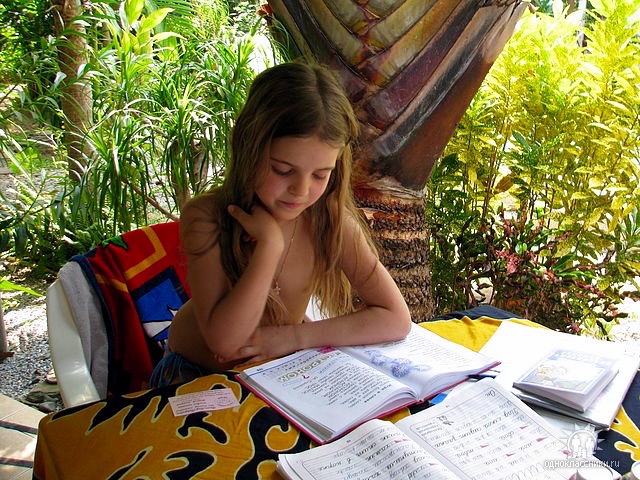
There were no Russian online schools yet. Studying went like this: for the first two or three weeks, while the school’s kick up the backside still had some effect, Nastya worked to a timetable every day; then she ignored her studies for a month or two under the slogan “I’ll start tomorrow”; and in the final month, buckling under the weight of our “Just wait till they make you repeat the year—that’ll be fun,” she sat down with her textbooks and caught up on everything she had missed in exam-cramming mode.
This approach allowed the child to see a great deal, avoid getting ill in winter and earn mostly good and excellent marks. So the teachers would have something to enter in their registers, our young sailor periodically emailed them photographs of her tests and assessments.
Two years ago, regular visits home became impossible, and we officially withdrew from school to go “NOWHERE.” That was halfway through Grade 7..
A new experience. Ordinary children in unusual circumstances
After leaving school, as usual, diligence in studying gave way to apathy after three weeks. And unlike on previous occasions, it did not return even by the end of the school year. The reason is simple— The “Education is enlightenment” kick up the backside, administered by parents without any third-party involvement, is NOT magic.
Lectures, threats and cajoling along the lines of “Do you really want to spend the rest of your life cleaning toilets?!” merely instil in a teenager an enduring dislike of conversations about studying and a fear that they really will spend their whole life cleaning toilets. For some reason, however, they do not motivate them to take action. At least, they did not work for us.
The only consolation was that our daughter read a great deal. Dumas, Jules Verne, Fenimore Cooper, plus modern books such as Divergent and Timeless. There was Pushkin too.
Our young sailor and In Search of the Castaways
By the summer holidays, the “Schoolwork” cart was stuck somewhere between 7 and 10 February and refused to budge any farther. The captain, as calm as a boa constrictor, soothed Mum’s anguish by suggesting that we simply leave the person alone for a few months. “She can’t do nothing forever! She’ll get down to studying eventually.” Meanwhile, Nastya’s classmates moved up to Grade 8..
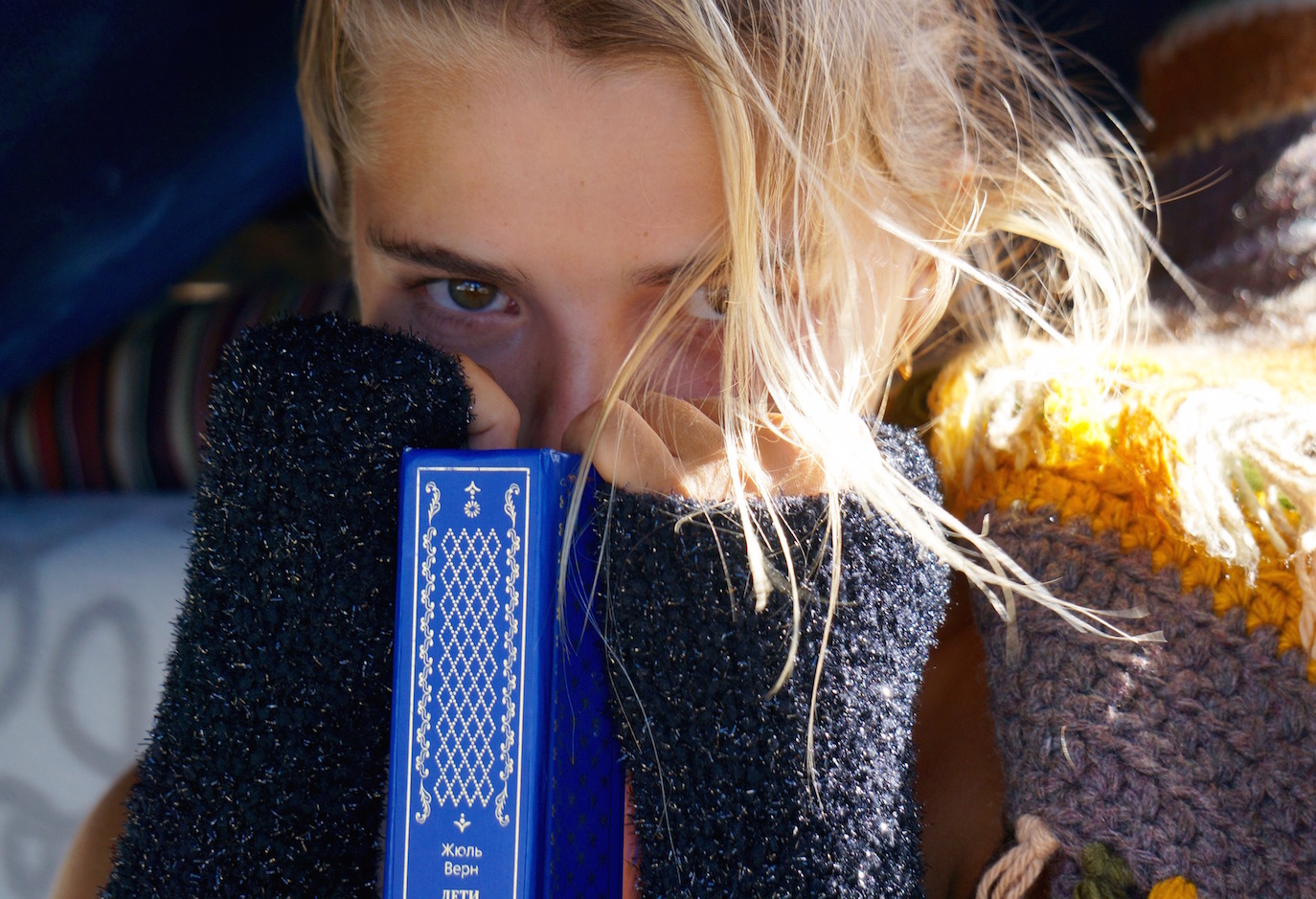
School? Never heard of it
It turned out that a teenager removed from an environment where everyone goes to school every day is perfectly capable of doing nothing forever. The sea, the heat, an endless holiday. Occasionally there were flashes of enlightenment, and the website internrturok.ru would finally be opened. We even downloaded video lessons and notes for every subject from Grades 7 through 9 so that she could study offline. That was also when we discovered the Home School on the aforementioned website.
If Andrey and I had been in complete agreement over our overall approach to education, the young lady would already have been enrolled in that school. But Andrey considers most of the school curriculum senseless and merciless, and memorising mountains of useless information a dead end. Besides, the “leave the person alone and let her find herself” experiment was in full swing aboard the yacht.
For me, this was the hardest part. If studying always came easily to you, and if from an early age you had enduring interests in several fields, it is extremely difficult to accept that your child lacks these qualities. And you desperately want to find out which qualities they do possess.
It does not matter if your child is unlike you and is interested in entirely different things. What matters is that the interest exists. Then there is something to develop.
My task is to discover what my child likes so much that she is prepared to make it her life’s work. Be it space exploration or cross-stitching. Our elder young sailor is interested in music and singing, occasionally in drawing, and she also loves cooking. And she would like to become the head chef at a top restaurant J. But it is precisely “would like to,” not “at any cost.” So, during an entire year off from school, Nastya cooked soup, a main course and stewed fruit for the whole crew, learning the Moonlight Sonata on the keyboard and chords on the guitar in between.
And let us not forget that in our case the children are automatically immersed in a powerful educational environment. Three subjects are actively studied in practice: geography, history and a foreign language. Reading, keeping a diary and writing coherent Instagram posts more or less fulfil the roles of “Literature” and “Russian.” The exact sciences huddle gloomily in the cupboard.
Meanwhile, our younger young sailor turns six. Somehow, in passing, she has learnt to read and count, speaks a little English, and when the mood takes her, draws and cross-stitches quite well. She swims and races about like a mad thing and is sometimes lazy. Because of her tender age, there are no educational problems with her yet. When they begin, we will enrol her in school.
Family reading. Now Lada reads to us herself.
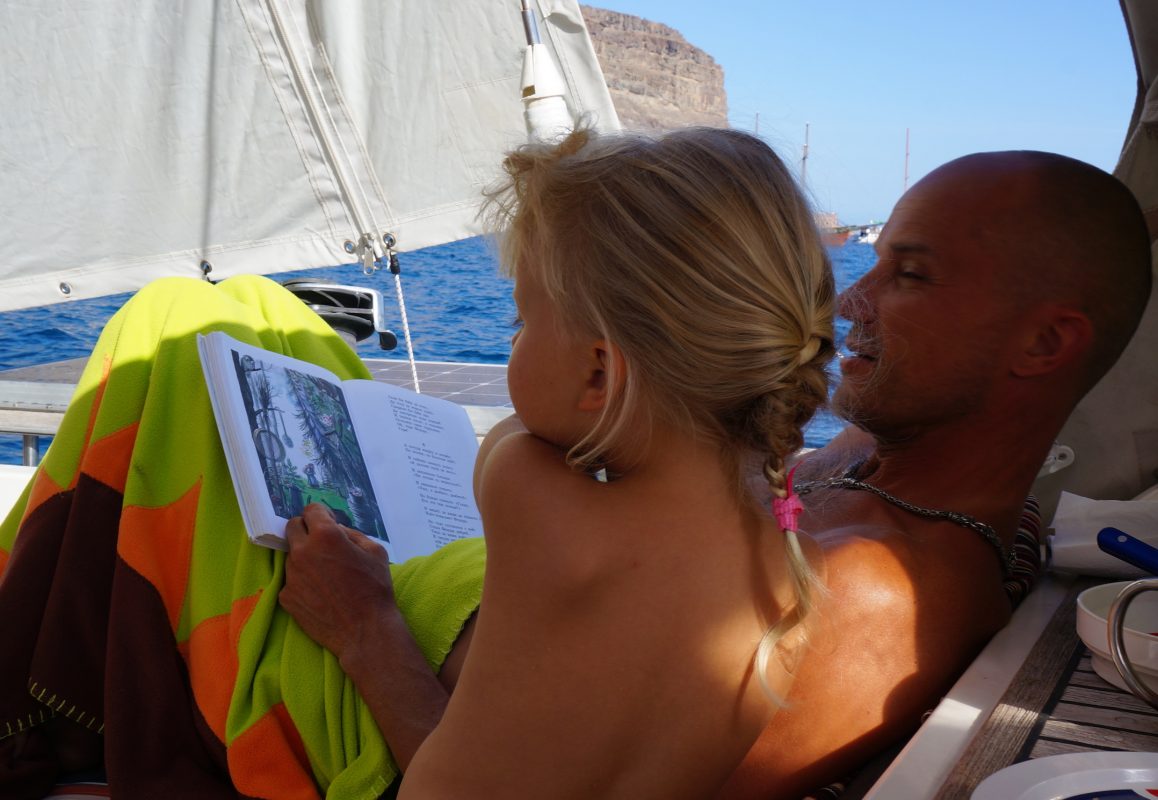
Midnight draws near, yet Hermann still has not come
May 2017
Nastya’s peers are finishing Grade 8, while after a series of stern talks she herself finally plucks up the courage to sit down and catch up with Grade 7. Since there is nowhere along our route for her to take the OGE anyway (there are no Russian embassies in the Pacific Ocean, and flying home costs megabucks), we are not horrified by her being a year behind. On the other hand, the girl is sailing around the world, knows how to handle a yacht and communicate with foreigners on their home turf, has picked coffee, has seen how breadfruit grows, and plans to land on Easter Island in the near future.
August 2017
On the eve of the current school year, heated debates arise among our crew about the form her education should take. Andrey proposes his own programme, based on the principle of a close interrelationship between the subjects studied, while I argue for an online school.
My motivation is discipline in mastering the material (I suspect ours will be lacking) and a desire not only to educate the children, but also to attend to my own affairs, including work. If you decide to educate your child yourself and achieve a positive result, I advise you to forget about any other intellectual activity.
Here is a copy-and-paste of the piece published for 1 September, plus readers’ comments giving the pros and cons from our Facebook group. It also includes useful advice and recommendations for various programmes that were sent to us privately. Special thanks to the authors for those!
>>
The Education Post.
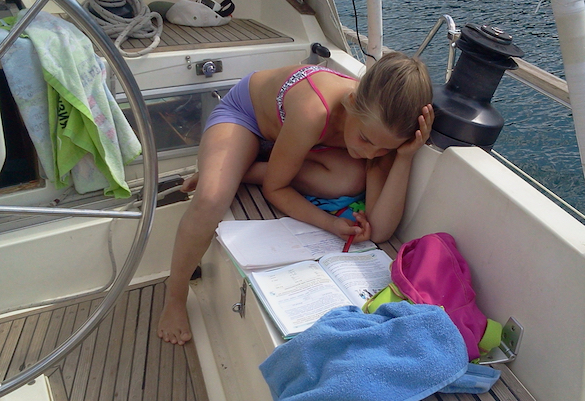
Montenegro, 2014
After some thought, Nastya chooses to try Dad’s plan.
Results of the experiment for the first term of the 2017–18 school year — several good literature essays written — several interesting history reports — various numeral systems and numerals, from Roman to Arabic, studied — several extensive reports on the countries and cities we visited.
We never did get as far as the exact and natural sciences, and I managed to persuade my colleagues (Nastya and her dad) to enrol in an online school with a teacher from the second term onward.
Online school
Link to the main website:
intrneturok.ru
Link to the Home School website:
home-school.interneturok.ru
Reasons for choosing this particular school — it operates on the basis of a well-developed online educational resource that we have known and used for several years — it issues a state-standard Secondary School Certificate (under the “with assessment” format) — all interaction is remote; physical attendance is required only twice in 11 years, when taking the OGE and EGE examinations — the possibility of studying offline, with internet access once a week or once a month, was agreed individually (the latter suits us) — a well-established pupil–teacher communication system (especially with constant internet access) — affordable tuition fees.
We really ought to charge them for the advertising;).
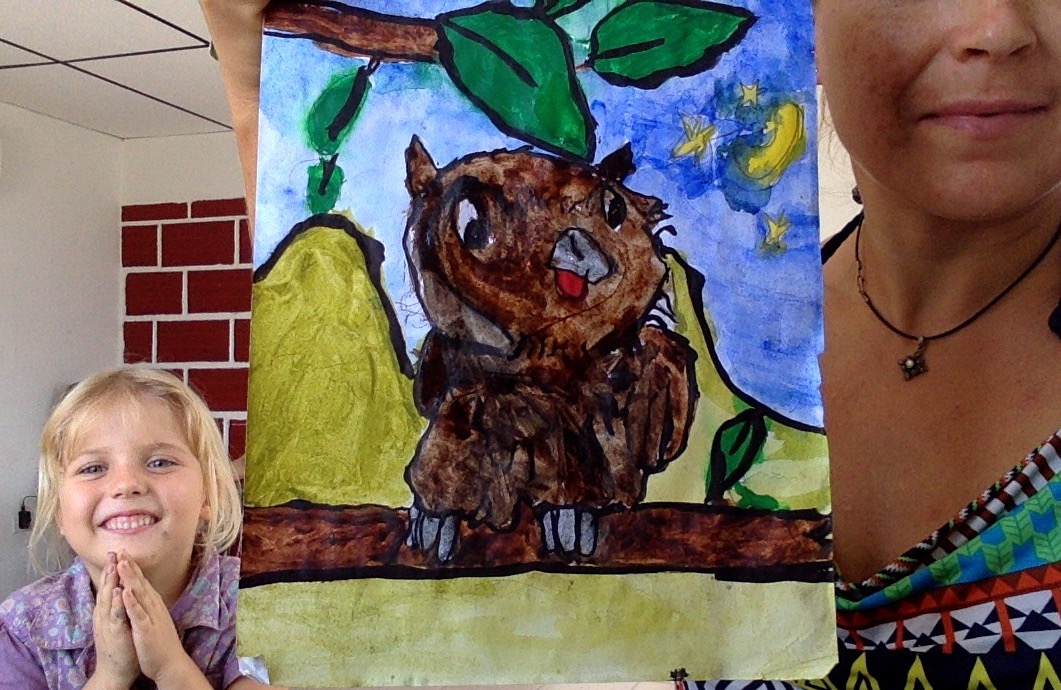
Ladunya’s homeschooling. She suddenly decided to draw an owl all by herself.
To organise the learning process, you need:
— a computer running
Windows; — the software (video lessons, notes, practice exercises and homework) downloaded to a separate memory card (flash drive); — a printer for printing the forms on which the homework is completed.
One potential disadvantage of a large online school serving all Russia is the lack of an individual approach and less flexible conditions than a smaller resource might offer.
Another drawback (probably inherent in any online school) is that homeschooling does not cover the subjects of Technical Drawing, Art, Technology and Physical Education.
So, what do we have today?
With a daily timetable, video lesson, notes, practice exercises and homework, as well as strict deadlines for submitting the latter, our inquisitive genius sits down to her lessons every day at 7 a.m. And for the most part, she completes the assignments in full and on time.
Because our genius’s inquisitiveness does not extend to the exact sciences, geometry and algebra consume an enormous amount of time, often from morning until evening. On such days, tears are shed generously by both pupil and her dear mama.
We do not require Nastya to earn an “excellent” or even a solid “good” in subjects she dislikes. She simply has to pass them in order to finish school. May the perfectionists forgive me (I understand you very well—personally, no mark below a “5” existed for me at school, and despite my perpetually bad behaviour, my Certificate had top marks across the board; but experience has shown that this is not what matters most).
What matters most is allowing your child to be different from you and to follow their own path without the burden of failing to live up to parental expectations.
A pleasant social bonus of the online school came in the form of a group chat for virtual classmates on a social network, where they communicate quite intelligently and cheerfully.
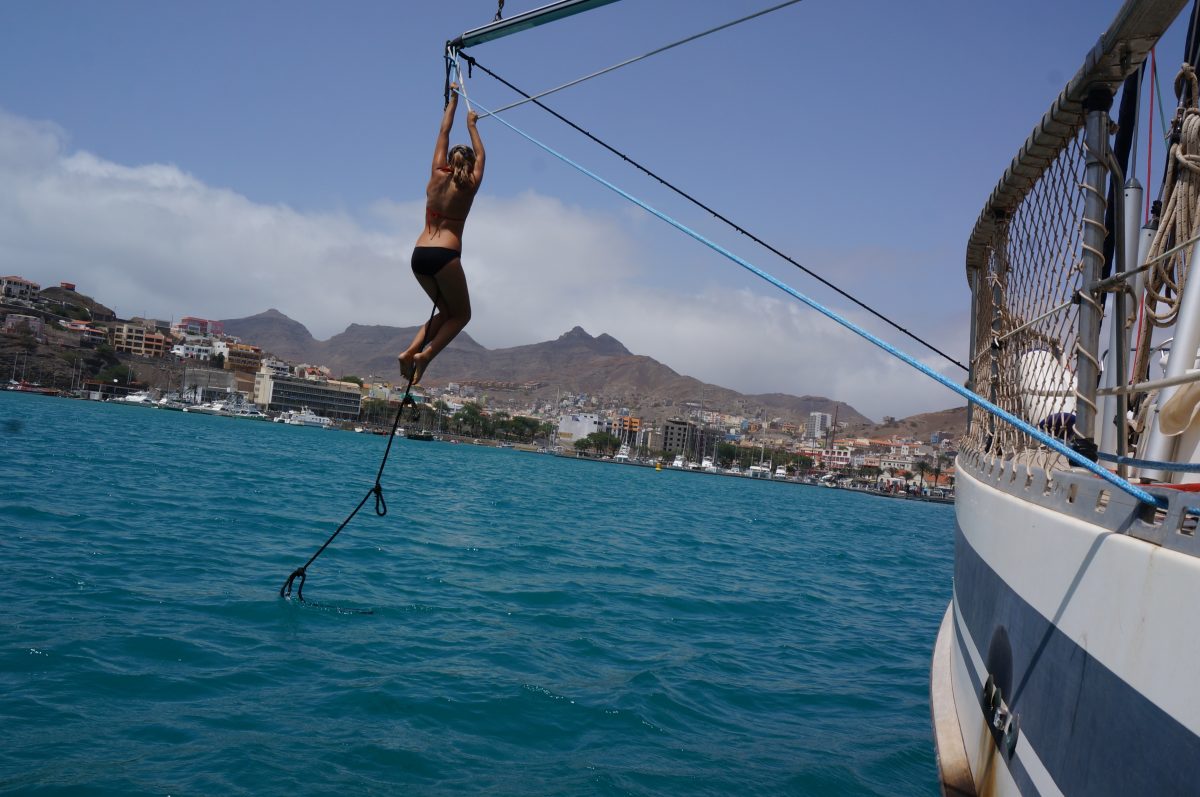
Homeschooling on a yacht. Now that’s a PE lesson )
Our experience has shown that without the kick provided by externally imposed deadlines, a teenager does not work.
Why did we choose Russian school education?
Because it is simple and familiar. For now, Nastya is considering a future in Russia, so I believe it necessary to give her 11 years of schooling; where she goes and what she does afterwards is up to her. A voyage around the world clearly demonstrates that any path, any country and any Life’s Work are possible.
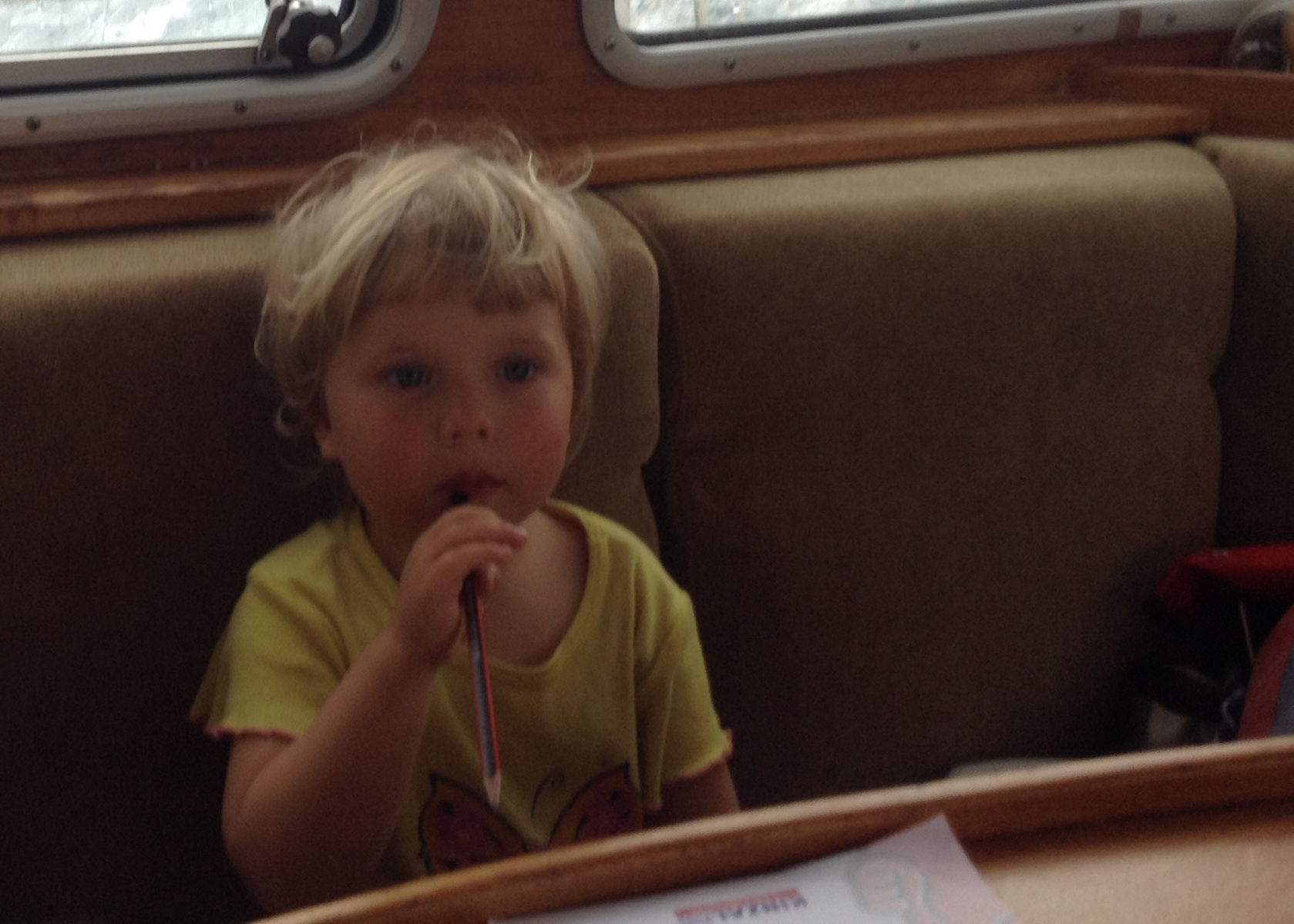
If you choose homeschooling without any affiliation to a school, be prepared to spend the lion’s share of your time every day explaining the material and motivating your child to study today rather than “later.”
The exceptions are gifted children who adore studying.
Friends, if you have experience of educating your children independently, please share it in the comments! Our method is by no means perfect; we are learning from you too.
Wishing everyone interesting thoughts! 🙂
Lada’s first homeschooling
Other pieces about education and socialisation while travelling
The Education Post + useful comments from readers
Homeschooling on a Yacht, 22.06.2015
Children on a Yacht: Socialisation and Safety
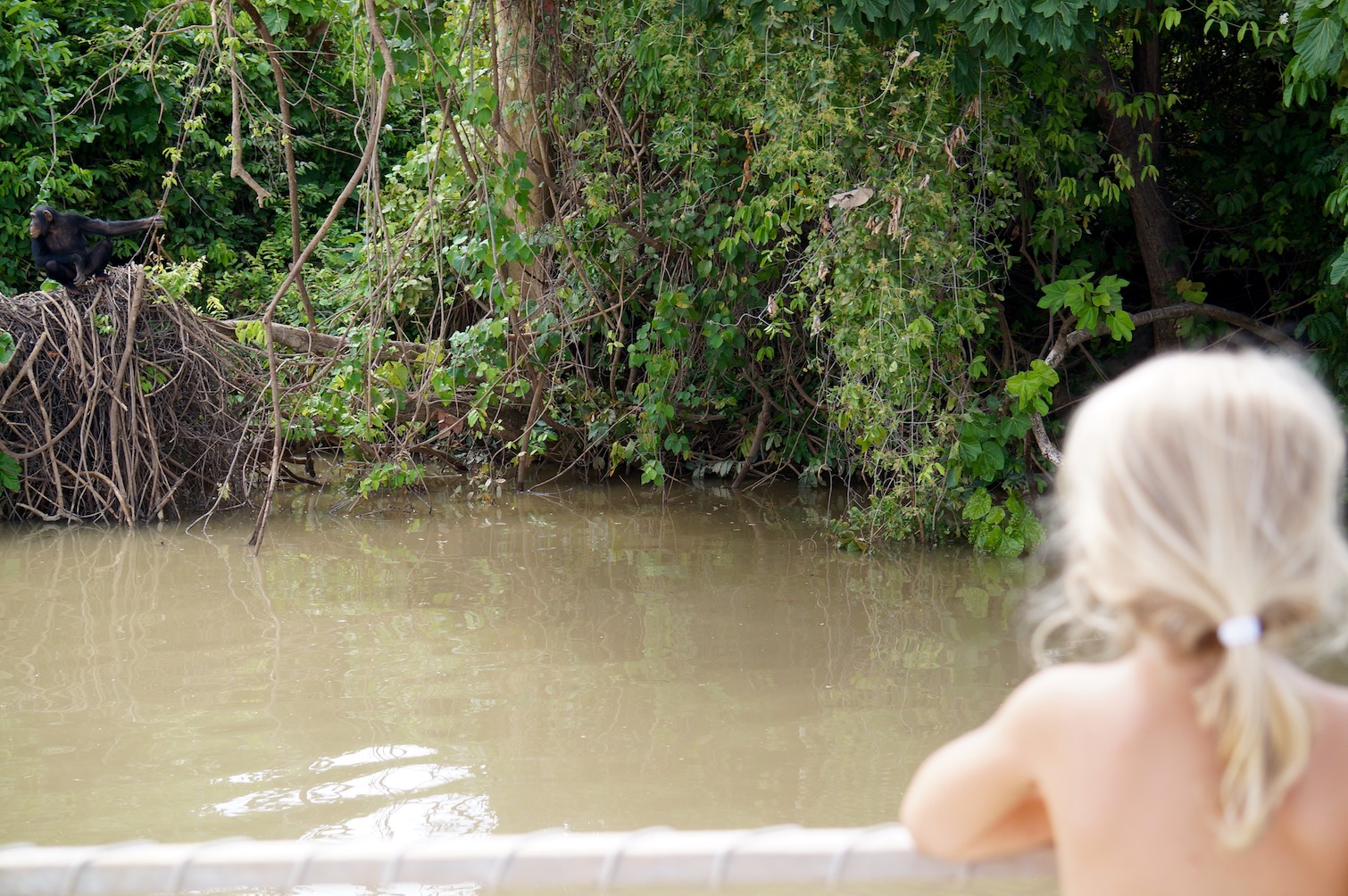
What You Don’t Get at an Ordinary School. The River Gambia. Lada Aboard and a Baby Chimpanzee in the Wild
Follow the videos and Instagram details of our family voyage around the world!
live video on our sailing circumnavigation channel on YouTube current details of life on our voyage around the world—in our Instagram
A voyage around the world through a teenager’s eyes —in our daughter Nastya’s Instagram
Leave comments and write to us, friends! We miss real, live communication.