
From the Travely-Family archive · Cape Horn
Day 52. Good News
An original publication from the former Travely-Family website. This English translation was preserved from the technical-site archive without editorial rewriting.
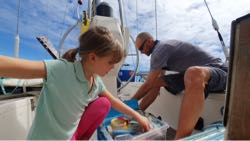
Day 52. Good news. Early morning, 19 October. There’s a rule: the moment you write that the next report will be out tomorrow, some sort of emergency is bound to happen. Yesterday, for example, we failed to establish contact with outer space, so we were left without email or a weather forecast. According to the not-so-fresh forecast, if we don’t cover a third of the remaining distance to Cape Town today, we’ll get stuck with a headwind tonight. Our speeds over the past few days have been nothing to cheer about: one day we make 27 miles in 24 hours, another, thank God, 60.
Though really we ought to be making 120................................................................................................................................................................. We’re zigzagging around, barely getting any closer to our destination. One moment the sails are flapping lifelessly, the next they’re carrying the yacht in the wrong direction. Lady Mary draws closer to the shipping lane from the Americas to Cape Town, then moves away from it to the north or south—in short, she’s weaving about, covering her tracks.
Meanwhile, a quiet resignation has settled over the crew: so we’re delayed—so what. We’ve stopped counting the hours and miles. By rights, in a couple of hours we should already have been making our grand entrance into Table Bay, in the glorious city of C, but it is still more than 200 miles away as the crow flies, which, given the expected headwind and our recent speeds, could stretch into another 3–4 days.................................................................................................................................................................
The swell is slight; we’re close-hauled in light winds, making up to 5 knots. If only we could hold this speed, but the wind is dying before it swings around onto the nose. While the crew sleeps, I amuse myself by fine-tuning the sails, trying to point as high into the wind as possible. But it isn’t going very well. The boat wants to sail on a beam reach. I refuse to give up. The captain will be up soon and will poke fun at my clumsiness. But for now, this is my time. After several kamikaze squid flung themselves onto the deck, we opened the fishing season after a break of more than a year—hurrah!
In the evenings we cast using squid as bait, but most of the time all we catch are tentacles. Once, a big fish took the bait, but it had no desire to become dinner. So all that remains is to fry up the scraps of tentacle for breakfast................................................................................................................................................................ 10 a.m. Hurrah! We managed to make contact and update the forecast.
And there’s good news. The headwind has been cancelled and a decent wind switched on—we’ll fly in by the morning after tomorrow. It will strengthen to 30 knots near the coast. Let’s just hope it doesn’t blow any harder, because we don’t like approaching land in a storm. It’s hard to believe that in two days we’ll finish the second epic stage of this difficult journey and approach the great and terrible Cape of Storms. That was what the Portuguese explorer Bartolomeu Dias called it in 1488. Terrible storms battered ships attempting to find a route to India.
A storm swept Dias out into the open ocean. When everything calmed down, the brave Bartolomeu turned north and soon ran into a coastline that, for the first time along the entire length of Africa, curved away to the north-east. The crew turned out to be an unromantic lot and did not support their commander’s idea of venturing into the Indian Ocean. The Portuguese returned home. King João rejoiced at the discovery of a route into the Indian Ocean and rubbed his hands together: Now my Murka and I will bring back twice as many spices from India.....
And in the name of that blessed hope, he rebranded the place, so that everything would have good feng shui. And the Cape of Storms became the Cape of Good Hope. Then, in 1597, Vasco da Gama confirmed that very feng shui, established the sea route to India, and secured the spice coast for the Portuguese for almost 300 years. Everyone else had to seek alternative routes, make great geographical discoveries, and undertake voyages around the world.................................................................................................................................................................
The young sailor and I are looking through a book about geographical discoveries, sent to us at the ends of the earth by Dmitry Samoilov. We compared the routes of the great navigators with ours. Clearly, in the Southern Hemisphere we are retracing about 80 percent of the route from Jules Verne’s novel. As for real historical figures, this is how it went.... or so I wanted to write, until I began describing all the routes of the great explorers whose space-time continuum intersected with our own journey. It comes to another post and a half.
I’ll have to finish it next time................................................................................................................................................................ For now, let’s talk about Cook. In August 1769, James Cook sailed south from Tahiti aboard Endeavour in search of the southern continent. According to his instructions, he was to continue to 40 degrees south latitude. If the southern continent had not materialised by then, he was to turn west and sail between 35 and 40 degrees.
That was how Cook reached New Zealand. From Tahiti to 37 degrees south, we followed precisely in Cook’s wake, except that at the 37th parallel we turned east rather than west. In the latitudes around 50 degrees south in the Pacific, all the way to rounding Cape Horn, Cook’s path and ours intersected once again. That was during his second voyage aboard Resolution in 1774–75.!................................................................................................................................................................
Cook was still searching for the unknown southern continent and came very close to it several times. Had he sailed a few degrees farther east or west, he would certainly have stumbled upon it. Looking at a map of Cook’s voyages, it’s almost painful to see how close he came to Antarctica, only for the ice to force him past it every time. On leaving the polar latitudes, the navigator declared that if the Southern Continent existed at all, it lay far away near the South Pole, in places inaccessible to ships. And land that cold was hardly likely to be good for anything.
After that, interest in the search for Terra Australis Incognita faded for half a century. I’m taking a break from the young sailor’s and my geographical and historical research so that I can finish and send this post. The rest will come later. Yes, all three of Cook’s voyages called at Cape Town, where Lady Mary will be in two days’ time. Keep your fingers crossed for us—the finish of the second stage is close!...............................................................................................................................................................
Friends, thank you for your morale-boosting comments. Here on the very home stretch, when we have so little patience left, your warm words fill us with positivity and make everything go more smoothly and joyfully. Hugs from the whole crew!.... Today our contact with the satellite was successful, and we received two days’ worth of email. Among the messages were notifications of contributions to the expedition’s ship’s fund via Paypal.Me/TravelyFamily and Yasobe.ru/na/TravelyFamily! Huge thanks to Evgeny Kh. and Dmitry D. You make this world a better place, and us happier..............................................................................................................................................................
Sent via satellite. You can follow the progress of the First Russian Three Great Capes Round-the-World Expedition with Children on our website under the Route tab, where the track from IRIDIUM is plotted. The same map, with the track and weather, is available at bit.ly/iridium360