
From the Travely-Family archive · Cape Horn
The Former Southernmost
An original publication from the former Travely-Family website. This English translation was preserved from the technical-site archive without editorial rewriting.
The Former Southernmost
The Arctic Wolf from the Strait of Magellan. The fishing village of Mansa and the former southernmost city on the planet. Fellow Russians in the roadstead. The only yacht in a closed port.
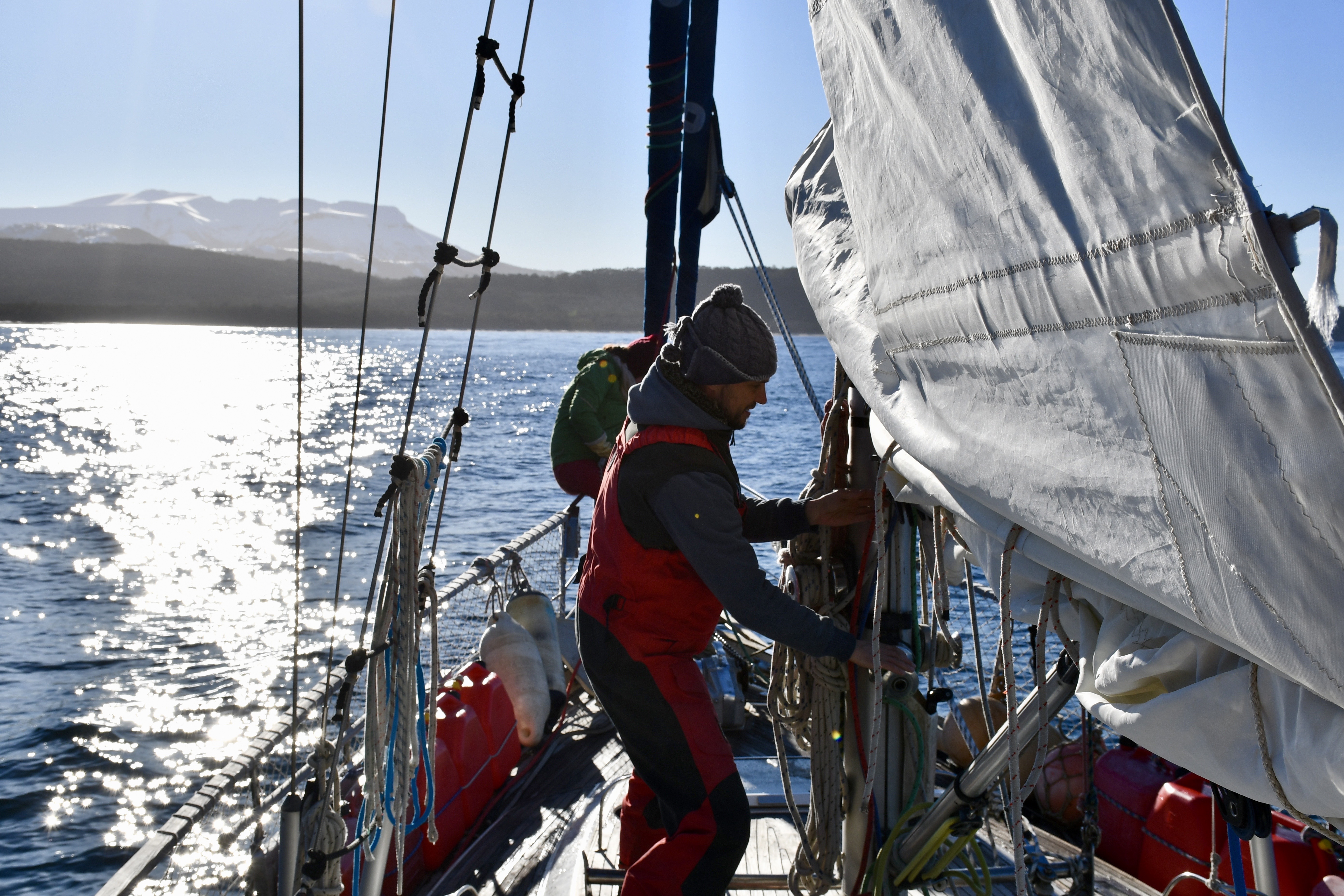
A mere 19 miles separated our “yesterday” amid dense forests and sheer cliffs, between which blue tongues of glaciers slide down into the water, from a “today” inhabited by people. From Bahía San Nicolás, the last uninhabited anchorage on the shore of the Strait of Magellan, we arrived at the fishing port of Mansa.
We circle around, deciding whether to come alongside the fishermen or anchor farther out. We settle on the anchor after all. The yacht is rolling, and there are whitecaps on the water. Everyone goes ashore; I’m on watch. The little fishing village didn’t make much of an impression on the crew. But one fisherman sold them some deliciously prepared crab meat for 20,000 pesos (and now, while the cap is in town, I’ve single-handedly finished off those crabs, heh-heh).
On to Punta Arenas!
We set out with the morning ebb. Navigation in the Strait of Magellan is difficult. The winds blow in from the Pacific, while the flood tide comes from the Atlantic. When the tidal current runs against the wind, it creates standing waves up to 4 metres high, dangerous even for large ships. To avoid getting caught in them, you have to leave at the right time, which we check against the tide tables and weather forecast.
As we make our way east, the terrain smooths out, the mountains give way to hills, and the shores immediately lose their air of mystery. But there will be lots of sunshine here: there’s nothing for the clouds to hang on to. (That’s what we mistakenly think because the sky has been clear for two days.) We’re lucky to be travelling in calm weather; the following swell doesn’t bother us, and by lunchtime we are off Punta Arenas, a Chilean city on the Strait of Magellan with a population of 130,000.
“Arctic Wolf”
There are several ships in the roadstead. AIS shows a Russian
MMSI for one of the red icons.
— Laduska, come out on deck, quick! Our people!
Arctic Wolf, Petropavlovsk-Kamchatsky. Well, of course, we head straight for her. The yacht’s strange manoeuvres are noticed from the bridge, and four people appear. Our young sailor climbs onto the wheelhouse roof, and we call across to Captain Eduard Sevostyanovich.
Arctic Wolf has been in Punta Arenas for three months. She fished in Antarctica during the season, then one shift flew home and a new one took over. They’re finishing repairs and heading to New Zealand, and from there back to Antarctica to fish in the Ross Sea. The crew barely goes ashore, only when they can hitch a ride on a local shore boat to buy something. We hope we’ll manage to meet not only a hull’s width apart and not only over the radio, but in person as well.
— Can we help you with anything? they shout from the bridge.
— Umm... Come over for tea!
— NO, we mean, do you need anything? Grain, tinned food, any kind of help? the fishing vessel’s captain says with a smile.
— We need a welder; one of our engine mounts is cracked.
They put their heads together aboard Arctic Wolf; later the captain spoke to their welder, and they decided that rather than weld the cast iron for a second time, which wouldn’t do much good, it would be better to have a new part made ashore out of mild steel. And the sailors gave us a lead.
A Sailor’s Happiness
Coming alongside the high steel hull of the tug
Cucao in the swell is nerve-racking. There are only big steel ships all around; the arrival of a yacht is quite an event. The tug’s crew skilfully take our mooring lines, and despite the swell we come alongside on the first attempt, arranging every fender we have between our hull and theirs. “If only we had a couple of tyres right now!” I think wistfully, and promise the cap that if I find even one when I go into town, I’ll definitely haul it back here.
Nastya is dying to go out and walk around civilisation, but the cap takes only Lada with him, leaving us aboard in case we have to shift berth or deal with a force majeure. Nastya is upset; she’s so desperate to go out for a stroll. When the captain and our young sailor return, we have to send them into town again. Two blissful hours alone are what I need right now more than a walk along the colonial streets.
On the Chances of Getting Ashore
The next morning, the tug we had pinned to the pier with our hull was preparing to leave. We jumped up early, only to discover that her departure had been postponed until 3 p.m. The question hanging in the air was whether we would be allowed to berth in the port or have to go out to anchor. The latter prospect brought no joy, because there’s nowhere to land ashore in the dinghy, the winds blow hard, and we have only oars. In other words, our chances of going for a walk every day were approaching zero. Just like those of the ships’ crews out in the roadstead. We were surprised to learn that they don’t even have dinghies, and their rare trips ashore take place only when necessary, aboard a port boat and for a fee.
More of Our People in the Roadstead
Yesterday, more Russian voices came over the radio. Ukrainian fishing vessels—Polyus 1 and MariGold (I’m not sure the name of the second vessel is correct). How wonderful it is to hear our native language over the air! Polyus arrived from the ocean yesterday; they got knocked about out there, they said. They anchored in the roadstead and will probably also head off to fish in Antarctica. Maybe we’ll get a chance to talk to them too. For now, we’re berthed in the port, rafted up three abreast against a little fishing boat at the pier.
You can’t just enter the port; you have to be on the list at the gatehouse. There it is, the city street, visible through the fence—but you have to walk nearly half a kilometre around to reach it.
One yachtsman we know from Puerto Williams, who happened to find himself in Punta Arenas by chance, tried to get through to our yacht, but they wouldn’t let him in. We learned this from a letter from René, the old sailor who remained in Puerto Williams.
Luck smiled on us, and we were allowed to berth on the other side of the pier, rafted up three abreast against a fishing vessel. So we did manage to get into town that day after all, and the next day too. We’ll tell you later about the unexpected storm, the parted mooring lines, and our forays ashore.
Friends, thank you for being with us! Thank you for your support—emotional, moral, and practical—via Paypal.me/TravelyFamily
You can follow the expedition in real time on our website under the Route tab, where our Iridium track is recorded. A map with the track and details is also available at bit.ly/iridium360