
From the Travely-Family archive · Australia and Tasmania
Australia in Quarantine: Weather, Wildlife, People
An original publication from the former Travely-Family website. This English translation was preserved from the technical-site archive without editorial rewriting.
What is upside down in Australia? Quarantine, the seasons, people, and the possibility of travel
Is it true that everyone in Australia walks upside down? This joke crops up in the comments so often that I’ll have to answer. Absolutely true. How else could there be such strange animals and unusual plants here, for example?
And the people here smile. I don’t agree with calling those smiles perfunctory, because I smile at people too. And what I feel when I do is goodwill and a readiness to help, not merely a habitual courtesy.
“When I arrived in the USA,” says Anya, who has lived in Australia for more than 10 years, “I felt like Crocodile Dundee there—I’d walk around smiling at everyone. The Americans looked at me suspiciously )).”
In other words, people smile more here than they do in the States, get it? And we’ve long since become like Crocodile Dundee ourselves. I’m afraid people back home will give us funny looks. But here it’s perfectly normal. You ride along the cycle path, happy to see everyone you meet, and are met with smiles in return. And you no longer feel at all strange saying “Hello” to passers-by and having them answer like old friends. This goodwill and readiness to help are part of Australian national culture. They say there’s even a question like this on the questionnaire for immigrants: “Are you prepared to help people?”—or something along those lines.
And they are prepared. The other day, a bolt came loose on our young sailor’s scooter wheel. We had barely stopped at the corner of someone’s house when we ran into the owner.
“Need any help?”
“Yes—would you happen to have a tool like this?”
“Come in.” And in we went, into a beautiful, cosy courtyard. The owner found the tool, went off to fetch another one, and fixed the wheel for us.
We said goodbye like old friends. We exchanged Facebook details with another new “old friend” after simply stopping outside her house to film a story about cuddly anti-stress teddy bears. People tie them to gates, balconies, and trees to make others smile and stop thinking about bad things. Lee, a singer widely known in certain local circles, came out onto the terrace; we had a chat, and now we’re arranging a “socially distanced” cup of coffee over Facebook..
The seasons
The seasons are upside down here too. While our friends post pictures of tulips coming into bloom, our young sailor is collecting leaves for a herbarium so she can make an autumn-leaf collage. Australian autumn is fun: you wake up and the air in the cabin is frosty, even though it gets hot in the sunshine during the day. Just a little more and our balcony will feel exactly like an Altai morning. Such a joyful, homely feeling. The birds sing in familiar voices rather than squawking like parrots. The familiar creak of the mooring lines brings you back to the yacht. And the familiar pile of things to do says: get out of bed, it’s seven already. And then it’s like “Cinderella getting her orders from the Stepmother”:
Sort through the footage, finish editing the Patagonia film, listen to the online course, do the homework, go for a hard, fast bike ride, finish one article, start another, write a post for the website already, reply to comments. (Most of them give me a boost, but some spoil my mood.)
I keep my Zen and promise myself that today I’ll do without coffee and junk food: nothing but healthy living, fruit, and vegetables. I need to get up earlier. The days are getting shorter and there’s less time to get going. Winter is coming, and nobody knows whether we’ll be able to get home any time soon...
The quarantine situation
Despite the colour of the map showing the spread of the ill-fated “COVID,” Australia immediately felt more comfortable in quarantine than many other places. The continent is isolated: first the external borders were closed for quarantine, then the internal ones. Western Australia is much quieter in this respect than densely populated Sydney and Melbourne.
Reading this extract from my diary dated 6 April, I think that so far we seem to have got away with nothing more than a fright:
“The situation as of 6 April
Things are more or less quiet here; an official lockdown has not yet been introduced. But it’s only a matter of time, because every few days they tighten another screw. Few people wear masks in Western Australia, but they keep their distance. There’s a notice at the marina: if you do not observe social distancing, we will ask you to leave the marina.
Since 1 April, gatherings of more than two people have been prohibited. One person may visit a family, while an entire family may visit someone who lives alone. Almost all shops and restaurants are closed, except food shops. People gently shy away from one another, but hardly anyone wears a mask. People are losing their jobs; there is a ruling that for the next six months, tenants who do not pay their rent cannot be evicted. Whenever we pass cafés and restaurants offering takeaway, we want to support them and buy at least something. But we don’t need takeaway food, and we need to conserve our own resources. Something tells me the Australian authorities will be able to provide their citizens with a softer safety net than ours can.
We’re waiting with trepidation to see whether Australia will go into total lockdown. They’re holding out for now, but the crisis is plain to see. Most shops have no toilet paper, and stocks of tinned food, rice, and pasta are running low. But there are no actual shortages, and prices are not rising across the board, only for certain products.
Another month or so of worldwide quarantine, and the 1990s will seem like paradise by comparison. Rioting has already begun in Mexico and Indonesia—people are breaking into homes and shops... I think we need to plant a big vegetable garden. The villages will survive, as always. Overall, the looming economic problems are not exactly inspiring. So the plan is to plant potatoes or head out to sea to fish:)”.
Good news
The quarantine measures have not been tightened since 1 April. Only a handful of people still wear masks. The panic and horror were reflected only in the amount of toilet paper available during the first weeks of quarantine. The shops have been restocked now. People spent the first week of April completely holed up, then got tired of it and began crawling back out onto the streets.
There were either two or three—2—new cases in the whole state over the preceding week, all of them among passengers arriving on cruise ships. They are immediately and properly isolated here, so the virus does not spread ashore.
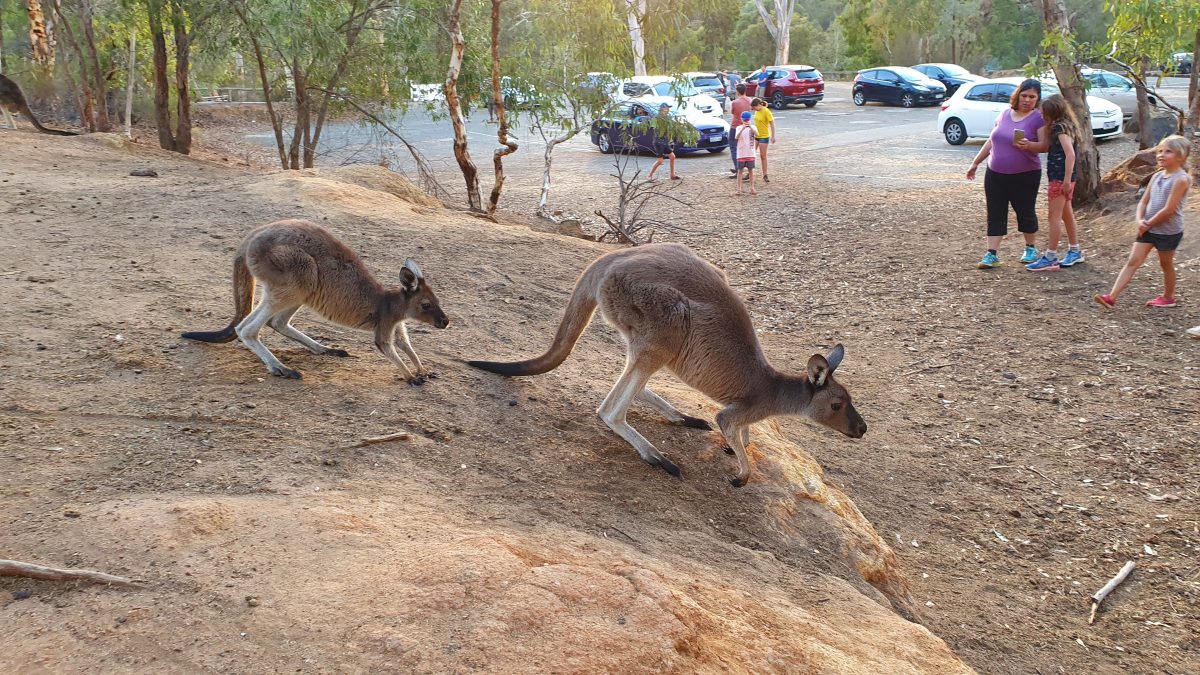
Western Australia was so delighted by this that, after only a short time in quarantine, it relaxed the rules a week ago: gatherings of up to 10 people are now allowed instead of only two. Picnics and outdoor get-togethers are permitted. You should have seen what happened then, guys! You can’t move for people in the national parks and picnic grounds.
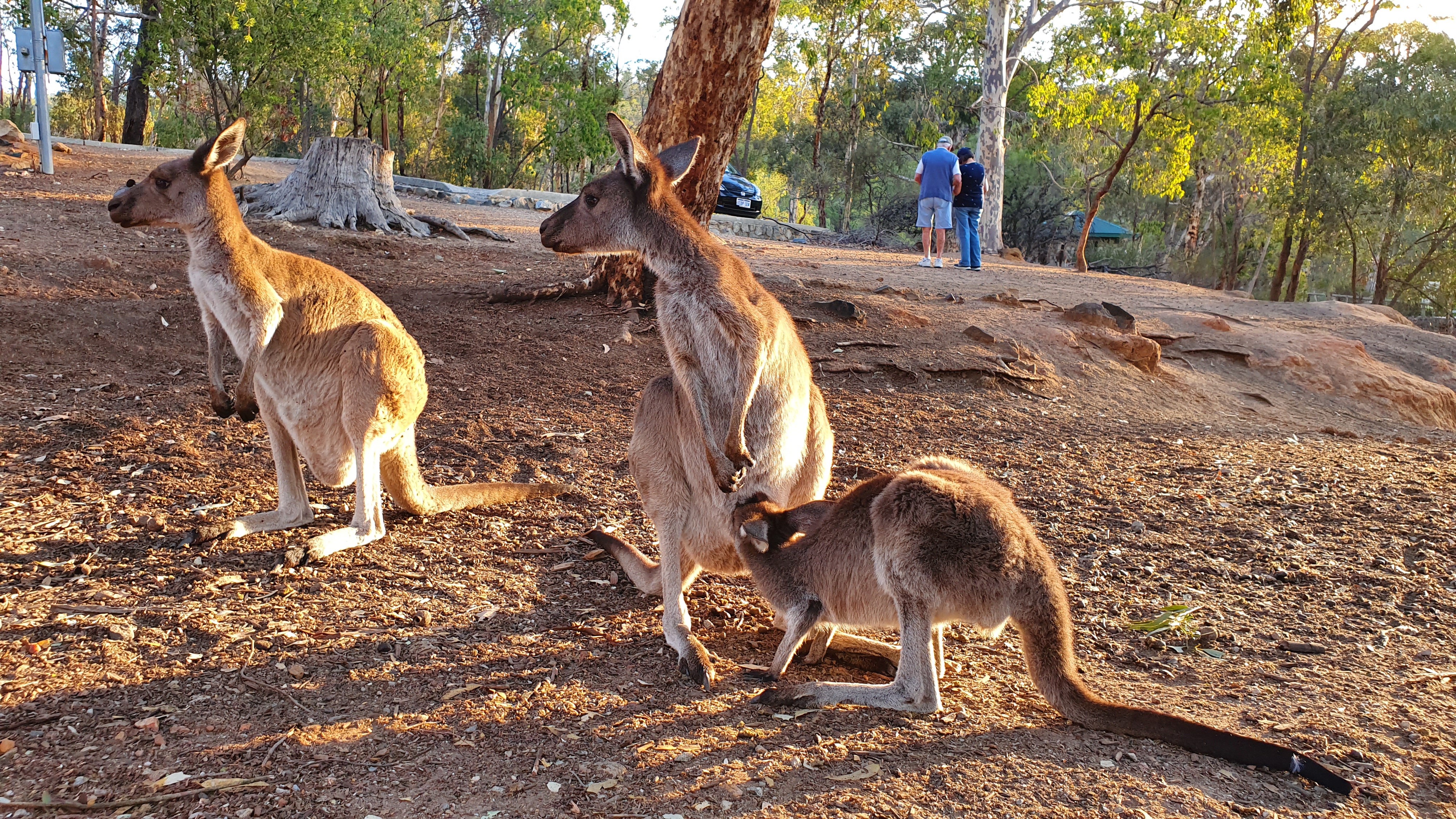
The photograph with the kangaroo in John Forrest National Park was taken yesterday, on the last hot day of autumn, when our friends and we emerged from our home offices:). It’s all about that healthy living, walking, and a picnic under the eucalyptus trees. We’ll give you a detailed account of these weekend walks and outings, so traditional in Australia, in our next reports.
People have appeared in the city:). Jubilant citizens are sipping wine on every terrace and balcony overlooking the sunset. And always in groups of more than two. Traffic has increased on the cycle paths, and traffic jams have returned to the roads in places, though they’re not as bad as they were in our former life. State schools reopened as normal after the Easter holidays. Most businesses, however, are still operating remotely, with people working from home. The situation is worse in Eastern Australia, so people there are staying home.
According to the latest information, there have been no new cases of COVID-19 in the entire state for the past 6 days or so. We’re watching. But there is no prospect of the external borders reopening yet. They say the continent will not reopen until a vaccine has been invented... Around January 2021, then:).
But there’s no problem heading out on a yacht. And as it turns out, that isn’t so frightening either. As long as there’s somewhere to put in. Here’s the information we have...
Round-the-world voyages and the pandemic
Sixteen days ago, a yacht arrived here in Fremantle, where we are currently berthed, from Cape Town. The solo sailor had been at sea for two and a half months. That fact did not help him avoid quarantine, which is a shame. But!—They let him stay in locked-down Australia; they did not drive him outside territorial waters and leave him to go wherever fate might take him, as they do in Indonesia, for example (according to rumours). The day before yesterday, the yachtsman was allowed to resume normal life in the marina, which has made him immensely happy.
Had the borders within the state reopened last week, we might have had a chance to meet the yacht Chelyabinsk, which arrived in Albany about 10 days ago (how time flies, eh!?). Just before they arrived, Oscar Konyukhov wrote to us: “Our acquaintance Vladimir Gornov from Chelyabinsk is approaching Albany.”
Three people from the Southern Urals—two men and a woman—set out from the Baltic in autumn aboard a 16-metre Hanse bearing the proud name Chelyabinsk, and are sailing around the world at a fairly rapid pace. For example, they crossed the Indian Ocean from Cape Town to Albany, Australia, in 36 days, 18 days faster than we did. Different boat, different speeds:).
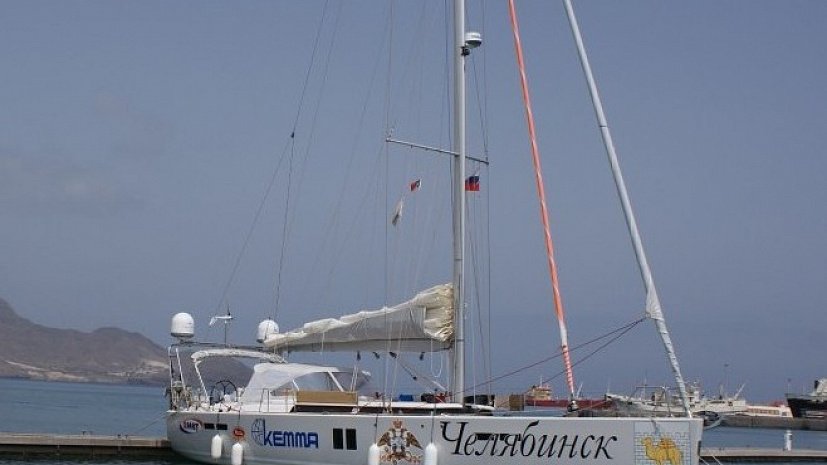
The crew entered Albany without visas, so they were not allowed ashore. But plenty of visitors came aboard. They managed to replenish their fuel, water, and provisions, and after 8 days at anchor, they set a course around southern Australia for New Caledonia. The Russian Geographical Society intended to intercede with the authorities there on behalf of the crew. Together with them, we’re hoping that something will change in the world during their month at sea. We were disappointed, of course, that Chelyabinsk did not come to us, but we became fast friends with the crew over the phone. It was only natural—we’re from the same neck of the woods: I’m from Zlatoust, and they’re from Chelyabinsk.
Photo from the internet
The crew are prepared for long passages: “If New Caledonia won’t take us, we’ll go to Tahiti. If that doesn’t work out, we’ll continue to the Panama Canal. And from there, if necessary, it’s not so far to the Russian coast,” says Anya, one of the circumnavigators. So there you have an example of a voyage continuing under coronavirus conditions. In Tahiti, the Chelyabinsk crew want to approach the local authorities and obtain one of the very coins that Bellingshausen and Lazarev handed out to local chiefs 200 years ago to establish friendly relations, as well as check the condition of the commemorative plaque on Kutuzov Atoll, installed by the captain during his previous voyage to Polynesia.
About our voyage
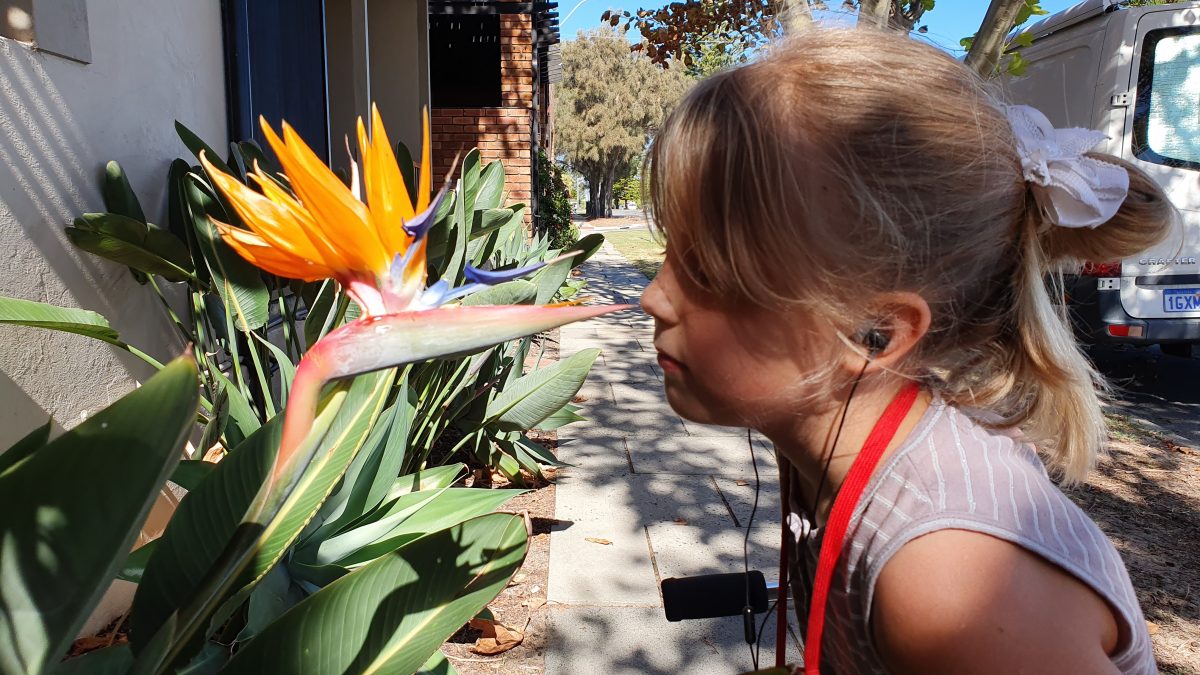
Our own circumnavigation continues in its usual shoreside mode. Bit by bit, we’re receiving parcels of spare parts, carrying out repairs, and working on our films. We’re currently making the first episode about Patagonia—it’s time to break up the Antarctic stories with some from Tierra del Fuego. Our young sailor is finishing Year 2 (in fact, Year 3) at her beloved Russian Geographical School of St Andrew the First-Called and is also studying simultaneously at the Russian school Mosaic in Perth.
As usual, a live broadcast from Western Australia will take place on Thursday at 10:00 Moscow time on our YouTube channel.
Come and join us! It’s fun with us:).