
From the Travely-Family archive · Other Entries
All Hands and Provisions. Day 56 of Self-Isolation
An original publication from the former Travely-Family website. This English translation was preserved from the technical-site archive without editorial rewriting.
All Hands and Provisions. Day 56 of Self-Isolation
Provisions at Sea: What We Have Left
Coconut water for breakfast + the tender flesh of a young coconut. This kind of diet is a joy. The captain deftly husks and chops the coconuts on a special board that has been travelling with us for three years, since our earlier Polynesian days. We left Suwarrow Atoll with the cockpit full of coconuts. To get to the helm, we had to climb over the bench. But by the end of the morning we had already stowed the nuts in lockers, buckets and bags, leaving only one crate on deck with the youngest and tastiest fruit. We eat those first. Besides coconuts, by day 56 of the passage from Tasmania to Tahiti, plenty of vegetables and fruit have survived on board: garlic, a sack of onions, one pumpkin, half a large crate of apples and two large sweet potatoes.
We also have Tasmanian honey, tinned food, grains and pasta, dried fruit and nuts, sauces, snacks, biscuits and chocolate. There is a box of chocolates and a couple of bottles of children’s champagne—the captain’s birthday is coming up. There is still so much food in the lockers, you would never think we had been living for two months without shops. Judging by experience, the tins will last another two months if we open two or three a day. People ask whether we ate coconut crabs on Suwarrow. No. First, they might be poisonous after the rat poisoning campaign back in 2013, and second, apparently you are not allowed to eat them anyway: the islet is small, and they would soon be gone.
We caught and boiled ordinary sea crabs—small, but tasty. Though a coconut crab probably has as much meat as half a chicken. It must be delicious. Oh well, let them live. It’s not as if we have nothing to eat, is it? And here on Suwarrow, they might be the last of the mutant tribe. We feel sorry for them. No, really. There were big coconut crabs in Mexico too, but they were nothing compared with the ones on Suwarrow.
Our Escort
For the third day, land birds have been following the yacht, as though seeing us off all the way from the atoll. Thousands of birds nest there, by the way. Suwarrow alone is home to no less than 9% of the world’s entire population of magnificent frigatebirds, on one tiny scrap of land—just think about that. But the birds chasing after us are not frigatebirds; they are something like sea swallows. We come across whole flocks of them hunting fish along the boundary between rain and dry weather while we chase the rain. We flew into a cloud, and the dark mass of rain switched the heat and calm over to a fresh breeze, waves and cool air. It has not switched back yet. It just keeps raining. Everything would be fine if it were not for the heel and the water pouring through the hatches. As usual, the call for all hands came after nightfall.
How Our Sail Floated Away
The halyard of the genoa, the largest headsail, parted without a sound. It was indistinguishable from a wave slamming into the bow. The skipper glanced at the instruments: our speed had dropped threefold. A couple of seconds later, a voice came from the deck:
“Switch on the deck lights. All hands.”
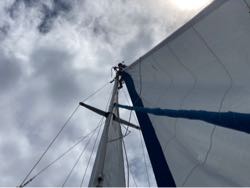
“Mum, the genoa’s gone!” Nastya looked out of the pilothouse window. Sure enough, it was gone. And we rushed out into the night. The halyard had parted where it entered the masthead. As the sail fell, it came out of the luff groove and was now held only by its upper and lower attachment points, which had come together on the bowsprit. The canvas lay in the ocean like a giant scoop filled with water.
“Marina, take the helm. Nastya, onto the bowsprit.” The captain issued orders from the mast. “Lada, torch! Pliers! Electrical tape! Scalpel. Thread. Alcohol. Cucumber.”
Before long, I left the helm and went to the bowsprit. Andrey rigged a temporary halyard. Nastya and I wrested the heavy, stiff canvas back from the sea and the wind. We fed it centimetre by centimetre into the narrow luff groove, thanking the heavens that this had not happened in a storm. The sail was temporarily back in place. Naturally, we scraped our knuckles raw, but that was nothing. The captain spent half of the next day—the half that happened to bring scorching heat and a complete lack of wind—up the mast, while the rest of us stayed below, grinding winches and passing up screws and electrical tape.
Our junior crew member took an active part in the work. We had only just started thinking about a swim after the job when a black rain cloud materialised on the horizon. The wind whistled, “Everybody follow me!”—and we raced close-hauled so as not to miss the rain. It poured for two hours. We collected water and showered in the rain until we were frozen. Lada went off to warm up, announcing as she left:
“I’m going to make soup, otherwise you’ll come back hungry.”
The rice and vegetable soup vanished in a single sitting, and everyone asked for seconds.
The Ocean Came Alive
“Dolphins!” proclaimed the captain as soon as the morning flooded the deck with sunlight. No one had dropped by for quite a while, and the girls dashed outside.
“They’re whales!”
At that, I could not resist and abandoned the half-washed dishes. Three-metre-long, black, hump-nosed fellow travellers sliced through the water alongside the hull. A characteristic sweep of the tail, a long exhalation. First there were four, then six small whales. They swam so close it seemed you could reach out and touch them.
“Can you hear them? They’re talking.”
“How? That squeaking sound?”
“Yes, can you hear it?!”
And sure enough, the group was having a polite conversation in thin, drawn-out whistles. I wonder what the whales were talking about? Not knowing their language, we simply listened and admired them until the pod headed off into the ocean on whale business of its own. Yesterday’s dolphins, though, found us rather boring. An entire pod, about twenty of them, arrived during the calm. They had to play chase only with one another, because there was not much fun to be had racing Lady Mary as she crawled towards Antarctica at 1.5 knots. We’ll see what they look like in the video shot on the action camera.
We hope they are visible. It is about 660 miles to the equator, a week’s sailing at a good speed. Fingers crossed there will be no calm. The finish is close. Sergey Yakubenko and Yulia Galushina have once again forwarded your comments from Facebook, VK and YouTube to us. Thank you, dear friends, for being with us! We are also reading your messages submitted through the form on the website. We cannot reply yet, but once we have internet access, we will get around to answering them too. Wishing you health and immunity against—you-know-what.
Hugs from day 56 of complete isolation, at 10 degrees south latitude and 159 degrees west longitude. Huge thanks to everyone supporting the expedition’s morale through YooMoney and PayPal. Thank you to Lev U., Roman Vl., Mikhail G. and Natalia D. for replenishing the expedition budget! Hugs to you. Thank you for including messages with your transfers. May everything work out for you! Sent by satellite link. To see where we are now, visit our website, travely-family.com, and open the Route tab. Lady Mary’s track from the MVS Telecom RockSTAR Iridium 360 tracker is displayed there.