
From the Travely-Family archive · Antarctica
Antarctica. How We Fought Our Way Through the Ice to Our Own People
An original publication from the former Travely-Family website. This English translation was preserved from the technical-site archive without editorial rewriting.
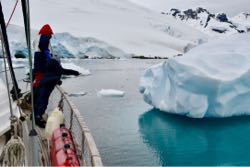
Antarctica. How We Fought Our Way Through the Ice to Our Own People. Before going to bed, the captain uttered the magic words:
“Wake me at 7 tomorrow. We’ll weigh anchor.”
That was how I realised we were going to Vernadsky Station.
We weighed anchor while the young sailors were still asleep. A new cruise ship carrying Antarctic tourists was lying off the entrance to Port Lockroy, while we headed back into the snows of the broad channel. Our course was south-southwest. When the children woke up, they asked in surprise what was happening and where we were going. Apparently, I was the only one who had picked up on the captain’s change of mood the night before.
When we reached almost open water dotted with icebergs, the cap left me on watch under sail. A good wind was blowing, and the yacht proudly carried her mainsail and genoa. A couple of miles ahead lay the narrow Lemaire Channel, and I had to steer us into it.
“Head for that rock over there. Now bear left; there’s another rock underwater. And pass the icebergs to windward,” the captain instructed me before disappearing into the warmth below.
Well, windward was fine—nothing we couldn’t handle. But the prospect of steering under sail into a 500-metre-wide channel hemmed in by sheer cliffs, in gusty winds, with icebergs, whales and ice floes darting around the water, scared me. I held on almost to the entrance, then timidly peered down the companionway:
“Well, you’ve warmed up by now, haven’t you?”
Of course he had—how could he not? Besides, the wind died away in an instant and, a minute later, began blowing from the opposite direction. That is a real hallmark of the Antarctic Peninsula: the winds rush back and forth, then suddenly freeze in some bizarre pose.
Despite the ice fields, conditions in the channel still inspired optimism. Several times, the captain climbed the mast as far as the lower spreaders to look for a passage through the ice. Glaciers streamed down from the very summits; sheer black cliffs, white snow and the blue of crevasses. No camera in the world could capture this cold grandeur and peculiar cosiness, this symphony of black, white and blue.
“It’s unbelievable how beautiful it is here!” Nastya said from time to time. And then words failed us.
But the ice began. Nastya and I armed ourselves with poles, ready to push away the larger blocks. The cap slowed down a little. Penguins, like seasoned flying divers, shot past the bow and surfaced astern. Sea lions peered curiously into our eyes, while whales exhaled noisily beside the sheer cliffs.
The ice field grew denser; we worked our poles, while the young sailor stood by to fetch the camera or bring us some water. The captain was at the helm. No sooner had I complained that we had whizzed too quickly past a beautiful piece of ice where a whole group of sea lions had been playing than Andrey reduced the revs and climbed the mast again. Vernadsky Station was 12 miles away.
The verdict was not encouraging:
“We won’t get through any farther.”
What did he mean, we wouldn’t get through? What about over there? Or here? Couldn’t we push the ice apart? What if it only looked impassable from where we were? Couldn’t we at least call them on the radio?
Andrey answered no to every question. As for the radio, he explained that we were still a mile short of direct line-of-sight range to the station. If we called from here, the signal would be poor, and they might think we were in distress.
So we turned back in complete radio silence, accompanied by the cracking of glaciers. Even a whale sighed loudly and sadly astern—apparently it was disappointed too.
Daaamn! As we turned among the ice floes, I still could not believe that we had failed to reach our own people that day. Could we perhaps go around by sea? No, we would not make it before dark. And first thing tomorrow morning we had to scarper north to get ahead of the cyclone’s meat grinder.
The Ukrainian guys never found out that we had been so close, at 65 degrees 06 minutes south. We had fallen just over one degree short of the Antarctic Circle, and were only a dozen miles from them.
Meanwhile, the ice had closed in over the section of Lemaire Channel we had just passed through. That was when we really had to work up a sweat—and even got rather nervous. The dense jumble of two-metre blocks was studded with still larger pieces.
“Astern!” I shouted, and the captain managed to engage reverse. The submerged part of a mini-iceberg scraped the antifouling paint from the hull, while its tip passed within centimetres of our side. Most of the blocks were not so dangerous if we managed to push them away in time. Nastya and I shoved with all our strength. Some floes still crashed into the stem or struck the sides. Those hundred metres of ice field were closing immediately astern of us, yet only an hour before we had passed through almost without trouble.
Perhaps, yes, we really should not go any farther. Lady Mary is certainly strong and essentially an icebreaker—but not in terms of her material. Fibreglass is still fibreglass; the main thing is not to overdo the strength testing.
Disheartened, we returned to our previous anchorage at Port Lockroy that evening.
At the same time as us, a dark steel ship was approaching the bay. English voices came over the radio.
“Oh!” the young sailor cried happily. “I think that’s a Russian accent!”
We checked the AIS, and sure enough, she was Russian! Her MMSI was Russian. The ship was called Polar Pioneer, and her port of registry was St Petersburg.
“Andryukh, let’s call them on the radio! If we can’t make friends with the polar researchers, at least we can make friends with the sailors.”
The cap reluctantly made contact. Who was bound where and from where—the usual exchange.
“Well, come over if you like,” came the reply over the radio.
“We can’t be bothered to launch the dinghy.”
“All right, goodbye, then.”
And that was that. We anchored. I felt there was still something missing to make us completely happy.
“Andryukh, why don’t we invite them over for tea?”
“Invite whom?”
“Well, the crew.”
What followed was business as usual: his twenty-two arguments against, and my twenty-two in favour. In the end, I took the radio.
“Polar Pioneer, why don’t you come over to us for tea?”
“How many people can you fit aboard?”
“Well, five to seven comfortably; any more would be a squeeze.”
“All right, I’ll ask the crew who wants to come. Then you should come over to us too.”
“That would be great, we’d love to, but our boat only has oars, the engine is another story, and you’re anchored a long way off.”
“Come over in our Zodiac!”
That’s what a few magic words can do! Fifteen minutes later, we were welcoming three stewardesses, an engineer and a future navigating officer aboard, and then speeding towards Polar Pioneer astride the inflated black tube of the Zodiac.
The ship had come in for only two hours. The tourists from Australia and the States were quickly put ashore on the island, the divers went diving, and the rest took a walk before returning to prepare for a barbecue on deck while the crew got the ship under way.
In that hour and a half, we accomplished the maximum programme. First, we spoke with the imposing, stern chief officer, Vladimir Alexandrovich, on the bridge. The wheelhouse looked impressive, just like in the films. An engine-room telegraph, control panels, levers and screens. The wheelhouse windows, almost invisible, afforded a panoramic view.
The ship had been built in 1982 and, until the collapse of the Soviet Union, had been a research and expedition vessel. Now she carried passengers. Polar Pioneer had sailed not only in the Arctic and Antarctic, but also through the southern seas, to Tahiti and other distant shores. Pioneer crossed the Drake Passage in any storm. At such times, towering storm waves broke over her all the way up to the bridge. On the first day, only about 10 of the 60 passengers would turn up for breakfast.
All this was told to us by the captain, to whom the good-natured engineer Pasha escorted us from the bridge. The captain introduced himself as Alexander, and we had a wonderfully warm chat in his cabin while the young sailor helped herself to fresh plums. We took apples, bananas and a perky orange back to Lady Mary as gifts from the captain.
“Do you have enough of everything aboard? Is there anything you need?” the ship’s captain asked.
“We seem to have everything. Though, if possible, we could buy about 100 litres of diesel from you.”
“Why didn’t you say so straight away? We’ll have to ask Grandpa.”
“And who is Grandpa?”
“Our chief engineer.”
Grandpa turned out to be a smiling lad named Denis, about 27 years old. The captain handed us over to him at the entrance to the engine room. The sign read: NO UNAUTHORISED...
The three decks of the engine room beat out a pulse, clattered, hummed and seethed. The children and I soon begged to be released back into the cool corridors, while our cap and Pioneer’s Grandpa inspected the heart of the polar ship.
On the way, I got held up somewhere, and the young sailors were immediately intercepted by Dasha, one of the stewardesses. Fifteen minutes later, we found them in the crew mess, tucking into tiramisu.
Then we had to race aboard the Zodiac, as the order to weigh anchor had already been given. The Zodiac came alongside the aft deck to take aboard two cans of diesel. They were for us—a gift from Pioneer.
We said a very warm goodbye to the captain and part of the crew. They waved to us from the bridge and deck, while we tossed our caps into the air from their fast launch. It was a pity Pioneer had spent only two hours beside us.
The Zodiac whisked us back to Lady Mary, and Sasha, her coxswain, even managed to return and leap aboard Polar Pioneer as she was getting under way in the twilight.
Early in the morning, we too would leave the coast of Antarctica for the restless Drake Passage. We had to get ahead of the storm.
We are about to establish contact with space, and very much hope that the evening mail from our shore team will come through. How eagerly we always await your comments and letters, our dear friends, both far away and near! Thank you for being there for us! One last hug to you all from Antarctica.
And from our entire crew, a huge thank-you for supporting the expedition through PayPal.me/TravelyFamily! Friends, you have become genuine members of our shore team. Special thanks to Viktor S. from Leningrad Region, Dmitry M. from Moscow and Margarita T. from Germany! You motivate us not to give up!