
From the Travely-Family archive · Antarctica
Icebergs! Antarctica Is Close
An original publication from the former Travely-Family website. This English translation was preserved from the technical-site archive without editorial rewriting.
There was no hint of what was coming when, on 1 February, I relieved Dan from the dawn watch. I took over on the bridge at 10 a.m., and by 11 I was already calling all hands, including a not-yet-awake Dan. The reefing pennant on the mainsail had chafed through at the cringle (the line used to haul the leech and luff of the sail down to the boom), and the sail was in trouble. We quickly lowered the main—quite an adventure in a swell: besides easing the halyard in sync, we also had to keep the gaff (the spar along the sail’s upper edge) in the correct position.
Act One came to an end
We went to warm up with tea. The air temperature was around 0°C.
For Act Two, we reeved the reefing pennant again. Its extra length meant we could continue using it. All this in 3–4-metre seas and at a height of nearly three metres above the 4-metre poop deck (the after part of the deck)—that is how high the boom is (well, everyone knows what a boom is, right? The spar attached crosswise to the mast, along which the mainsail is set).
We kept at it until dusk. The seas became short and steep, so we decided not to set the main in those conditions and to wait until morning.
The night watch passed more or less peacefully. Semyonych the autopilot only played up a couple of times; otherwise, everything was normal.
At 4 a.m. I handed the watch over to Dan and fell into the arms of Morpheus.
So what happened next? Where’s the suspense? Exactly!
All hands!
A couple of hours later, I was called on deck in an emergency. Dan had roused the crew to set the main. He handed the helm over to Semyonych and went on deck himself to supervise the hoist and steady the gaff. Halfway up, they discovered a tear in the halyard that was rapidly getting worse. They began lowering the main slowly, and everything would have been fine, except Semyonych decided he’d had enough and stopped steering.
I took the helm and, still half asleep, spent the first few minutes yawing about 15 degrees either side of course. Dan said something to me that, translated politely, meant, “Sir, could you please hold a more precise course?”
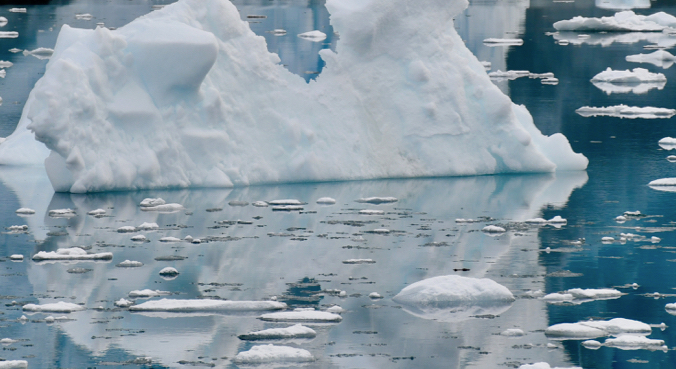
At that point I almost woke up, steadied the course, and the guys were able to lower the gaff safely. And then... an enormous ship appeared dead ahead. At first I couldn’t believe my eyes, but the silhouette of a bulk carrier matched its colossal size. Surely I wasn’t imagining it?
The sun came out for a couple of minutes and clarified the situation—the ship lit up white. An iceberg! On the radar, eight miles away and dead ahead. At this news, Semyonych the windvane autopilot suddenly came to his senses. I handed the helm back to him and went off to get some more sleep.
Work Aboard
The rigging team set about removing and splicing the peak halyard, because we do not have a spare 80-metre line for it.
Dan let me sleep about an hour and a half longer, but then woke me for my watch. He said this was already the second iceberg; he had spotted the first early that morning. From now on, we would keep an especially vigilant radar watch.
In the saloon I found them splicing a line from two pieces, while up on deck it was completely calm and we were motoring with two staysails set.
For us, a calm means a chance to carry out a mass of deck work that cannot be done in wind and rough seas. We transferred fuel from the cube containers into the tanks, replaced the boom sheet on the foresail, the preventer tackle on the main, and the hauling part of the peak-halyard purchase (oh, I’ll drive myself crazy translating all of this. In a word—ropes), sorted through some of the lines stored on deck and condemned them as worn out.
Then dinner-lunch, another couple of hours’ sleep, and the night watch again. This time it was more tense, because in addition to the routine, we had to monitor the radar with extra vigilance.
It Snowed During the Night
2 February. Snow squalls and their approach show up on the radar. Fortunately, though, we encountered no icebergs. It was only at 10 a.m., after I had relieved Dan from his early-morning watch, that I saw another iceberg nine miles away.
For breakfast, buckwheat with milk and the remains of yesterday’s buns. While I was catching up on sleep, the guys set the main, made sure all the lines were now working, and lowered it again half an hour later: there was too much wind for it while sailing close-hauled.
We still have another twenty-four hours of sailing into a southerly wind bringing refreshing coolness 😆.
During the night, we crossed the longitude of Point Nemo—the oceanic pole of inaccessibility—though about 500 miles farther south, closer to Antarctica.
Written at 57 degrees south latitude.
Here is the link to the map and our real-time position, plotted by our Rockstar Iridium 360 satellite tracker:
https://www.iridium360.ru/guest/journey/8db92642