
From the Travely-Family archive · Other Entries
Antarctica. A Refuge for Castaways and Expedition Worries
An original publication from the former Travely-Family website. This English translation was preserved from the technical-site archive without editorial rewriting.
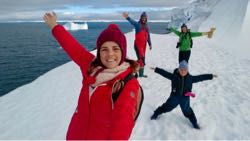
Antarctica. A Refuge for Castaways and Expedition Worries. We are reading all your comments on our Antarctic reports. Friends, thank you so much for your concern and worry, your words of support, and the warmth you send us all the way to the other side of the Earth! We won’t let you down: we’ll definitely come back safe, sound and in high spirits, with heaps of videos and photos, which we’ll publish as soon as we get our first internet connection. You’ve been asking how the children are coping with Antarctica. To our surprise, they are absolutely thrilled by it.
I quote Nastya: Mum, when you used to say in the tropics, “Oh, how beautiful everything is!” I couldn’t really keep the conversation going. Palm trees, mountains—so what... I’d already had my fill of the tropics, and I was sick of the heat. Snow and cold—now that’s fantastic! Wherever I turn now, it’s always “Oh!” and “Wow!” The ice, the blue icebergs and the white mountains. It’s so beautiful that I’m afraid I won’t find the words to describe it in my diary. All I want to say all the time is: This is sooooo freaking amaaaazing!..............................................................................................................................................................................................................................................................
Lada: I don’t want to go back to the tropics at all. It’s nice here, it isn’t hot, and there are lots of animals. They’re not the same in the tropics; there are no fur seals or sea lions there. But here there are penguins, leopard seals, whales, dolphins and elephant seals. I’d like to stay in the cool for a while. Everyone thinks it’s stormy here all the time, very cold and snowy, and that hardly any animals live here. But it’s completely different. First, there are lots of Russians here. Second, it’s very beautiful. You can find semi-precious stones in the mountains and rocks—red and green jasper.
The moss makes it feel cosy; it’s such a cheerful colour. And sometimes the ice is a very deep blue. There’s lots of ice floating around, and it makes our yacht feel like an icebreaker. Besides, there are winds and storms in the tropics too.........................................................................................................................................................................................................................................................................
So, the Melchior Islands, Gamma Island, 64.20S 62.59W, the seasonal Argentine base Melchior. Two small, dark-red barrack-style buildings with closed black shutters and doors. A sign says: If you need anything for assistance and survival, go to the third building, the one with the orange door. The ground floor of said building is a technical storeroom. A couple of cubic metres of timber, including some thick slabs. Gas cylinders, a drum of diesel, and buckets of paint and varnish. Fancy carrying out some quick repairs on your boat? There are saws, drill bits, nails and all the rest.
The captain found some tools and nailed back a board that had fallen out of the storeroom wall. Upstairs are the castaways’ apartments. In the spacious entrance hall, you are greeted by a bench-press machine. Two potbelly stoves and a visitors’ logbook. In it, we found several greetings from people we knew: from the yacht Petr Pervy, dating from 2017; from Lady Dana, whom we met last year on Easter Island; from the latest group of guests aboard the yacht Mon Coeur with Captain Litau; and from the British expedition yacht Pelagic Australis, which we met in the southernmost town in the world.
We added our own little greeting and went on a tour of the building. A plaster Virgin Mary stands on a table, one slender hand seeming to hold a mop rising from the floor. There is a kitchen with crockery and a bathroom with porcelain fixtures. We didn’t check whether the plumbing and drainage worked; we assume they probably don’t. One room has two- and three-tier bunks with oilcloth-covered mattresses. In the next room are shelves of provisions; the labelled jars contain everything from dried potatoes and powdered milk to vegetable oil.
The people who set up this outpost ask anyone taking provisions to notify the Argentine Navy. Every seasonal Antarctic station probably has one of these miraculous refuges for people in distress. And it fills your heart with a certain warmth: there it is, the brotherhood of the polar regions—you won’t be left to perish!...........................................................................................................................................................................................................................................................
It’s time to climb the snowy ridge above the ocean; its whiteness is irresistible. Besides, the captain has already broken a trail halfway up the mountain. From below, it looks as though there is no way you could climb that high. But once you are crawling up the slope, you desperately want to conquer the last 10 metres to the summit. Only the blue-tinged crevasses just below the edge stop us. We talked Nastya out of risking her life and went sliding back down, squealing with delight. If only we had snow sliders here—you could shoot straight into the water; what a water park that would be!
While we were sliding down the sheer slope, some snow Yetis or birds made off with our young sailor’s bright-pink mitten, which had been lying at the foot of the slope. There was no wind; we combed the entire patch of island where we had been walking four times, but found no trace of the mitten. Now the skuas and penguins are taking turns wearing it. And little Lada has only one left. Wonders never cease...........................................................................................................................................................................................................................................................................
In the evening, Andrei is tensely analysing the weather forecast and comparing it with actual conditions. Today the sky is unusually clear and there is no wind, yet the barometer has plunged to 978 hPa. With a drop like that, it ought to blow hard. The forecast says nothing about either an increase in wind or a fall in pressure. God only knows how the forecast correlates with reality here: this region is new to us, and one of the most difficult to boot. On top of that, chunks of ice keep nosing into our narrow little bay, and an iceberg has been sitting at the entrance for some time.
We don’t want the neck of the bottle corked shut, or we’ll have to spend the winter in that very survival hut. Nastya stays on a half-asleep night watch, setting an alarm and checking the surroundings every two hours. The captain does not sleep until halfway through the night, while I tell him that if it’s making him so nervous, we should just dash back north.
“We’ll see what the weather and the ice do,” the skipper replies, and finally drifts off to sleep........................................................................................................................................................................................................................................................................... Somewhere nearby, our Polish friend Henryk Wolski should be aboard an expedition cruise ship.
We met on Easter Island when he was delivering a yacht from Antarctica to the northern seas, all the way across the Pacific. Henryk flew into Ushuaia on 26 February and set out for Antarctica. The next day, we are heading for the mainland, where his ship, Fram, is due to stop. It’ll be great to see him! Around 7 March, Fram should reach the vicinity of the Ukrainian Vernadsky Station, and then Henryk is supposed to write to us about the ice conditions. That is when we’ll find out whether ice has blocked the approaches to our Slavic brothers, or whether it will part for a couple of days after all.
In any event, we will spend the following night by the mainland. We’ll make our final decision there........................................................................................................................................................................................................................................................................... At 6.15 in the morning, the captain looked out through the hatch: “All hands!”
A small iceberg, about 15 metres in diameter, had crept right up to the stern. Its submerged section had almost slid beneath our rudder and propeller. Losing the propeller and rudder in the channels of the Antarctic Peninsula, where we have to do a lot of motoring, would be an utter disaster..... Andryukha shot off in the dinghy to the bollards and slipped the loops of two mooring lines. He slackened the other two from the deck, ready to throw them into the water if we failed to cast off from the shore in time. While Lady Mary dodged the iceberg in the 40-metre-wide bay, I rowed ashore to take the loops off a large rock. My hands work at loosening the line; the enormous gloves hamper my movements; the tide threatens to pour into my boots. As luck would have it, the loop is stuck. Just like in a film.
“Untie the knot!” the captain shouts.
I don’t manage it straight away, and it takes a tremendous effort, but then the rope is trapped under the rock. I’m puffing like a steam engine, but the rope won’t budge. My fingers and hands suddenly grow tired and start aching, the dinghy is bouncing on the rocks, and the yacht is lying broadside to the iceberg. One tug, another, another... Oooone! T-two! Phew, it’s moving.
“Pull!” I yell triumphantly, dropping one line into the water and grabbing the second. They haul me back towards the yacht. Panting heavily, Nastya and I use the winch to hoist the dinghy onto the deck while the captain steers us out of the fjord. We look astern, and the iceberg is already sitting exactly where we spent the night. The sea lions nod their heads, and the penguins hunch up gloomily. Ahead lies a 40-mile passage to the mainland. Wet snow is hammering down, and there is no wind. And there is more floating ice now.......
We’ll tell you about our anchorage in a mysterious mainland bay with no connection to space, and how we spend our nights pushing the ice aside, in the next report............................................................................................................................................................................................................................................ Friends, how wonderful it is to have you with us through your letters and comments!
And from our polar autumn, we wish all wonderful women a happy celebration of spring! May your hearts beat with joy and love, may your health be strong and those behind you dependable! May your dreams come true, and may you find harmony! The whole crew sends you hugs from the Ice Continent, from the position 62.52W 64.54S. The figures after the point indicate minutes, not hundredths, because the satellite encoding permits only!,? and............................................................................................................................................................................................................................................................................
A special and enormous thank-you for supporting the expedition via PayPal.me/TravelyFamily. We thank Andrei Kh. from St Petersburg, Yulia T. from Kharkiv, and Bulat A. from Astana! You are our true shore team, part of a unique expedition project and Russia’s first family Antarctic expedition with children!