
From the Travely-Family archive · Pacific Ocean
How to Reach Cape Horn. A Philosophy of Growth
An original publication from the former Travely-Family website. This English translation was preserved from the technical-site archive without editorial rewriting.
How to Reach Cape Horn. A Philosophy of Growth. This satellite report was written en route to Cape Horn across the South Pacific. It came as I was reflecting on why, just six months ago, we had not been ready to change course—to abandon our westward circumnavigation along the trade-wind route for the difficult journey through the dangerous high latitudes from west to east, and via Antarctica at that. Yet now we were not only ready, but barely had to think twice about turning when the stars aligned so perfectly.
This is about how boundaries expand, and how a straightforward circumnavigation turns into a voyage with an exploratory and geographical purpose: to become the first family crew with children in Russian history to take on the Everest of sailing and Antarctica.
There is a Russian saying: “Once the claw is caught, the whole bird is lost.” Have you noticed that when you begin doing something one small step at a time, each step that follows comes more easily? Say you snap at your husband for the first time and get away with it. Before you know it, you are no longer a tender fairy with shining eyes, but just a domestic sawmill. Cheat once, and something quietly clicks inside; the second time it hardly seems like a crime. With each concession, you allow yourself to go a little farther than you did before.
Not deliberately—it just happens. And a new normal tiptoes softly into your very being. That is how a teetotaller becomes an alcoholic, and a decent enough fellow turns into a devil, as in The Godfather, for example. The same pattern works not only for falling but for growing, though growth is harder than falling. An ordinary person can become a saint, a brave soul, even a hero. It all depends on the direction of those seemingly insignificant little steps. The trick is that it is easy to move in any direction one small step at a time. And if you choose the side of Light, you are bound to arrive there.
In Practice
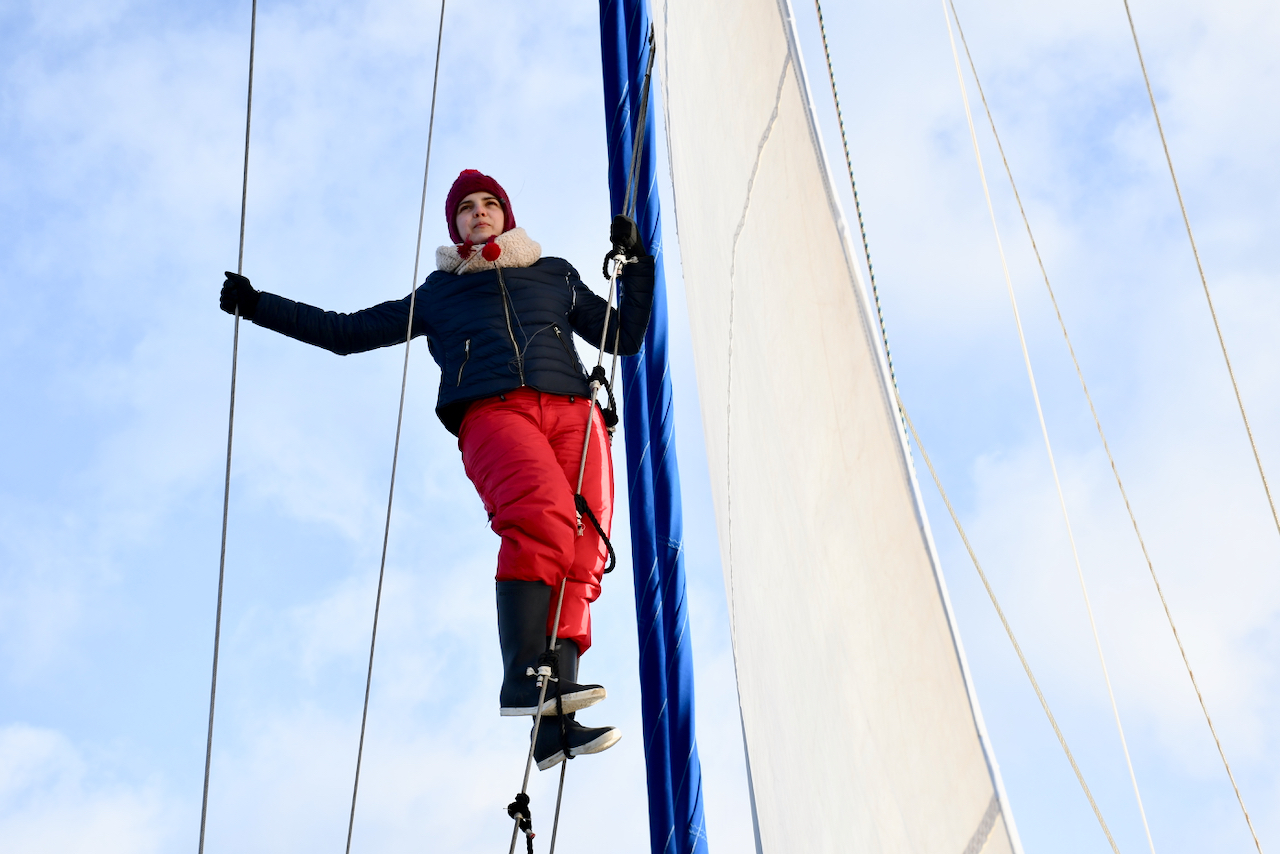
When we headed in a different direction from the other yachts in the Pacific, the funnel of possibilities open to our crew widened astonishingly. It was not only the adults who felt this. The children’s perspective was voiced in the previous post. Hidden within our upwind passage to Easter Island, which sees about 30 yachts a year, were the steps we are now taking towards Cape Horn. It is not about determination or courage, but about ordinary—and, incidentally, rather boring—daily life. One day underway, then two... then a week. I console myself with the thought that if it all goes completely pear-shaped, we can turn for the Marquesas Islands.
So we go flying from one side of the boat to the other. Pots full of eggs go flying too, and there are a few other difficulties. But never mind: everyone is alive and well, and even cracking jokes. The forecast promises no hurricanes, just a steady 20–25 knots of wind on the nose. And we have already come so far—we are hardly going to turn back! We will catch our breath a little at the anchorage.
At the open anchorages off Easter Island and Pitcairn, things are even more entertaining than they were crossing the ocean. “Well, OK, we’ll stay in passage mode: no glassware or unsecured objects.” At least we do not have to work the sails or sleep curled up on the watch berth. What could be lovelier? And the regular merry quest of shifting among various not-quite-bays is more surprising and invigorating than tormenting. After all, the most mysterious island on the planet is at stake! Had we not come by sea, we would never in our lives have visited it, considering the distances and the cost of flights.
The next small step was Pitcairn Island. We had to keep going anyway; the island lies on the route from Easter Island to French Polynesia. Along the way, we hove to in a storm and met head seas around five metres high. We tried it, and nothing terrible happened. We watched films, treated ourselves to sweet buns, and complained about the rolling—at least we had something to grumble about.
Then came the various inaccessible anchorages off Pitcairn; by comparison, Easter Island was a resort. Twice we swamped the dinghy while landing, once even with the captain aboard. Whenever I get into the dinghy, I say a prayer. But what a place! It is the stuff of legend. The island of the ship Bounty, of mutiny, heroism, love and crime. A tiny people with the most romantic and tragic history in the world.
There is no airport; the only physical link with the outside world is a supply ship four times a year. And the people! How else could we chat with living descendants of the Bounty mutineers or wander among moss-covered crosses? As we sailed away from Pitcairn, the children and I almost cried.
On Fear of the Open Ocean
Five years ago, when Nastya and I, dying of seasickness, asked the captain how much farther it was to land, he replied imperturbably:
“Two kilometres.”
“???”
“Down.”
And then you do not sink once, or twice, or twenty times. You get used to the sea; it no longer frightens you that only three centimetres of hull stand between you and the abyss. And I do not worry about the children: they are growing inwardly in the same way, only without the anguish. Children take adventures more easily—they are not mother hens.
There is no land for thousands of miles around—so what? Here in the un-pacific Pacific Ocean, even our seasickness retreated, turning Nastya and me into full-fledged sailors. And the horizon of our own capabilities moved at least 10,000 kilometres farther away in a single forced march (that is exactly how far we sailed non-stop through the Roaring Forties and Furious Fifties to reach the Drake Passage).
And with every new tiny step, you can see one step farther. The less you need for emotional and physical comfort, the more you can do. You can do Cape Horn too. Especially if your motivation goes beyond pushing yourself to the limit just so you can tick the box marked “Vasya was here.”
Surely you have been on a hike at least once. What do you dream about as you squelch through the mud on the twentieth kilometre of the trek? A hot bath and coffee in your favourite armchair. So why are you not there instead? Or take sport. To my mind, daily training is physically harder than being tossed about inside a yacht. Yet billions of people train—what drives them? Simply that we are more than a body that likes curling up under a blanket. It is hard to slave away, pulling off risky deals—but the thrill is the fuel in your batteries. Starting your own business in the middle of a crisis is one hell of a job. But what a high when it works! And what valuable experience when it does not. We take risks every day—all of us. Just in different ways.
The flame of “I can do anything!” is extinguished drop by drop by various failures. Sometimes you lose your nerve, falling spectacularly short of your own ideals, and the response is: “What can you do, then?” Circumstances mock you, showing that you are neither steadfast, nor honest, nor noble. You are simply lying to yourself. And little by little, you stop believing you are capable of taking a stand. Both a weakling and a hero live inside each of us. The first wants to take the edge off with a little cognac and the sofa. The second says, “Come on, get up.”
And we whack him over the head: “Get lost—it won’t work anyway!” And the inner weakling rejoices as he drags us to the bottom..... When I started driving, an acquaintance took a ride with me and said, “Stop acting like a second cousin on the road. Don’t hug the kerb—you drive well already!” That made me think. It is important to stop feeling like a second cousin—or, in other words, an insignificant person. And this is not a story about vanity—look at how great I am! It is about believing in yourself.
On Motives

WHAT are you trying to prove, and to whom, by coming here, where it is so hard and cold? Let us ask the captain for the answer.
“My motivation has two parts. The first is rising above myself, developing in every respect—strength of character and willpower, responsibility and self-discipline. Improving my mastery in the field that is now my main occupation: handling a sailing vessel. Crossing the Pacific through the Roaring Forties and Furious Fifties is one of those landmark achievements; you have to grow into it as a person, a sailor and a traveller.
“The second part has to do with spiritual development, though not in the sense of opening the third eye. I have read and heard many people who crossed oceans and weathered storms describe their sense, out on the Ocean, that a yacht is a mere wood chip tossed about by mighty waves, and that whether you survive depends on their mercy. It is different for me. I unite myself with my vessel; I fill the yacht completely with myself. The yacht is me. The very mastery I mentioned in the previous point is needed to fit as harmoniously as possible between two forces of nature—the ocean and the wind.
The sails must be trimmed so that the yacht moves optimally while leaving room for the comfort of those inside. At the same time, the boat must not be over-canvassed, to avoid excessive wear and the loss of rigging in wind gusts. When it works, the yacht moves at her normal speed without extreme heel or violent motion, and the crew suffers no particular discomfort. Then comes a unity with the forces of nature, a sense that I am not a wood chip at the mercy of the elements. I am part of both the wind and the ocean. Standing at the boundary between the elements, I reconcile them through myself.
That is how the understanding comes that, however many times the power of the elements may exceed human capabilities, they pose no danger to you if you do not fight them but interact with them harmoniously. Yet to do that, you must surrender to them completely. It is humility and extreme caution at once, boundless patience and the determination to act. And the third, additional point is to teach all this to my children, and by personal example to help them rise above themselves through overcoming real difficulties rather than training exercises.”
At the moment we decided to head for Cape Horn via the phantom reefs of the Pacific, Nastya sighed mournfully:
“Two months of our lives thrown away!”
So we decided to learn simply to live on the ocean instead of waiting for the next stop so we could get off. And we are almost managing it, though on the fortieth day of the passage it is tiring.
Chronicle of the Passage to Cape Horn. Day 40
The pre-New Year rain is pelting down, and it is +16°C inside the boat. The temperature outside is 12°C. The wind and current have some secret plan. This morning we were 128 miles from the oceanic pole of inaccessibility; now we are 130 miles away. We changed tack. After philosophising about mindset, even rerunning the interminable preventer in the rain did not seem quite so unpleasant. I usually dislike that job. You have to run 25 metres of line from the stern to the bow and back to the stern through every possible cleat and narrow fairlead.
Three times, intricate knots formed, and I meditatively pulled 20 metres back out and started all over again. Waves, rain. Not a whiff of heroism—only patience..... Before bed, the young sailor set her alarm for 7:30 a.m., saying she had to go to school. In the morning she reset it for 8:30. It is already eleven, and the schoolgirl is still in her den. I wake her with the words: “Do you know what separates a loser from someone who is always lucky? One small step. A lucky person simply makes themselves spend the first five minutes doing the thing they cannot be bothered to do.”
So that is the philosophy of moving forward we ended up with. Friends, does any of this resonate with how you feel? Write and tell us what you think!
We loved your idea for the hashtag #HappyNewYearLadyMary! And we wish you a happy New Year, the year’s greatest celebration, our dear friends! Thank you for sailing the un-pacific Pacific Ocean with us despite the distances and contrasts, for inspiring us and being inspired. You are helping us, and many others, understand that we are all capable of more. May the new year bring you new opportunities and the strength to achieve great things. We wish you wisdom and warmth, self-belief and good health! May your home overflow with abundance and joy warm your hearts. Love and be loved!
We embrace you from 48° south latitude and 126° west longitude. Thank you for being there. Happy New Year!