
From the Travely-Family archive · Antarctica
The End of the Antarctic Odyssey
An original publication from the former Travely-Family website. This English translation was preserved from the technical-site archive without editorial rewriting.
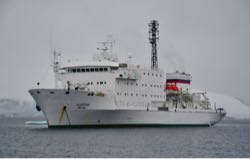
The end of the Antarctic odyssey. On 10 March at 7 a.m., we left Port Lockroy Harbour, coordinates 64.50 S 63.29 W, where the digits after the decimal point are minutes. We set course for Tierra del Fuego, Ushuaia. It is 695 miles away, about a week’s passage. We had barely rounded the islet when the white silhouette of an expedition ship appeared against the glacier. It turned out to be Akademik Ioffe. Our people! Encouraged by yesterday’s warm welcome aboard Polar Pioneer, I call Akademik on the radio. The First Russian Antarctic Expedition with children sends you greetings from these far-flung parts, I say.
In a weary voice, the radio operator suggests we speak a little later; they are busy at the moment. Okay, I say, and go to tidy up the lines. A couple of minutes later, we draw level with the ship and wave towards the bridge. At once the radio crackles: “Lady Mary, this is Akademik Ioffe!” “Lady Mary receiving.” First come the questions: who we are, where we are going, where we have come from. And I say how delighted we—and especially the children—are to meet fellow Russians at the ends of the earth. The children nod with interest. Silence on the radio, a click, and another voice comes on air: the captain.............................................................................................................................................................................................................................
“What a fine lot you are,” he says. “It takes great courage to go to Antarctica with children! Do you have everything you need aboard? The conditions can hardly be the most comfortable. Is there anything you need?” Thank you very much, we say. Everything is fine. And after Polar Pioneer gave us a couple of cans of fuel yesterday, this is practically a resort. “And whom am I speaking to?” I ask. “Captain Alexander Vladimirovich Volkov speaking. And who are you?”....Yes, he also agrees that my mother gave me a very fitting name. And Captain Volkov of Akademik Ioffe and I exchange warm wishes; he wishes us a safe passage and expresses the hope that we will meet.....
As usual on such occasions, my soul is flooded with an achingly warm sense of some kind of kinship, brotherhood and, for some reason, loss. After Captain Volkov and I embrace over the radio, our ships go their separate ways. They are off to take tourists sightseeing; we are heading out into the Bellingshausen Sea. These conversations with our polar ships are enormously heartening. Now we’ll definitely make it before the storm!..............................................................................................................................................................................................................................................
The Bellingshausen Sea. The wind, just the way we like it, is on the nose. We are being set farther south, straight towards Vernadsky, and by lunchtime the station is as many miles away as we have covered since morning. “Andryukh, maybe it’s a sign and we’re supposed to go there?” I make one last attempt. After all, we can reach them from the sea, not only through the channel. “Yes,” the captain replies, “we can. The only thing is, I don’t know how the floating ice will behave in 50 knots of wind.”...... Hmm, convinced. We turn away.
The Bellingshausen Sea is the birthplace of giant icebergs; all the largest ice mountains of our Antarctic voyage were encountered here. Clouds and fog prevent us from taking in the vast high plateaux, each the size of a small town. The icebergs are so immense and heavy that they stand perfectly motionless amid the heaving waves, as though resting on solid ground. Smaller blocks of ice hurtle about and dive beneath the surface; we have to keep a constant watch on the water. Our cockpit, it must be said, is not entirely suited to polar latitudes: it is protected from neither wind nor precipitation.
There is no canopy, and the tiny sprayhood covers only the companionway and instruments, but cannot shelter the lookout. Next time we head into the cold, we’ll definitely prepare a proper watchkeeping station. Because it is freezing. Like riding on the roof of a bus in a hard frost...........................................................................................................................................................................................................................................
Visibility is poor. The radar is on, and more often than not it is the first to spot the next maxi-iceberg as it crawls out of the fog, just like in the song. The seas are high and nasty, tossing the yacht about something fierce. The female contingent is seasick; only the captain, as always, could not care less about mal de mer. Nastya takes the first watch, and feels ill even at the helm. A couple of hours later my watch begins, along with the slalom between blocks of ice. Icebergs have to be passed on the windward side—that is, with the boat between the wind and the iceberg.
Otherwise, on the leeward side, you end up in a tail of ice chunks the size of a house, or a cupboard under the stairs. Just now an icy pyramid at least the size of Mount Kailash has emerged to windward. We cannot get around it on the correct side. We pass a mile to leeward, and that is when my watch’s finest hour begins. We have entered the wake of a giant iceberg, which means fragments of ice are scattered for a couple of miles, about 50 metres apart. “Aaaah!!! Andryukhaaa, I’m scaaared! They’re every 50 metres!” “Fifty metres? That’s loads,” the captain says merrily.
“Our boat’s only twelve metres—you’ll slip through.” Yeah, you could slip through in a car on a motorway, but this is under sail, in waves! Andryukha laughs and goes below. The fright even cures my seasickness while I weave between the floes. But after that trail, only one hulking great lump remains ahead; beyond it, the open Bellingshausen Sea reveals itself. We keep watch on deck until dusk and do not switch off the radar for another two days. Fortunately, however, we encounter no more ice. By evening we are still within sight of the Antarctic Peninsula.
High mountain peaks emerge from the fog, glowing vivid orange in the sunset..............................................................................................................................................................................................................................................
11 March. The captain keeps a close eye on conditions and periodically trims the sails. Nastya studies English nautical terminology or reads the zombie-book Gone with the Wind. Or grudgingly washes the dishes, since seasickness is worse in the galley. Nothing bothers our young sailor: she plays and reads, and when anyone suggests doing lessons, she wrinkles her freckled nose and explains that right now she is either very busy, or was just about to eat, or is seasick altogether. In short, she is slacking. It is a good thing we can still teach and test her on the sly.
Sometimes we play at seeing who can think of the most words derived from “water,” and so on; sometimes we start a game of synonyms and opposites. Not realising that these are lessons and problems, Ladunya cheerfully adds up her grandmothers’ ages in her head, first working out how old they are from their years of birth, and calculates how many miles we have covered and how many remain. The other day she made herself a “croynik.” “Where’s my croynik, I ask you?” Or: “Who put sweets in my croynik? Well, thank you, I’ll eat those too!” It turned out that croynik comes from the word “to cut out”: a little box where the young sailor had hidden sweets, including the last Maska chocolate from the polar crew at Bellingshausen.
We roar with laughter: “Sunshine, why cut them out when you can simply eat them?” “No, cutting them out is more fun!”...............................................................................................................................................................................................................................................
12 March. At the entrance to the Drake Passage, the waves have room to build, and enormous swells lift the yacht about 6 metres. The crew flies from bulkhead to bulkhead, collecting fresh bumps and bruises. Preparing and eating food once again turns into an acrobatic performance, and, to be honest, I am counting the hours until we reach Tierra del Fuego. The entire passage is dominated by one imperative: Make It Before the Storm. Alas, not everything is helping us do so. On the second day, the forward staysail tears—the one that had so long been covering the genoa’s back, so to speak (the large headsail).
The genoa had taken a real beating back in the 40s and 50s latitudes of the Pacific. But the staysail had held. Then suddenly, in a gust, the cloth jerks, the hardware clatters against the metal spar, and the sail soars into the low clouds, fluttering like a banner: We may die, but we shall never surrender! At the same time the sheet parts, and a block flies into the sea together with an important part of the furling system. We rush out to furl it; taking the sail down in this wind and these seas is impossible for now. The clew, reinforced with four layers, is shredded into thin strips.
While we are furling it, the seam opens up for another couple of metres. The captain lashes the staysail to the forestay, leaving us under the mainsail alone, with the third reef in. Our speed drops by about 30 percent, and the yacht’s motion becomes harsher. Having a headsail had smoothed out the leaps over the waves. We are not setting the genoa yet; we are saving it. Losing both headsails at the start of a passage through the most dangerous strait on the planet would be less than ideal. So we continue under mainsail alone for almost twenty-four hours.
The wind feels like about 30 knots; in the gusts, foam blows off the wave crests. “Feels like” because, back on the passage from Polynesia to Patagonia, a storm blew the wind sensor off the mast, and now wind strength is measured with a moistened finger held aloft. Our estimate for the wind in these latitudes is based on the weather forecast, plus an allowance of another 10–20 knots over the forecast. We are on a broad reach, almost dead downwind, and if we fail to keep watch, the sail will gybe. Then we will have to start the engine and steer back onto course.
To be honest, I am a little anxious. Andrei hypnotises the latest forecast and plots a course for the entrance to the Beagle Channel, taking the new wind data into account. If everything goes to plan, we will reach Cape Horn just as the wind strengthens. The forecast promises 30–35 knots, which means it may blow 50 at the Horn—that is 25 metres per second. And right on the nose, too. If we make it under the shelter of the islands by then, perhaps we can anchor and will not have to ride out the storm hove-to. Fingers crossed...............................................................................................................................................................................................................................................
Guys, thank you so much for your comments and letters! The worse the weather, the more eagerly we await them. We cannot reply personally, but we are hugging every one of you from the Drake Passage! And your support through likes and reposts makes us sooo happy. And yes, since we have crossed north of 60 degrees south latitude again, we can once more be seen on marinetraffic.com. Lady Mary’s MMSI is 273334590...............................................................................................................................................................................................................................................
Dear friends, our true comrades, thank you enormously for sustaining the expedition through PayPal.me/TravelyFamily! We thank Andrey_Gr. from Israel, Alexander P. from Samara, Dmitry I. from Novosibirsk, Sergei L. from Tomsk and Anna S. from Yekaterinburg! You inspire us to inspire people to make their dreams come true!