
From the Travely-Family archive · Other Entries
Catching a Shore Line. Antarctic Anchorages
An original publication from the former Travely-Family website. This English translation was preserved from the technical-site archive without editorial rewriting.
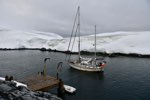
Catching a Shore Line. Antarctic Anchorages. A Night Among Icebergs.
Our overnight Antarctic passage began with the captain retiring to his bedchamber at 9 p.m. and Nastya taking the watch. Before our young sailor went to sleep, we played Battle King. That’s what we call chess now. Ladunka is not constrained by the rules of the game—well, she does know the rules and already plays amazingly well, increasingly leaving me stumped. I’m no grandmaster, of course, but I have still been playing chess longer than our young sailor. Anyway, about the rules. She does not attach much importance to the fact that the king is the weakest piece and must be shielded from the world. So her king is a battle king. And while the remnants of my guard defend their weakling, Laduska’s brave ruler marches into battle and hacks down my pieces left and right!
“Your king’s quite the action hero!” I laugh helplessly.
We both dissolve into laughter, and now every evening she asks me to play Battle King with her.
We kept watch inside the wheelhouse, hypnotising the radar every five minutes. For one minute out of every six it would wake up, revealing to the attentive eye the fading specks of waves and the constant icebergs. At around midnight I relieved Nastya for literally an hour, and at one in the morning I woke the captain. Andrei stood watch until half past five, steering around icebergs sticking up directly ahead a couple of times. By morning the wind had risen to 20 metres per second—that’s 40 knots. So we rushed to take down the mainsail.
There had been no such wind in the forecast, and we did not much fancy flying fast through a sea strewn with chunks of ice. Even under the small headsail alone—the staysail—Lady Mary continued hurtling past the icebergs at 7 knots. To stop the radar from gobbling up all our electricity, we sent the old fellow off to rest and sent me out on deck into the needles of rain. The rain and I spent the next three hours there while the captain dozed in snatches and our young sailor and the other crew member simply slept like logs. As I jogged gently in place by the helm to warm my frozen feet, I remembered the scene from The Irony of Fate where Lukashin does warm-up exercises in the freezing cold, muttering, “I must drink less, I must drink less...”
The white caps of the Melchior Islands emerged from the grey fog. Between them, the hazy silhouette appeared of the British ice-class research vessel HMS Protector, which had overtaken us yesterday. A small iceberg—a twenty-by-ten-metre lump of ice resembling an elephant without ears or perhaps a hippopotamus—rolled very close by. Waves washed over its sloping sides, and waterfalls streamed down the giant’s blue shoulders. Protector was lying in the roadstead between the islets, in a very exposed spot. From the high bridge, what looked like the entire crew, apart from the engineers, waved to us.
We approached Argentina’s seasonal Antarctic station. Summer was over, and there was not a soul in the neat red buildings. A narrow fjord 40 metres wide and 200 metres long was to be our anchorage for the day. Simply dropping anchor was not enough: when the wind and currents changed, the boat would swing around on the anchor chain. This was where the long, 100-metre lines we had bought in Ushuaia would come in handy, in addition to the 30-metre ones we already had.
I would have to take the lines ashore to the rocky beach in the dinghy. The unusual surroundings—ice and snow, cold stones slippery with frost—and there was me, wearing three jackets, having to climb out of the dinghy onto higher ground and tie up the boat...
At first I was afraid: what if I failed to secure the line in time and a gust of wind drove our yacht onto the rocks? Falling into the water from the rocking dinghy did not exactly appeal either—the rigid plastic dinghy, with no inflatable tubes, was not so stable; I was clumsy in a thousand layers of clothing, and the rocks were sheathed in ice. But in practice, as always, the job turned out to be perfectly manageable. First I tried to throw a loop from the dinghy over a bollard on the old landing stage, but then I climbed out over the rocks after all, leading the dinghy on one leash and Lady Mary on the other.
Lady Mary would not make it the long way around—the old line was not long enough. I temporarily secured it to a piece of protruding rebar. A little mountaineering, and I reached the bollard. The only problem was that to reach the rebar, I had to climb down above the sea. Yet more mountaineering...
There! Done! I rowed back for the next line. Snow was falling beautifully, the captain was at the helm, Nastya was paying out the lines, and our young sailor was inside the wheelhouse. It was a pity there was no one to film the whole process of taking our mooring lines ashore onto Antarctica’s snowy coast. On the way back to the yacht I no longer needed to row; I could haul myself along the line, which I did while bawling out a song about a ferryman. Somewhere on a snowy wall, sea lions listened to the enchanting caterwauling. We had spotted their group at the entrance to this narrow appendage.
On the other side, a chinstrap penguin gave me a sidelong glance as it stood alone on the rocks of the headland. Along the snowline, past the station’s red building, an albino bird minced on thin little legs. White, pure white—if not for its beak, it would have blended completely into the surroundings. I secured the fourth mooring line and tumbled into the wheelhouse to warm up. After a morning on watch and mountaineering adventures in wet snow, every one of my hundred layers was soaked through: two windbreakers, one of them supposedly waterproof; a thin down jacket; a hoodie; and a striped sailor shirt.
Wet and partly salty. Even the sailor shirt—clean and fresh—the one I sleep in. How I regretted being too lazy at half past five that morning to change out of my sleeping clothes and into my daytime ones. I sleep in soft fleece-lined trousers, warm socks, a long-sleeved sailor shirt and, over it, a soft blue hoodie with a delicate little snowflake. Everything surrounding the snowflake would now have to be rinsed in fresh water.
To celebrate our safe arrival and successful mooring, we made lunch and settled down in the heater’s warmth to watch a cosy film. The children and I had long dreamed of spending half a day relaxing with films and treats. And that was how we spent half the day, postponing our trip ashore until tomorrow. Today only the captain landed. He inspected the hut left open for travellers, where, in case of emergency, there were barrels of supplies, some firewood, warm clothes and beds, along with a notice saying something like, “Take whatever you need if force majeure has left you stranded here.”
Diesel fuel was available too—a thousand-litre drum. We were just about down to the minimum, so we were thinking of taking a few jerrycans, allowing us to turn on the heater whenever it felt chilly rather than waiting until it became cold. In return, we would repay the Argentinian station with a good deed—leave some money or nail back the board that had come loose at second-storey level and fallen out of the wall. Otherwise, savage snowdrifts would blow in through the hole over the winter.
Today we finally received a whole sheaf of your comments from Facebook, VK and the YouTube channel, relayed by our shore headquarters. Thank you, friends! How wonderful it is to read greetings from the mainland! Oh yes, by the way, tomorrow is Wednesday, and the next video episode about our expedition towards Antarctica via the Pacific Ocean’s phantom islands will be released on our channel. Watch, read, subscribe and be sure to invite your friends! Judging by the responses to our videos and written chronicles, together we can help many people paint their lives in new colours, believe in a dream and make it come true! May the world have more shining eyes and passionate hearts! Thank you for sharing our reports from the ends of the earth with your friends. Hugs to all of you from 64.19 degrees south and 62.58 degrees west!
From the bottom of our polar hearts, we thank our true shore team—you, who support the first Russian family Antarctic expedition through PayPal.me/TravelyFamily. Thank you to Evgeny Sh. from Veliky Novgorod, Yaroslav M. from Melitopol and Oleg R. from Vladimir. You are making the world a better place!