
From the Travely-Family archive · Pacific Ocean
9 Days in the Pacific: A Change of Wind, Stowaways, “Weary Corsairs” and Royal Navy Traditions
An original publication from the former Travely-Family website. This English translation was preserved from the technical-site archive without editorial rewriting.
9 Days in the Pacific: A Change of Wind, Stowaways, Weary Corsairs and Royal Navy Traditions
Why!?! No, but seriously, why!? Why do birds perch on the rail facing the sea rather than the deck of the ark that has given them shelter for the night? What difference does it make to them?? Why is it always the tail—and whatever is underneath it—that ends up hanging over the deck!?
— Such were the thoughts occupying the first mate on a cloudy Pacific morning as she digested the captain’s words: “Have you seen what your pets did there overnight? Go and clean it up.”
And it was me who had begged him the evening before not to chase away the two large birds dozing on the bow (Greenpeace, for crying out loud)—whether they were boobies, gulls or... who knows what they were. The result: don’t walk along the starboard side; it’s been mined. And I know perfectly well that if they fly back this evening, I’ll beg the captain not to disturb their sleep all over again. Then in the morning I’ll bombard Heaven with rhetorical questions. We humans do love stepping on the same rake:).
But fortunately, a rain squall swept in and spared me the clean-up. It also revealed the inadequately sealed leaks in the hatches.
Day nine in the ocean
No sooner had the first mate decided to write that this passage was strikingly different from all our previous years at sea, because we were leading a completely ordinary life, almost as if we were at anchor: sleeping in the cabin rather than under the table (as our young sailor had done on passages for the past two years). Cooking, doing laundry, studying, bathing and carrying out minor repairs.
Yesterday, for instance, the captain crawled under the sink to fiddle with some hoses and released a family of mosquitoes that had not bothered us until now (and what they were feeding on down there, I’m almost afraid to ask). Having tasted freedom, the family decided that instead of languishing under the sink, it would drink some warm blood. And poor Laduska was almost in tears this morning—they’d bitten her toes and heel, which, as everyone knows, are the most painfully itchy places for mosquito bites. So we’re not crossing the ocean alone, but in the company of vampires.
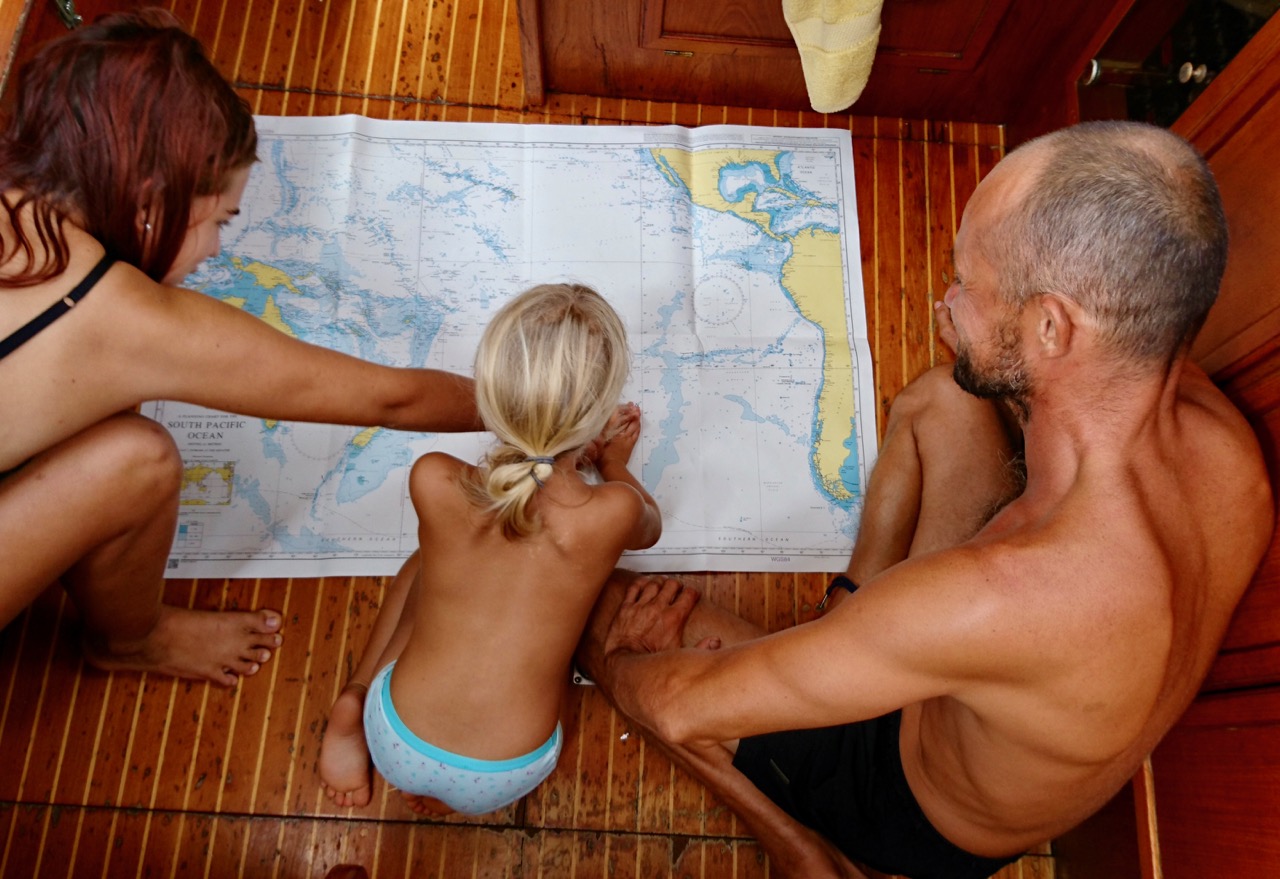
Studying the chart of the Pacific Ocean when the boat isn’t rolling
Anyway, no sooner had I set out to remark that we were living just as we did ashore than the rolling, but still level, run gave way to an almost headwind. And heel. And rain. On the other hand, our speed went from 2 km/h all the way up to 5 knots (9–10 km/h).
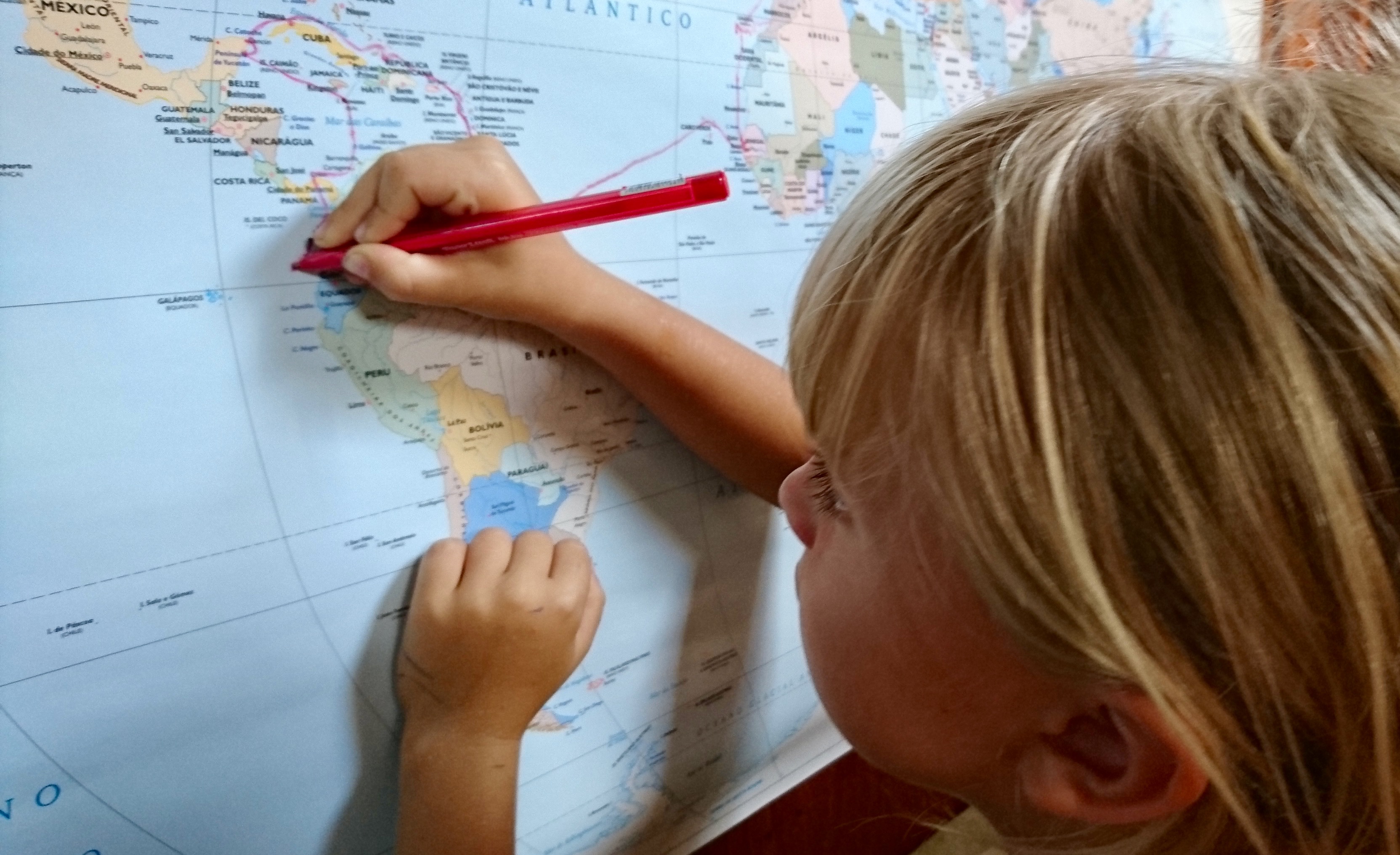
Our young sailor is diligently doing her handwriting exercises, even though she’s seasick today. She writes a couple of squiggles, lies down for about five minutes, then does another line—and goes back to bed. And thanks to my own seasickness, I now have an excuse for why I won’t be editing video today.
The captain got chilled to the bone in the rain and finally put on his lurid yellow, reflective-striped jacket, which makes him look like a railway worker laying sleepers. He says it doesn’t leak. Now we could work as traffic controllers on the autobahn—the brightness makes your eyes sting, there’s no way anyone could run us over, and no way anyone would believe that someone might willingly put on an outfit like that. At any rate, the whales and fish scattered immediately.
Incidentally, the “crocodile” hasn’t taken the bait throughout the entire passage, despite our having two fishing rigs out: the usual rod and a reel with line perched on the winch. We had a couple of bites, but they got away. With no fish to be had, we’re making do with vegetables and tinned food. Maybe I should make borscht?
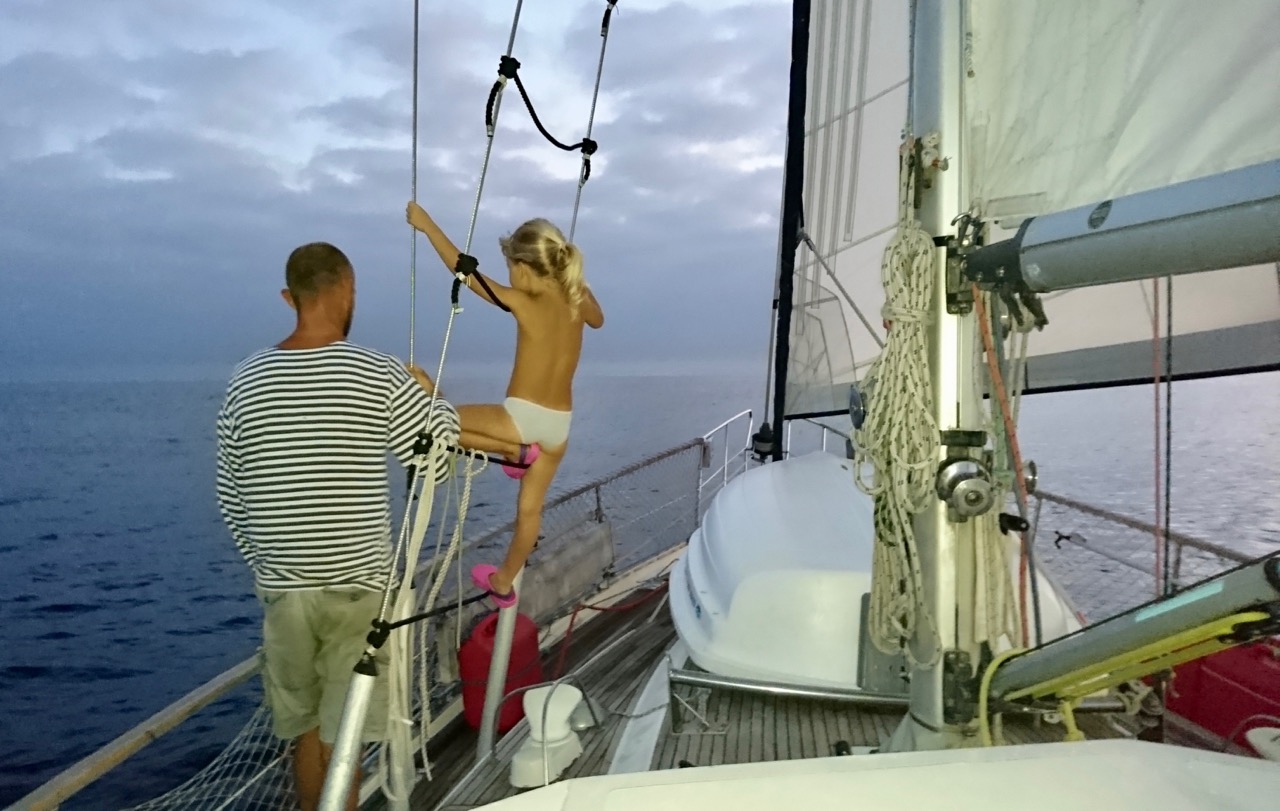
The captain and our young sailor talking to the dolphins.
This is our third day alone in the ocean
No vessels, not even on AIS. So the rumble that has just sounded overhead causes considerable excitement among those of us feeling seasick. But however hard we peer, we can see nothing but clouds, and the radar detector remains silent. Must have been a secret little plane. We’re alone again—no ships, no fish ).
Before we left Panama, Andrei configured the satellite communications so that notifications of your Facebook comments come through by email. It’s sooo wonderful! Thank you, friends! We connect once every two days; we can’t reply, but we see your warm comments, and it feels damn good. As though we weren’t hundreds of miles from anyone, but had actually had a chat with real people. Write moar!:).
We’re crossing the second degree of north latitude. Neptune’s Day is 120 miles away. Thanks to our Facebook friend Sergei Yakubenko, we’ve even prepared special Equator-Crossing Certificates for the occasion. Thank you, my friend!
The other day I read in a book that in the British Royal Navy, everyone crossing the equator for the first time was called a tadpole. And a sailor dressed as Neptune, along with his cronies, would subject them to all kinds of dreadful torment for it—dunking them, beating them with sticks, daubing their backsides with paint and even... nooo, we definitely won’t be doing THAT. So what are we to do? Our entire crew is made up of tadpoles:). Dunk everyone in the equatorial waters? But then who’ll sail the boat. Current coordinates: 02°00 north latitude. 83°22 west longitude.
To be continued!