
From the Travely-Family archive · Pacific Ocean
666 Miles to Cape Horn
An original publication from the former Travely-Family website. This English translation was preserved from the technical-site archive without editorial rewriting.
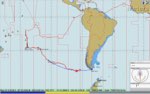
666 miles to Cape Horn. 53 days in the ocean. Transmitted by satellite.
For the first month and a half, we were prepared for a veery long journey across the ocean, and we didn’t pay much attention to the days. But once we entered the final thousand miles and our sixth ten-day stretch at sea, we began calculating more and more often how far remained to the still-unknown Tierra del Fuego. The island got its name from the fires spotted by the first mariners as they sailed along its shores. When Joshua Slocum, the first sailor to circumnavigate the globe single-handed in a small yacht, stopped at Tierra del Fuego in the late nineteenth century, he scattered tacks across the deck.
They served as traps for the natives who wanted to sneak aboard at night and help themselves to anything lying around. Until recently, the only things lying loose on our deck were two buckets; luckily, we untied them in time and moved them inside. Otherwise they would have been washed overboard yesterday. Finding no buckets, the wave tore a solar panel from its mountings in a fit of spite. We managed to catch it and put it back in place undamaged.
Unfortunately, we haven’t really managed to film the power of the elements. I grumble at myself for being lazy, but do nothing about it. When the waves are enormous and sweeping across the deck, nobody is particularly keen to go out there. After all, you have to don a spacesuit, clip on outside, and wait for an hour or so—not every wave is that spectacular. And if the right wave does hit, it will go right over your head, no waterproof gear will save you, and you’ll have to wash yet again. The shower water is cold, and we’ve started rationing it.
The watermaker chokes in the waves and shuts down. And here’s another thing! Its output has dropped by half. Apparently it is harder to separate the fresh-water fraction from cold seawater than from warm. Instead of the former 25 litres per hour, the unit now produces about 10–15 litres. But that’s not the point; the point is how to film the waves properly, because the camera doesn’t convey even a tenth of what you see. The wind is whistling, and it’s a balmy 5 degrees. In short, so far no willing kamikaze volunteers have emerged among the crew.
And filming from inside through the slightly murky glass doesn’t look especially impressive either. For now we’re practising a bit of autosuggestion: next time the waves come, we’ll definitely lash the GoPro to the mast. Provided, of course, it doesn’t switch itself off, we might actually have something to show. The technology is going haywire. The GoPro either switches itself off, records for four seconds at a time, or drains a full battery in an hour while doing nothing. The MacBooks aren’t far behind. Mine has started shutting down when the battery still shows 50%.
If it dies completely, the entire crew will be left with just one MacBook—and after 5.5 years at sea, that one isn’t quite right in the head either. Even so, MacBooks and iPads are the most reliable smart devices. We had another laptop as well, a brand-new Windows one for Nastya’s schoolwork. One passage and one fall to the floor were enough for it. Someone accidentally caught the power cord, the laptop fell, and never drew another breath. A MacBook’s power cable is held in its socket by a magnet, and that brilliant invention has saved its life a hundred times. In short, if my little MacBook croaks... ah, I’d better not talk about it—what if it hears me?
Yesterday, for the first time in nearly a month and a half, we saw that we were not alone in the ocean. Toward dawn, AIS suddenly detected a freighter 20 miles away, travelling in the same direction. We had seen no other ships on either radar or AIS for a month and a half. This first neighbour held our attention for several hours. But it passed 14 miles to the north and remained in our memory as a tiny red boat on the chartplotter screen.
Otherwise, the crew’s life can hardly be called varied. Except that now we run the heater not for an hour twice a day, but for around three hours at a time. Any less and the morning temperature doesn’t have time to rise from 10 degrees to 20. Our young sailor is still the most cold-resistant of us all. Right now it’s 16.5 degrees in our floating home, the whole crew is wearing trousers and hoodies, while Ladunya is in a T-shirt and shorts. She says it’s because she moves around so much, and to prove it, launches into a dance. The dance consists of flights from the bulkhead to the chart table and back again. Nastya goes off to make pasta in a creamy mushroom sauce with fried onions.
Breakages. The waves eased a little yesterday, and we discovered that our tireless windvane self-steering gear, Iron Felix, is not made of iron after all. One of its lines is about to part. Nastya and I donned our marine polar-explorer suits, while the captain went for a swim. He pulled his little wetsuit on over his underpants, added neoprene booties and his St Petersburg hat—you get the picture.
“Should I take fins?” he asks.
“No, better take a mask and snorkel.”
The diver climbed into a climbing harness and disappeared over the stern. It turned out that, besides the line, the windvane had lost an important nut somewhere in the Southern Ocean. The captain had to soak his backside in the icy water somewhat longer than planned. At least the heater was roaring by then, and the engine had heated enough water for washing. So Andryukha got an unplanned warm shower. Another unpleasant issue is that gas is leaking somewhere; for a couple of days the smell has been stronger than it should be. And now our chief cook has also detected hissing behind the stove.
Perhaps the supply hose has sprung a leak. We hope we can repair it before the last cylinder runs out. So for now, cooking the pasta has been postponed until after we sort out the engine. Yes, yes, it has joined the party too. The engine has been cross with us about something since Tahiti. Remember how we wrote about the schemes of our boat brownie, nicknamed Yachtie? We dealt with the major problems in three or four attempts back in the Society Islands. But Yachtie didn’t settle down—he must have got cold, and while making his way toward the warmth, he somehow disrupted the engine’s cooling system.
No water is coming out of it. Which means none is being sucked in either. In other words, run the engine for more than half an hour and it will overheat, and that’ll be that. And with no sun, we have to run the engine for a couple of hours a day to charge the batteries. Oh, and it looks as though the brownie has been playing tricks with the gas too. The old fellow must be freezing—perhaps we should find him some little socks? While I write this report, hiding behind a headache, the captain has taken the bilge apart.
We’ve moved the clocks forward again; now we are only 9 hours behind Moscow. Dawn breaks at half past two in the morning, and it gets dark around 23:00. We’ve long since lost the habit of such long days, because near the equator, day and night are roughly equal at any time of year. The wind is 25–30 knots; a typical wave is around 3 metres, with occasional visitors of about six. A snapshot of this particular minute: the captain is grimly making a gasket for the cap of the seawater strainer in the engine cooling system. The Tahitian one wasn’t airtight enough, and air was being drawn into the system. Our young sailor is building a nest among the sofa cushions that have been tossed haphazardly onto her sea berth. Nastya is tidying the galley before repairing the gas supply. I’m typing. What if battle comes tomorrow and I’m tired?
We ought to get online—what if something has come through? Friends, thank you for your comments; we always look forward to them so much! We already want to hug you for real, not virtually—that’s how it works.
An afterword for everyone who missed something. Friends, our circumnavigation has not veered off course, been interrupted, or even slowed down. It is currently tropical-storm season south of the equator. Instead of waiting it out in New Zealand or on an equatorial atoll, we decided to make a voyage around Cape Horn. Along the way, we conducted a scientific and practical investigation of the phantom islands of the South Pacific, including the Maria-Theresa Reef made famous by Jules Verne. You can find the expedition chronicles and results in our previous reports. By the end of hurricane season, we plan to return to our route and continue westward through Oceania. We decided on this 10,000-mile detour to fulfil a childhood dream.
Huge warm greetings to everyone from 57.05 S and 87.18 W! We wish you the very best year! And a happy Old New Year to you, friends—the only kindred peoples in the world for whom the phrase “Old New Year” causes no cognitive dissonance. And happy birthday to my best-in-the-world mum, who spent her whole life enduring and waiting for a high-altitude mountaineer husband, and now endures and waits for her seafaring-vagabond children!
And our heartfelt thanks for the contributions to the expedition budget through PayPal.me/TravelyFamily go to our genuine shore-based accomplices: Alexey K. from Singapore, Mikhail K. from Moscow, Vladislav P. from Tallinn, Oleg F. from the Altai Republic, and Arkady R. from Yekaterinburg. You inspire us to write new reports despite our computers going haywire.