
From the Travely-Family archive · Pacific Ocean
Pitcairn Island. The Peculiarities of Getting Back to the Yacht
An original publication from the former Travely-Family website. This English translation was preserved from the technical-site archive without editorial rewriting.
Pitcairn Island. The Peculiarities of Getting Back to the Yacht
The start of this day was extreme, changed our plans, and was described in the previous report:). Resuscitating the outboard, the island’s highest point, a hospitable house by the cemetery, and Pitcairn’s famous dead.
The morning after the swamping
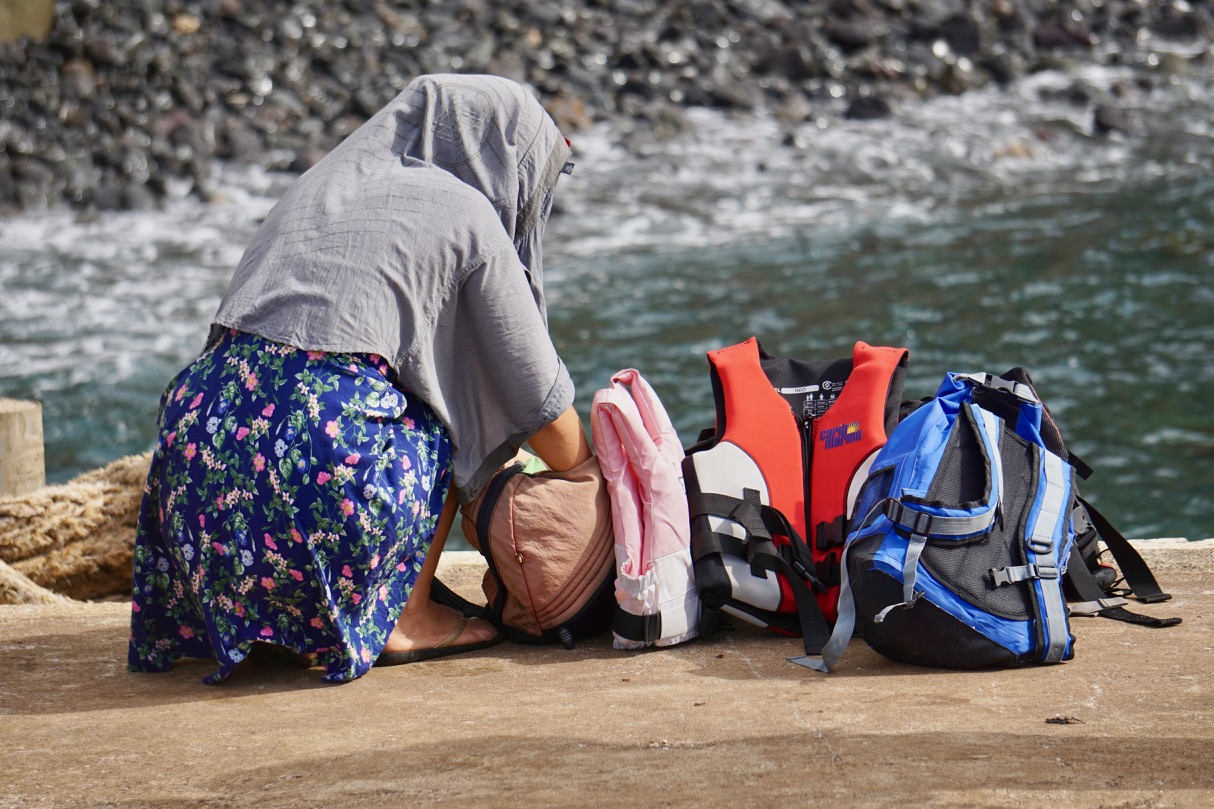
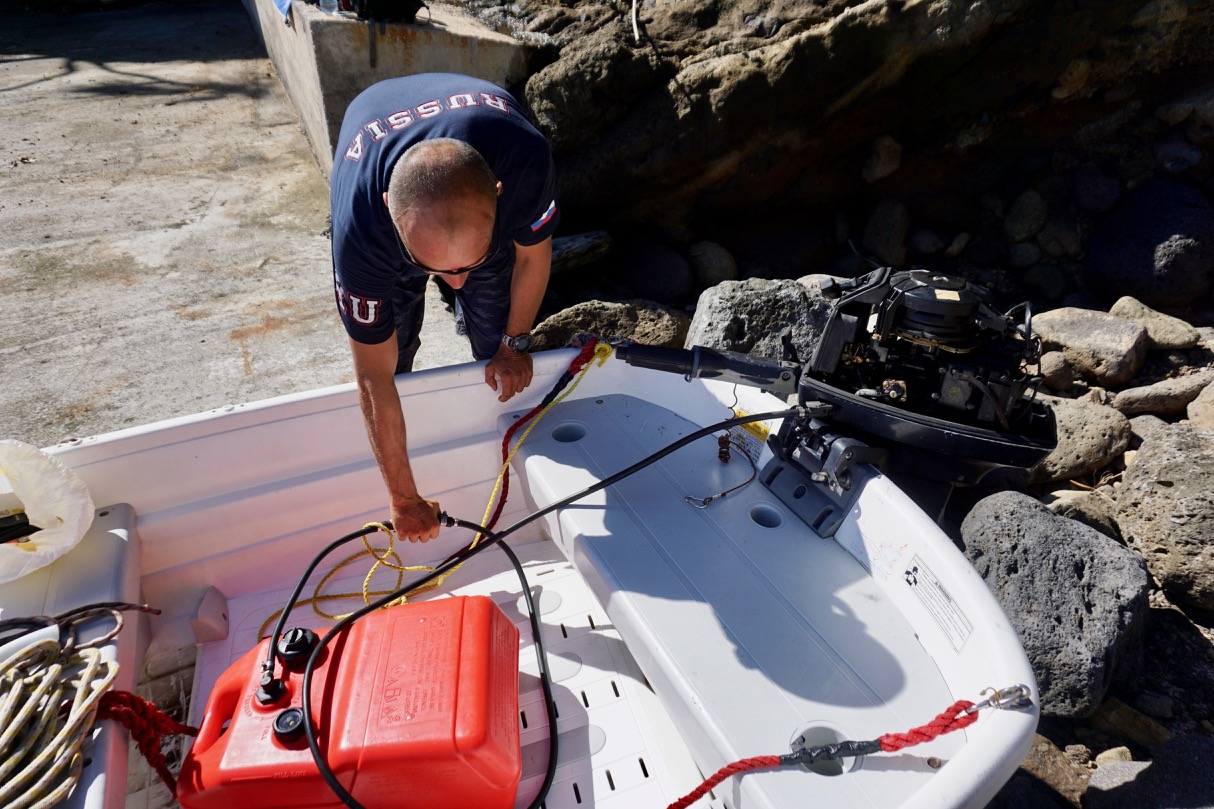
The captain took apart the waterlogged outboard and set about repairing it....While our rescuer Chris went to fetch tools, I set up the tripod—this was the first and only day when it hadn’t spent all that time pointlessly sloshing about in salt water at the bottom of the dinghy, but actually came in handy. We’ll see what became of the footage of the waves, whose spray reaches all the way up to the road.
It is increasingly depressing to shoot video with the big lens—it would produce beautiful images if not for one thing: over four years at sea, dust has somehow got inside the lens, between the elements, leaving spots across the screen. You can clean them up in photographs, but in video... Well, all in all, mine is a luminous sorrow. There’s nowhere to have it repaired, nowhere to buy a new lens either, and it costs an arm and a leg....
Dismantling the engine
/
The living and dead of Pitcairn Island
While I indulged in gloomy reflections on the fate of the video footage, Chris helped as much as he could and was ready to drive me over the mountains to the village. Along the way, I realized just how long the road to the village would be without a quad bike, and eventually found myself in a cosy little house by the cemetery.
This cemetery does not make you melancholy at all; it only sets you thinking and makes you want to delve into the mysteries of the lives hidden behind the plaques bearing names and dates... There are graves from the 1810s onwards. In other words, once all the mutineers were gone (no one knows where they were laid to rest), those who followed began to be buried properly in the cemetery.
Only one grave has survived to the present day—that of the last Bounty mutineer, John Adams. He lies on the edge of his own estate, deep in the village.
Adams is revered as the founder of the Pitcairn community, its father and mentor. The settlement bears his name—Adamstown. John took part in the mutiny on the Bounty at the tender age of about 20, and came to Pitcairn with nine mutineers in search of refuge and freedom. They brought 20 Polynesians with them, of whom, according to different accounts, either 14 or 11 were women. At first they lived peacefully. Then the natives rebelled against their oppression and set out to kill Christian—the leader of the mutineers. By then, admittedly, he had already lost almost all his authority.
But the Tahitians did not care, and they bumped Christian off in front of his pregnant wife. Besides Christian, they also sent a few of his comrades to meet their maker. The widows went berserk, understandably, and joined the remaining Bounty men in taking out the Tahitians.
After the wars between the mutineers and the Polynesians over women and territory, only two men survived—the elderly Young and the young Adams, who for some reason had been known aboard ship as Alexander Smith.
Young taught Adams to read from the ship’s Bible and to write and work the land, then died from complications of asthma. John Adams attained enlightenment and set about turning the children of rebels and cannibals into a model Victorian community. He taught the children literacy and farming and presided over a female platoon comprising the nine remaining souls.
The famous Bible is kept in the Pitcairn Island Museum to this day. The descendants of those Tahitian women and mutineers are now scattered mostly across New Zealand, Australia, Britain, and a few other places. The largest community settled on Norfolk Island. All of Pitcairn’s residents were resettled on that island north of New Zealand in 1856. But many could not endure the ordeal of Norfolk Island and returned to their native soil. The remnants of the community are living out their days together on their bountiful island. The remains of their ancestors lie in the sunny cemetery above a cliff by the ocean.
Here, for example, lies Fletcher Christian’s son, with the simple British name Thursday October Christian...—just listen to how elegant that sounds.—...That’s what a mutiny aboard ship can do even to officers of the Royal Navy.
Pitcairners out fishing
The population is ageing inexorably, and the young people are in no hurry to return from New Zealand, where the children leave for school at the age of 13. There are only three children on the island now—girls aged 8, 10, and 11. Two lads—17-year-old Kimioro and his 19-year-old brother Jayden—have returned home after college for just one year.... Soon there will be nobody left to live and work here.
Over the mountains by quad bike
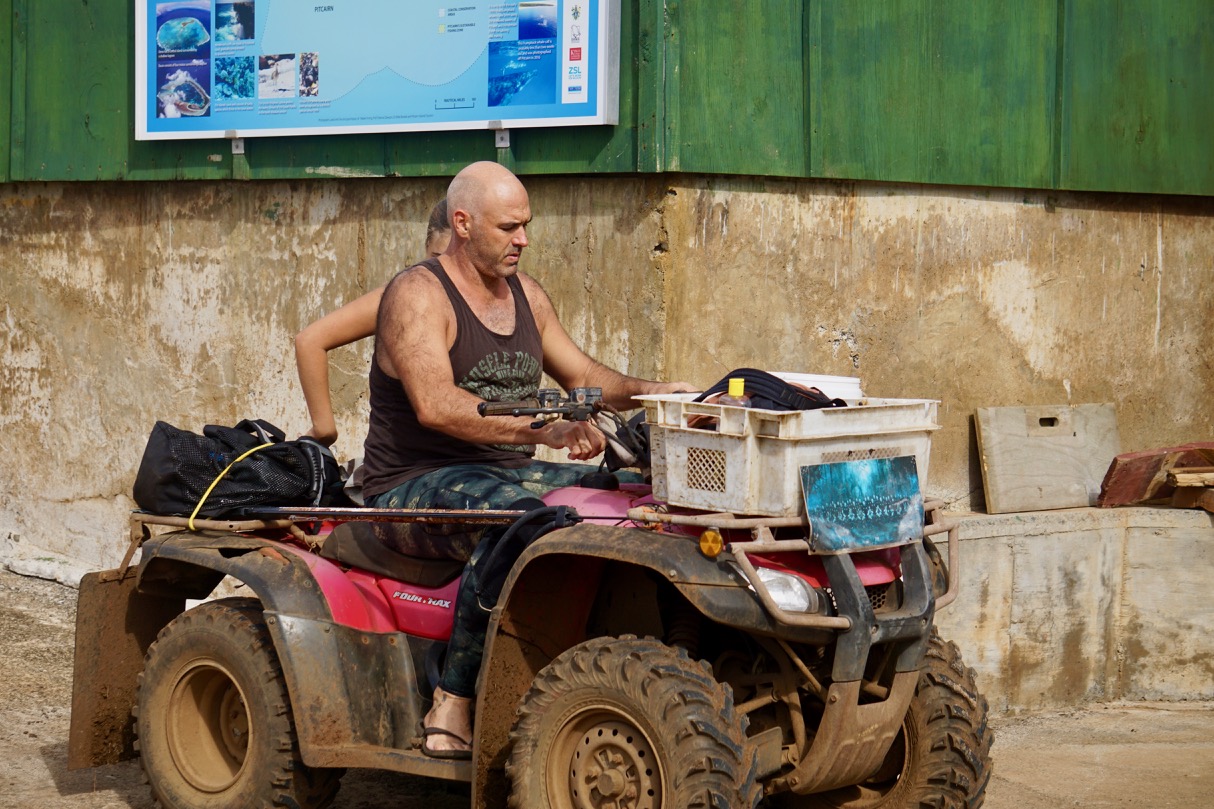
The quad bike is the island’s main form of transport. There are also two Jeep-type vehicles, but they are rarely used. The road, washed out by the rains, climbs steeply uphill. The island’s only giant Galápagos tortoise lives in the wild undergrowth. It was given to Pitcairn once upon a time, but for some reason they sent just one, rather than a pair. As if on cue, Miss T is “gambolling merrily” across the clearing. The locals supplement the old lady’s diet with papayas and bananas.
Our rescuers Amanda and Chris live in the hostel—a house for contract workers, very compact and cosy, like something from a film. A large veranda and a sliver of an ocean view. Amanda is the teacher at the local school. In six months she will leave for New Zealand, and another teacher will take her place, also for a one-year term.
Nastya and Lada are already having tea in the cosy sitting room. Lada has scored herself a little present—plastic furniture for tiny dolls.
After three, our new acquaintances prepare to go fishing again. On two quad bikes we ride over the hills and around the bends in the road, beneath a canopy first of bamboo and banana palms, then of mighty giants whose roots grow down from their branches and whose enormous trunks resemble intertwining ropes. Fran joins the others on a quad bike—another woman from the school. She has short hair and an aloof, businesslike air, the most businesslike and aloof of all the islanders.
We ask them to let the cap know and get off along the way—just before the climb to the island’s highest point. It is high time we saw Pitcairn from above.
On the way, Andryukha radios that he is already somewhere en route to meet us. The red dirt track climbs upwards. At the highest point there is a round concrete pad where satellite equipment once stood, apparently installed in 1967. A proper “country cottage-style” toilet with a toilet seat. The door is fastened with a nail, there is nice white paper, and everything is spotless.
From the top, through shaggy long-needled pines, there is a view of the ocean and the whole rumpled green island. The scent of conifers and a light breeze. You want to sit and contemplate for a very, very long time, with no need to hurry anywhere. But it is already time—we have to get back to the yacht somehow. After this morning’s incident, the very thought gives me goosebumps.
The children and the cap return. This is Bounty Bay
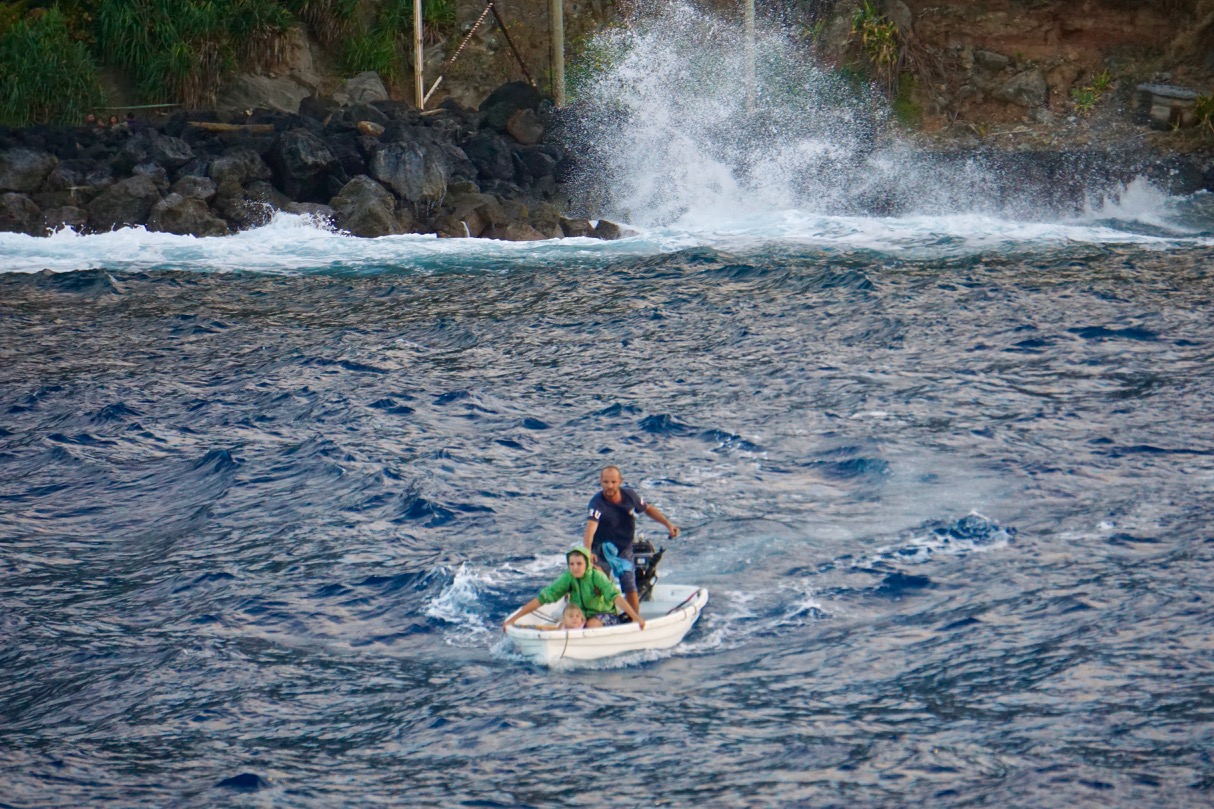
We walk down the steep dirt road to the western jetty. The land around it is uninhabited. While Andryukha and the children procure bananas, two dashing lads roar past on a motorbike and a three-wheeler. Those same dashing lads had already helped us when we left, and now, apparently, they are coming here especially for us. We quicken our pace. Miss T has hidden herself away somewhere, while the surf whooshes out of an underwater grotto as though it were a geyser.
The waves curl into tubes and smash against the rocks. And I am honestly rather afraid of the departure ahead.
Departure
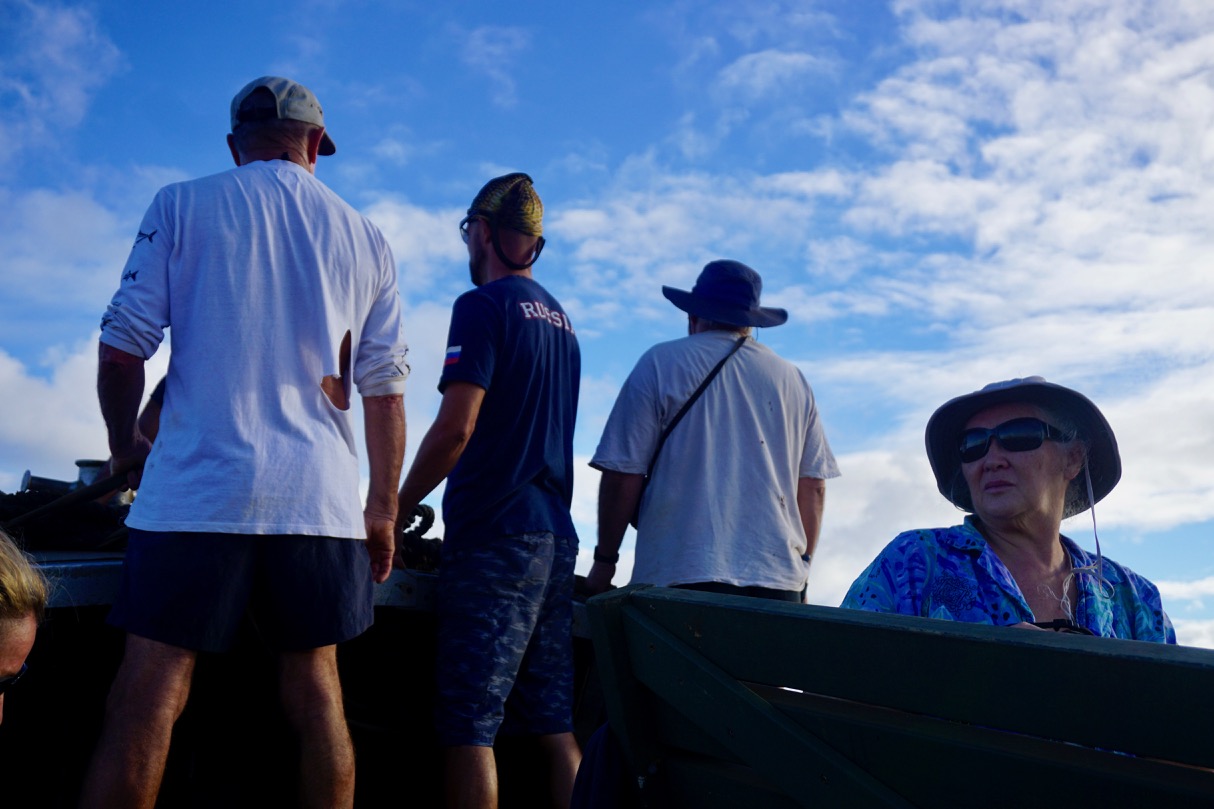
Andrey stripped down and rebuilt the outboard so thoroughly that, with a curse, it started working. Now it is spitting. Apparently it disapproves of having been started before being lowered into the water. The dashing lads Jayden and Kimioro, together with Chris and Andryukha, position the dinghy stern-first to the water on the low square section of the jetty, while we stand on the higher part. We wait for the right wave, and it comes—of course it does. It floods the low edge of the jetty; one, two, heave! The men shove the dinghy into the water, and we all whip it around so that its bow faces the wave. They help us climb down. Even from the low square section, it is almost a metre’s drop. And that metre is dancing the whole time.
Sit on your bum!—Andryukha directs the boarding from the dinghy. Nastya, and then I, slide down the slimy algae on our backsides, not worrying about how we are going to get the stains out of our light-coloured shorts and trousers.
Phe-ew. Now we count the waves. One, two, three. We push off from the jetty so the dinghy’s edge does not get thrown onto the concrete, keeping this morning’s swamping in mind...
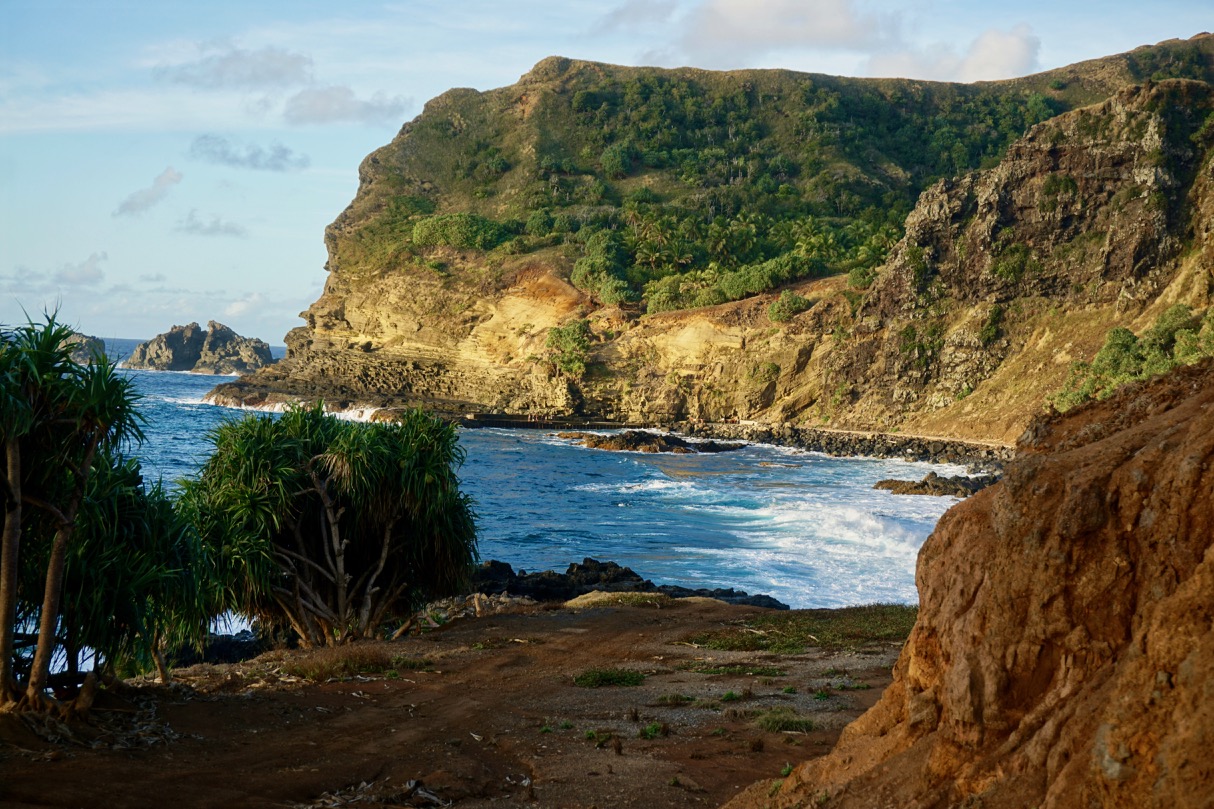
Go!—Jayden waves. We open the throttle; the dinghy spits and grumbles, but carries us towards Lady Mary. We made it through.
After the morning’s adventures (see the previous report), getting aboard the yacht and then out of the dinghy proceeds as normal. Leaping, lurching, pounding hearts, soaked to the skin...—nothing unexpected.
In the centre of the frame is the very jetty we had to leave from